• HOME
  • NEWS
  • EXPLORE
    • CAREER
      • Companies
      • Jobs
    • EVENTS
    • iGEM
      • News
      • Team
    • PHOTOS
    • VIDEO
    • WIKI
  • BLOG
  • COMMUNITY
    • FACEBOOK
    • INSTAGRAM
    • TWITTER
Friday, May 15, 2026
BIOENGINEER.ORG
No Result
View All Result
  • Login
  • HOME
  • NEWS
  • EXPLORE
    • CAREER
      • Companies
      • Jobs
        • Lecturer
        • PhD Studentship
        • Postdoc
        • Research Assistant
    • EVENTS
    • iGEM
      • News
      • Team
    • PHOTOS
    • VIDEO
    • WIKI
  • BLOG
  • COMMUNITY
    • FACEBOOK
    • INSTAGRAM
    • TWITTER
  • HOME
  • NEWS
  • EXPLORE
    • CAREER
      • Companies
      • Jobs
        • Lecturer
        • PhD Studentship
        • Postdoc
        • Research Assistant
    • EVENTS
    • iGEM
      • News
      • Team
    • PHOTOS
    • VIDEO
    • WIKI
  • BLOG
  • COMMUNITY
    • FACEBOOK
    • INSTAGRAM
    • TWITTER
No Result
View All Result
Bioengineer.org
No Result
View All Result
Home NEWS Science News Biology

Type of sugar used to sweeten sheep milk kefir may improve consumer acceptance

Bioengineer by Bioengineer
December 15, 2020
in Biology
Reading Time: 2 mins read
0
IMAGE
Share on FacebookShare on TwitterShare on LinkedinShare on RedditShare on Telegram

Consumers’ emotional reactions to and sensory acceptance of kefir are influenced by type of sugar added, according to research in the Journal of Dairy Science®
IMAGE

Credit: Journal of Dairy Science

Philadelphia, December 15, 2020 – The study of human emotions can be used to gauge the sensory acceptance of dairy products. A possible route to increase worldwide consumption of sheep milk kefir may be to improve its sensory acceptance, which can be a determining factor for its inclusion in daily diets. In an article appearing in the Journal of Dairy Science, scientists studied the effects of kefir sweetened with five different sugars on sensory acceptance and emotional profile in regular consumers of fermented dairy products.

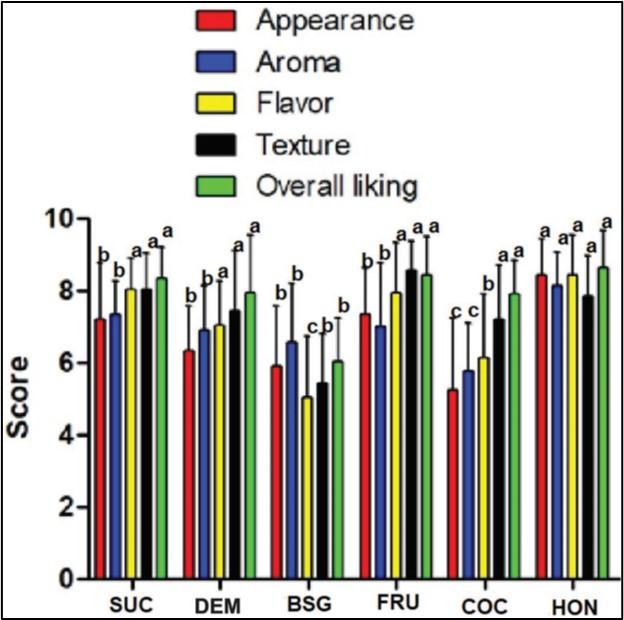
The authors of this study, from the Federal Institute of Rio de Janeiro, Fluminese Federal University, Federal Institute of Paraná, and Natural Resources Institute Finland, assessed the addition of demerara sugar, brown sugar, fructose, coconut sugar, and honey to sheep milk kefir. One hundred consumers rated the appearance, aroma, taste, texture, and overall impression, and expressed whether they were satisfied, active, loving, calm, comfortable, energetic, happy, healthy, refreshing, disgusted, worried, or upset.

Sheep produce 10.6 million tons of milk per year, or 1.3 percent of the world’s milk production. “The results of the present study are relevant for the sheep milk dairy industry, as they indicate that emotional perceptions and sensory acceptance of kefir sweetened with different agents are directly correlated,” said lead author Adriano G. Cruz, PhD, Food Department, Federal Institute of Rio de Janeiro, Rio de Janeiro, Brazil. “The evaluation of emotions evoked by products can be an important tool to obtain additional information that can be used for product optimization and market strategies by the sheep milk industry.”

The use of brown sugar decreased ratings for taste, texture, and overall impression, as well as the emotions “active,” “loving,” “energetic,” “healthy,” and “refreshing.” The use of coconut sugar decreased ratings for appearance, aroma, and taste, in addition to the feelings “refreshing” and “upset.” The use of honey improved ratings for appearance and aroma but reduced the ratings for the emotions “active,” “loving,” “energetic,” and “healthy.” Kefir samples with higher sensory acceptance scores were associated with higher levels of the feelings “satisfied,” “active,” “comfortable,” “energetic,” “healthy,” and “refreshing.”

The results of the study suggest that demerara sugar or fructose should be used as a substitute for sucrose in the production of sheep milk kefir to increase consumption.

Professor Cruz added, “These findings are interesting, as they give useful information to sheep milk processors to establish different marketing strategies for each group of samples, serving as initial guidelines.”

###

This research illustrates that the study of emotions can be used to obtain data related to products’ sensory acceptance.

Media Contact
Eileen Leahy
[email protected]

Related Journal Article

http://dx.doi.org/10.3168/jds.2020-18702

Tags: AgricultureBehaviorFood/Food ScienceNutrition/Nutrients
Share12Tweet8Share2ShareShareShare2

Related Posts

Single mother must adapt swiftly — the survival of her colony depends on it — Biology

Single mother must adapt swiftly — the survival of her colony depends on it

May 15, 2026
Why Are Nearly Everyone Right-Handed? It Might Be Linked to How We Learned to Walk — Biology

Why Are Nearly Everyone Right-Handed? It Might Be Linked to How We Learned to Walk

May 15, 2026

Excessive Neuronal Activity Initiates Severe Autoimmune Brain Disorder

May 15, 2026

Precision Anti-Aging Strategies Focus on Eliminating Harmful Senescent Cells While Preserving Beneficial Ones

May 15, 2026
Please login to join discussion

POPULAR NEWS

  • Research Indicates Potential Connection Between Prenatal Medication Exposure and Elevated Autism Risk

    843 shares
    Share 337 Tweet 211
  • New Study Reveals Plants Can Detect the Sound of Rain

    730 shares
    Share 291 Tweet 182
  • Salmonella Haem Blocks Macrophages, Boosts Infection

    62 shares
    Share 25 Tweet 16
  • Breastmilk Balances E. coli and Beneficial Bacteria in Infant Gut Microbiomes

    58 shares
    Share 23 Tweet 15

About

We bring you the latest biotechnology news from best research centers and universities around the world. Check our website.

Follow us

Recent News

Nurse Care Reduces Hospital Use in Multimorbid Patients

Epinephrine vs. Saline in Neonatal Resuscitation Study

Hepatitis C Elimination via Risk-Based Screening, Decentralized Care

Subscribe to Blog via Email

Enter your email address to subscribe to this blog and receive notifications of new posts by email.

Join 82 other subscribers
  • Contact Us

Bioengineer.org © Copyright 2023 All Rights Reserved.

Welcome Back!

Login to your account below

Forgotten Password?

Retrieve your password

Please enter your username or email address to reset your password.

Log In
No Result
View All Result
  • Homepages
    • Home Page 1
    • Home Page 2
  • News
  • National
  • Business
  • Health
  • Lifestyle
  • Science

Bioengineer.org © Copyright 2023 All Rights Reserved.