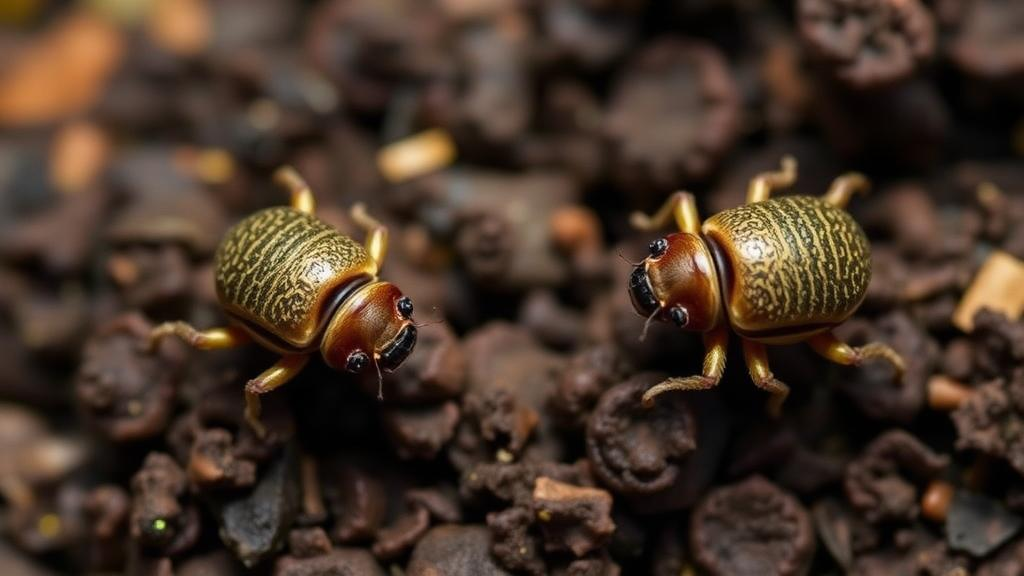
Deep in the mountain forests of the Korean Peninsula, beetles small enough to sit on a grain of rice have been hiding a secret in plain sight. For two decades, entomologists catalogued a particular group of minute scarab beetles under a single Japanese name, assuming the Korean populations belonged to a species first described from Japan in 1874. A new taxonomic review, published in the journal ZooKeys, has now shattered that assumption. By combining painstaking comparisons of beetle anatomy with DNA barcoding of the mitochondrial COI gene, researchers J. Shim and J.-H. Song have revealed that what was once recorded as one Korean species is in fact two entirely new species to science, both previously misidentified under the name Panelus parvulus.
The genus Panelus, established in 1895, is a lineage of very small, oval dung beetles belonging to the subfamily Scarabaeinae, the group that contains the familiar ball-rolling dung beetles. These tiny relatives, however, measure less than three millimeters in length and lead far more cryptic lives. The genus currently comprises 39 species distributed across two subgenera, occurring throughout the Palaearctic and Oriental regions, with centers of diversity in East and Southeast Asia. Until this study, only a single Panelus species had ever been recorded from the Korean Peninsula, a specimen identified in 2004 as the Japanese species P. parvulus, originally described by Waterhouse from Japan 150 years ago.
The first crack in that long-standing identification appeared when the researchers noticed something odd in the published illustrations. The form and structures of Korean specimens, particularly the shape of the male genitalia, did not match the illustrations of true Japanese P. parvulus provided in a 2008 study. In beetles, the aedeagus, the male copulatory organ, is often the single most reliable character for distinguishing closely related species, because even slight differences in its shape prevent interbreeding between populations. A mismatch in this structure was a strong hint that the Korean beetles might not be the Japanese species at all, and it prompted a full-scale investigation into how many species were actually hiding under the name.
The team examined specimens held in several Korean institutional collections, including the Chungnam National University Insect Collection, the National Agricultural Science Insect Collection, the Sungshin Women’s University Insect Collection, and the National Institute of Biological Resources. They also obtained a high-resolution photograph of the actual holotype of P. parvulus, the original specimen on which the species name was based in 1874, housed at the Natural History Museum in London. Comparing modern Korean material against this 150-year-old reference specimen allowed the researchers to establish precisely what true P. parvulus looks like and how the Korean beetles differed from it in punctation patterns, thoracic structures, and genital morphology.
The morphological evidence was compelling. The Korean beetles fell into two distinct groups. One, now named Panelus jinilli, differs from true P. parvulus in the extent of fused punctures along the rear margin of the pronotum, the near-invisibility of punctures on the mesoventrite, the proportions of the metaventrite, the number of fine serrations between the teeth of the front tibiae, and the distinctive shapes of the male parameres and the female spermatheca. The second group, named Panelus virginalis, shows coarse, oval punctures on the mesoventrite where P. parvulus has a smooth surface, along with a strikingly different L-shaped, hook-curved spermatheca. Both new species are tiny, with body lengths ranging from roughly 1.7 to 2.6 millimeters, and both were collected primarily with flight interception traps in forested habitats.
To confirm that these morphological differences reflected genuine species boundaries rather than mere variation within single populations, the researchers turned to molecular data. They generated eleven new COI barcode sequences of 658 base pairs from Korean and Japanese specimens, using the standard Folmer primers, and analyzed them alongside sequences of two other scarab species that served as outgroups. Phylogenetic trees were constructed using maximum likelihood, neighbor-joining, and maximum parsimony methods, with bootstrap support evaluated over one thousand replicates. The results were unambiguous: all four species, the two new Korean species and the two morphologically similar Japanese species P. parvulus and P. ovatus, were recovered as separate, independent lineages.
The genetic distances told a strikingly clear story. Within each of the four species, COI divergence among individuals ranged from just 0.1 to 2.1 percent, with a mean of 0.7 percent, indicating that specimens assigned to the same species carry essentially identical barcodes. Between species, however, the picture changed dramatically. The smallest interspecific distance, 5.5 to 5.7 percent, was found between the Korean P. jinilli and the Japanese P. ovatus, the two species that are morphologically most similar to each other. All other pairwise comparisons between species ranged from 12.6 to 15.2 percent divergence, a gap so large that the species boundaries are beyond reasonable doubt. This pattern, in which genetic gaps between species dwarf variation within them by an order of magnitude, is exactly what integrative taxonomists look for when delimiting species.
The two new species also differ in their ecology and distribution in intriguing ways. Panelus jinilli is known from low mountainous areas at elevations of around 200 meters in southwestern South Korea, where it has been attracted to dung baits of cows, leopard cats, and domestic cats, as well as deer dung and decaying feathers, suggesting a generalist scavenging diet. Panelus virginalis, in contrast, is a montane species found above 300 meters across a wide swathe of southern and central South Korea, from Mount Gyeryongsan to Mount Jirisan and coastal islands, and it appears to be more strongly attracted to necrophagous baits such as decaying meat, shrimp, and dead fish than to dung. Together with the Japanese species, these Korean beetles represent the northernmost known members of the entire genus Panelus, extending the range of this largely tropical and subtropical lineage into the temperate zone.
Perhaps the most tantalizing mystery surrounds P. virginalis. Despite an enormous sampling effort that yielded more than 260 specimens from dozens of localities and multiple years, every single individual examined is female. The species name itself, derived from the Latin word for virgin or maiden, acknowledges this peculiar pattern. The authors are careful, however, not to overclaim. While all-female populations can indicate parthenogenesis, a form of asexual reproduction that has been presumed in a few other scarab beetles such as certain Cyclocephala species, the absence of males alone is not conclusive proof. Alternative explanations remain possible, including differences between the sexes in behavior, seasonal activity, microhabitat preferences, or simply how detectable each sex is to the traps used. The researchers also note that reproductive endosymbionts such as Wolbachia, bacteria known to manipulate reproduction in many insects, could theoretically play a role, although Wolbachia-induced parthenogenesis has not been generally demonstrated in beetles.
Resolving that question will require broader population-level sampling, additional genetic data beyond mitochondrial DNA alone, and screening for endosymbiotic bacteria, and the authors frame parthenogenesis in P. virginalis as a tentative hypothesis for future work. In the meantime, the study delivers a practical legacy for East Asian entomology: a revised identification key covering the Panelus species of Korea, Japan, and Taiwan, the regions whose faunas are geographically closest and morphologically most entangled. The work also stands as a vivid reminder of how much biodiversity remains undocumented even in well-studied temperate countries, and how a two-millimeter beetle, overlooked in museum drawers for decades, can rewrite itself into two species the moment someone looks closely enough at its serrated tibiae, its punctured breastplate, and the barcode written in its DNA.
Subject of Research: Integrative taxonomic review of Korean Panelus dung beetles with descriptions of two new species
Article Title: A review of Panelus occurring in the Korean Peninsula ( Coleoptera , Scarabaeidae , Scarabaeinae ) with descriptions of two new species
Article References: Shim, J., Ahn, K.-J., & Song, J.-H. (2026). A review of Panelus occurring in the Korean Peninsula (Coleoptera, Scarabaeidae, Scarabaeinae) with descriptions of two new species. ZooKeys, 1292, 159-176. https://doi.org/10.3897/zookeys.1292.200337
Image Credits: AI Generated
DOI: 10.3897/zookeys.1292.200337
Keywords: Panelus, Scarabaeidae, dung beetles, taxonomy, new species, COI barcoding, South Korea, species delimitation, ZooKeys, entomology, parthenogenesis, integrative taxonomy
News Source: Drew Townsend. (October 17, 2026). Two Tiny New Dung Beetle Species Emerge from Korea’s Forests After DNA Sleuthing. Scienmag.