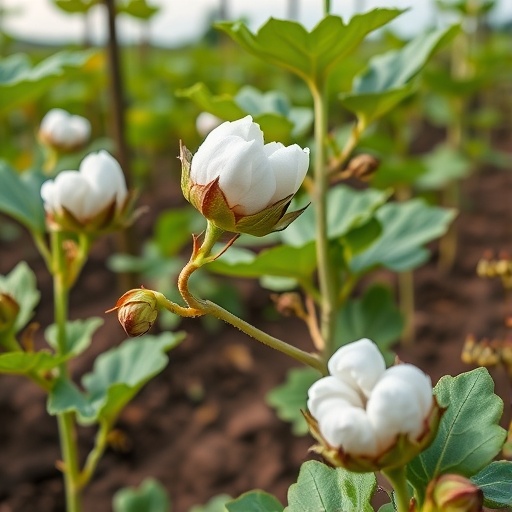
In an illuminating breakthrough, scientists at China Agricultural University have unraveled the intricate collaboration between two pivotal plant hormones—jasmonate and ethylene—in regulating potassium acquisition in cotton plants exposed to potassium-deficient conditions. This discovery offers profound insights into the physiological and molecular mechanisms by which cotton, a globally significant crop, adapts to nutrient stress, presenting novel strategies to enhance agricultural productivity under suboptimal soil nutrient availability.
The research zeroes in on how these hormones fine-tune a specific signaling cascade that ultimately boosts potassium uptake, a vital nutrient for plant growth, development, and photosynthetic efficiency. Potassium deficiency is a common agricultural challenge, limiting cotton yield in many parts of the world. Despite the known individual roles of jasmonate and ethylene in stress responses, their cooperative interaction in nutrient uptake modulation had remained elusive until this investigation.
Central to their findings is the concerted action of two transcription factors, GhMYC2s and GhEIN3dD, which respond to jasmonate and ethylene signaling, respectively. These factors converge to activate GhZAT10, another transcription regulator, establishing an integrated regulatory network. GhZAT10 then orchestrates the upregulation of GhKUP3aD, a gene encoding a high-affinity potassium transporter. This sequential activation ensures enhanced potassium import under conditions where external supply is limited.
The elucidation of this pathway not only fills critical gaps in molecular plant physiology but also opens avenues for targeted genetic interventions. For instance, manipulating the expression of GhMYC2s, GhEIN3dD, or GhZAT10 could lead to cotton varieties inherently more efficient in potassium uptake, reducing dependency on chemical fertilizers and improving sustainability metrics in cotton cultivation.
Field experiments validating these molecular insights demonstrated that exogenous application of methyl jasmonate, a jasmonate derivative, combined with 1-aminocyclopropane-1-carboxylic acid (ACC), an ethylene precursor, significantly improved leaf potassium content. Enhanced potassium uptake was directly linked to improved photosynthetic performance, as potassium is essential for stomatal function, enzyme activation, and osmotic regulation in chloroplasts.
Consequently, these treated plants exhibited superior growth metrics and seed cotton yield compared to untreated controls under severe potassium-deficient conditions. This translational aspect bridges laboratory findings with agricultural practice, underscoring the potential for hormone-based foliar treatments to mitigate nutrient stress in cotton fields globally.
The interplay between jasmonate and ethylene pathways highlights plants’ sophisticated hormonal crosstalk that fine-tunes nutrient acquisition and stress adaptation. While jasmonates have traditionally been associated with defense and stress signaling, their role in nutrient homeostasis is gaining recognition, particularly when synergizing with ethylene signaling mechanisms.
The study employed state-of-the-art techniques, including gene expression profiling, chromatin immunoprecipitation, and promoter activity assays, to confirm direct binding and transcriptional activation within the identified regulatory chain. These rigorous molecular analyses provide high confidence in the causative relationships delineated.
Moreover, the team investigated whether the upregulation of GhKUP3aD indeed translated into functional enhancements in potassium transport by employing electrophysiological assays, which confirmed increased transporter activity in treated plants. This functional validation underscores the physiological relevance of the hormonal regulation pathway.
Intriguingly, the specificity of GhZAT10 as a nodal transcription factor integrating jasmonate and ethylene signals suggests potential cross-regulation with other stress-responsive pathways. This layered control might confer resilience to multiple environmental challenges, an area ripe for future exploration.
Importantly, the findings not only bear relevance for cotton but could potentially be extrapolated to other crops facing potassium limitations, including cereals and legumes. Understanding conserved hormonal regulation strategies across species could revolutionize nutrient management practices in diverse agroecosystems.
This discovery dovetails with broader sustainability goals in agriculture by enabling reduced fertilizer inputs without compromising yield, thus mitigating environmental impacts such as soil degradation and eutrophication linked to excessive fertilizer use. Enhancing innate nutrient uptake pathways aligns with eco-friendly crop production paradigms.
The integration of molecular biology, plant physiology, and agronomy in this research exemplifies multidisciplinary efforts to solve pressing challenges in food security. The translational success of hormone applications in field conditions strengthens the case for developing commercially viable bio-stimulant products based on jasmonate and ethylene derivatives.
In conclusion, the research from China Agricultural University marks a milestone in elucidating hormone-mediated regulation of essential nutrient acquisition in cotton. The strategic activation of GhMYC2s and GhEIN3dD to induce GhZAT10, which in turn upregulates GhKUP3aD, charts a regulatory roadmap that can be harnessed to boost crop resilience and productivity under nutrient-stress environments.
Subject of Research: Interaction between jasmonate and ethylene signaling in potassium uptake regulation in cotton under potassium-deficient conditions.
Article Title: Hormonal Crosstalk Enhances Potassium Uptake and Yield in Cotton via GhMYC2s-GhEIN3dD-GhZAT10-GhKUP3aD Regulatory Module
Keywords: Jasmonate, Ethylene, Potassium Uptake, GhMYC2s, GhEIN3dD, GhZAT10, GhKUP3aD, Cotton, Nutrient Deficiency, Hormonal Crosstalk, Potassium Transporter, Plant Stress Physiology
Tags: cotton potassium uptake regulationenhancing cotton yield under nutrient limitationGhKUP3aD potassium transporter geneGhMYC2s and GhEIN3dD transcription factorsGhZAT10 regulatory networkhormonal signaling in nutrient stressimproving crop potassium efficiencyjasmonate and ethylene interaction in plantsmolecular mechanisms of nutrient uptakeplant hormone cooperation in agriculturepotassium deficiency response in cottonpotassium transport under nutrient stress