UC Riverside research is supported by a four-year grant worth more than $1.2 million
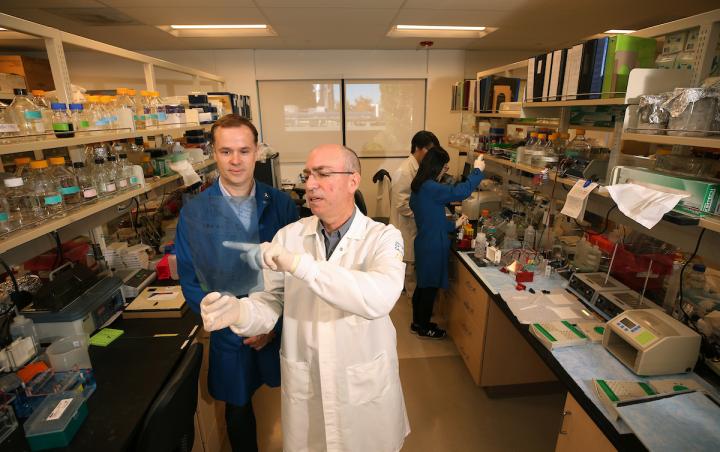
Credit: Stan Lim, UC Riverside.
RIVERSIDE, Calif. — A research team led by biochemists at the University of California, Riverside, has received a four-year grant from the National Institutes of Health, or NIH, to study breast cancer — the most common cancer in women worldwide — and the racial disparities in the treatment of the disease.
The more than $1.2 million grant will support two projects: The first, led by Ernest Martinez, a professor of biochemistry at UC Riverside, will investigate the biology of aggressive “luminal B breast cancer,” which occurs in younger women and makes up about 10% of all breast cancers; the second, led by John Jefferson Perry, an assistant professor of biochemistry at UC Riverside, will focus on “triple-negative breast cancer,” which is more prevalent in Latina/Hispanic and black women.
“The overall goal of the projects is to improve early detection, drug development, and patient survival,” Martinez said. “The grant is more than a typical research grant. It also aims to develop the resources, infrastructure, and training programs necessary to develop the next generation of therapeutics researchers that reflect the ethnic diversity of inland Southern California.”
Both Martinez and Perry will be joined by researchers at City of Hope, as well as Maurizio Pellecchia and Byron Ford, who are professors of biomedical sciences in the UC Riverside School of Medicine.
Martinez explained that no biomarkers exist for separating good from poor prognosis luminal B breast cancers. A combination of “biological” and “marker,” a biomarker is a quantifiable characteristic of a biological process.
“Luminal B breast cancer has been understudied, particularly in Latina/Hispanic women,” he said. “Poor prognosis luminal B breast cancers are only identified after a woman fails to respond to neoadjuvant therapy, and options for cure are limited. Hence, biomarkers that identify biologically aggressive luminal B breast cancer and new therapeutic drugs are urgently needed.”
The more extensively studied triple-negative breast cancer, or TNBC, is frequently chemotherapy-resistant and carries the poorest prognosis, particularly in African American women.
“The molecular mechanisms of TNBC-initiation in African American and Latina/Hispanic women are poorly understood,” Perry said. “New more effective drugs are urgently needed.”
City of Hope has received a comparable grant from the NIH for the two projects. Martinez and Dr. Victoria Seewaldt of City of Hope are the program directors of the projects. In the first research project, Martinez and Seewaldt will be joined by Dustin Schones and Dr. Veronica Jones of City of Hope. In the second project, Perry will be joined by Jeannine McCune and Chris Sistrunk of City of Hope.
Pellecchia of the UCR School of Medicine and Sistrunk of City of Hope will co-lead a cancer research education program team and will be joined by Ford of UCR and David Ann of City of Hope.
The grant will support two graduate students and several undergraduate students at UCR.
###
The University of California, Riverside is a doctoral research university, a living laboratory for groundbreaking exploration of issues critical to Inland Southern California, the state and communities around the world. Reflecting California’s diverse culture, UCR’s enrollment is more than 24,000 students. The campus opened a medical school in 2013 and has reached the heart of the Coachella Valley by way of the UCR Palm Desert Center. The campus has an annual statewide economic impact of almost $2 billion. To learn more, email [email protected].
Media Contact
Iqbal Pittalwala
[email protected]
951-827-6050