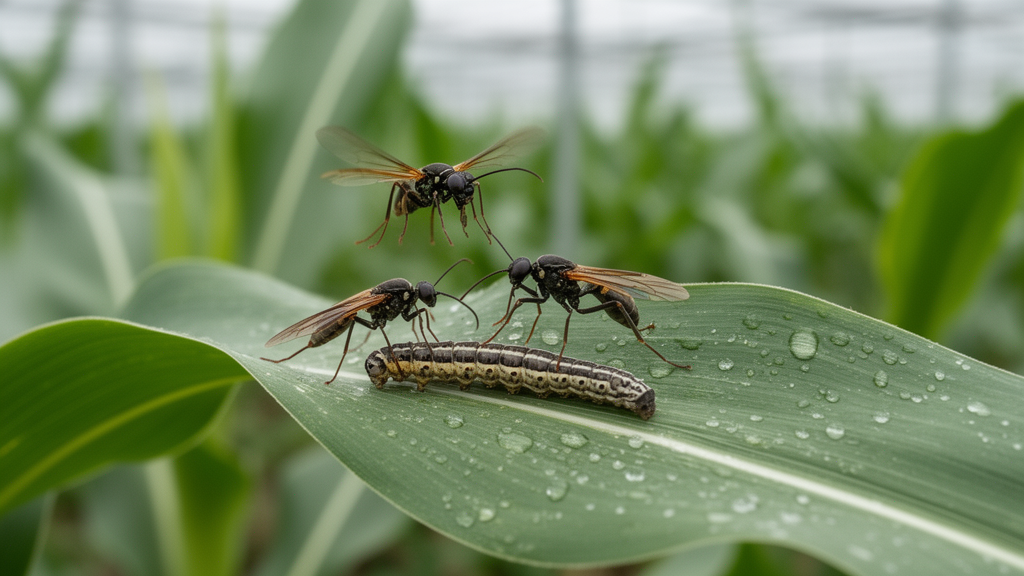
The invasive fall armyworm, Spodoptera frugiperda, has become one of the most destructive pests of maize worldwide, and researchers are racing to find biological tools that can rein it in. A new laboratory study from India, published in the Egyptian Journal of Biological Pest Control, compares two solitary egg-larval endoparasitoid wasps, Chelonus formosanus and Chelonus blackburni, as candidates for rearing and release against this pest. Under strictly controlled insectary conditions, the two braconids completed their life cycles on fall armyworm eggs at comparable speeds, but C. formosanus outperformed its congener on the key measures of pupation and adult emergence, leading the authors to flag it as the more promising of the pair for biological control programs.
The fall armyworm is a formidable adversary. Native to tropical and subtropical regions of the Americas, this highly polyphagous moth caterpillar feeds on more than 350 plant species across 76 plant families. Its strong migratory behavior allowed it to sweep into Africa, where it was first reported in 2016, and then into Asia. In India, the pest was first recorded on maize in Karnataka in May 2018, and it reached Rajasthan in early 2019, where detections on Rabi maize in the southern part of the state were confirmed by both morphological and molecular methods. Larvae attack maize at every critical stage, feeding on leaves, stems and branches during vegetative growth and on tassels, silks and developing cobs during reproduction. According to figures cited in the study from Day and colleagues, uncontrolled fall armyworm infestations could cost maize producers between 8.3 and 20.6 million tonnes of yield per year.
That scale of damage explains why the authors argue that relying solely on chemical insecticides is unsustainable. Rising resistance, environmental harm and the high cost of pesticides for smallholder farmers all push biological control to the foreground. The study situates its work within Integrated Pest Management, an approach that leverages natural enemies to suppress pest populations over the long term while preserving economic viability and environmental health. India already hosts a documented guild of native natural enemies that have adapted to attack the invasive moth, including egg and larval parasitoids and predators. Among the larval parasitoids identified in Indian fields are Chelonus species, Bracon brevicornis, Campoletis chlorideae and Cotesia species, while the egg parasitoid Telenomus remus has shown notable potential.
The Cheloninae subfamily, to which both study species belong, is particularly interesting because of its unusual koinobiont parasitism strategy. As solitary egg-larval endoparasitoids, these wasps oviposit into the eggs of the host, but the parasitoid larva delays its main development until the host caterpillar hatches and grows. A single parasitoid grub develops within each infected host larva and eventually emerges from it. Previous work cited in the paper reported high rates of parasitism by both C. blackburni and C. formosanus against fall armyworm in Indian maize fields.
To test the two species head to head, the researchers maintained cultures under precise laboratory conditions: a temperature of 26 plus or minus 2 degrees Celsius, relative humidity of 75 plus or minus 5 percent, and a 12:12 hour light-dark photoperiod. Fall armyworm larvae for the host colony came from the rearing laboratory of the Department of Entomology at Rajasthan College of Agriculture, MPUAT, Udaipur, and were kept individually to prevent cannibalism. Colonies were reared on artificial diet, and adult moths were paired in Kraft paper bags, fed a 10 percent honey solution, and allowed to lay eggs that were collected daily. Parasitized host neonates were subsequently reared on a defined artificial diet containing chickpea powder, wheat germ, corn flour, brewer’s yeast and other standard components.
The developmental biology of the two wasps proved remarkably similar. Incubation periods were 24.27 plus or minus 1.78 hours for C. formosanus and 24.64 plus or minus 1.87 hours for C. blackburni. The total larval period, summed across five instars, lasted 17.55 days for C. formosanus and 18.55 days for C. blackburni, with individual instar durations ranging from roughly 2.55 days for first instars to about 4.73 and 5.00 days for fifth instars in the two species respectively. Pupal periods were 10.27 plus or minus 0.68 days and 11.09 plus or minus 0.82 days. Adding these phases together, the total developmental period was 27.82 days for C. formosanus and 29.65 days for C. blackburni, meaning the faster species completed its cycle nearly two days sooner.
Reproductive traits also came out close between the species. Female C. formosanus laid an average of 192.18 plus or minus 7.56 eggs on fall armyworm eggs, while female C. blackburni laid slightly more, 198.73 plus or minus 13.09 eggs. Adult female longevity was 6.02 plus or minus 0.64 days for C. formosanus and 6.55 plus or minus 0.43 days for C. blackburni. Males of both species lived shorter lives, averaging 4.18 plus or minus 0.34 days for C. formosanus and 4.64 plus or minus 0.50 days for C. blackburni. These figures matter for mass-rearing programs because fecundity and adult lifespan determine how many hosts a rearing colony can process per generation and how quickly stocks can be built up for release.
The clearest separation between the two species emerged in parasitism performance. Pupation rate, calculated as the number of cocoons divided by the total number of parasitoid larvae, reached 66.17 percent for C. formosanus against 59.61 percent for C. blackburni, a difference the authors report as statistically significant at P less than 0.0001. Adult emergence rate, the number of parasitoids divided by the total number of cocoons, was likewise significantly higher for C. formosanus at 63.84 percent compared with 52.44 percent for C. blackburni, also at P less than 0.0001. In practical terms, 66.17 percent of parasitoid larvae from C. formosanus reached the cocoon stage, and 63.84 percent of those cocoons yielded adult wasps, compared with 59.61 percent and 52.44 percent respectively for C. blackburni, a substantial gap in the efficiency with which each species converts parasitoid larvae into new adult parasitoids.
The discussion places these findings in a broader context of Chelonus research on fall armyworm. The authors note that Shen and colleagues demonstrated in 2023 that Chelonus can develop on zero to two day old fall armyworm eggs under laboratory conditions with high parasitism, pupation, emergence and female rates, supporting its potential as a biological control agent in Africa. Other work shows that parasitism by egg parasitoids such as Trichogramma wanzai and Trichogrammatoidea lutea drops sharply as host eggs age, while the parasitoid C. bifoveolatus can successfully develop on older eggs, and the factitious host Corcyra cephalonica can support mass-rearing even though rearing on fall armyworm itself supports faster population growth. Survey studies cited in the paper recorded ten parasitoid species attacking fall armyworm in one assessment and nine species across egg, egg-larval and larval categories in farmers’ fields of southern Rajasthan, underscoring a rich native enemy community.
The authors conclude that C. formosanus demonstrated better performance than C. blackburni as a biological control agent against fall armyworm under the tested conditions, and they suggest that the demonstrated efficacy and site-specific presence of dominant parasitoids like Chelonus species justify prioritizing them for mass rearing and conservation biological control programs. They also call for future work on integrating native parasitoids and investigating synergistic effects of combining multiple proven parasitoid species for more resilient and sustainable fall armyworm management. Important caveats remain: this was a controlled laboratory study at a single set of environmental conditions, and the paper’s data availability statement notes that no datasets were generated or analyzed during the investigation beyond the reported analyses. Field performance, release strategies, compatibility with other IPM tactics and long-term suppression of fall armyworm populations will all need to be demonstrated before these wasps can be deployed at scale, but the laboratory evidence marks a concrete step toward harnessing native parasitoids against one of the world’s most damaging maize pests.
Subject of Research: Laboratory comparison of the biology and parasitism of two Chelonus parasitoid wasps on the invasive fall armyworm Spodoptera frugiperda
Article Title: Koinobiont parasitism and biology of braconid parasitoid on invasive fall armyworm s podoptera frugiperda (j.e. smith) in controlled conditions
Article References: Kumar, A., Babu, S. R., Ramya, A. R., Singh, V., Kumar, M., Gahlot, V. S., & Jain, D. (2026). Koinobiont parasitism and biology of braconid parasitoid on invasive fall armyworm s podoptera frugiperda (j.e. smith) in controlled conditions. Egyptian Journal of Biological Pest Control, 36(1), Article 33. https://doi.org/10.1186/s41938-026-00907-1
Image Credits: AI Generated
DOI: 10.1186/s41938-026-00907-1
Keywords: fall armyworm, Spodoptera frugiperda, Chelonus formosanus, Chelonus blackburni, biological control, parasitoid wasps, maize pests, integrated pest management, laboratory rearing, koinobiont parasitism, India, invasive species
News Source: Alan Morgan. (October 28, 2026). Two Parasitoid Wasps Show Promise Against Invasive Fall Armyworm in Lab Tests. Scienmag.