• HOME
  • NEWS
  • EXPLORE
    • CAREER
      • Companies
      • Jobs
    • EVENTS
    • iGEM
      • News
      • Team
    • PHOTOS
    • VIDEO
    • WIKI
  • BLOG
  • COMMUNITY
    • FACEBOOK
    • INSTAGRAM
    • TWITTER
Sunday, June 28, 2026
BIOENGINEER.ORG
No Result
View All Result
  • Login
  • HOME
  • NEWS
  • EXPLORE
    • CAREER
      • Companies
      • Jobs
        • Lecturer
        • PhD Studentship
        • Postdoc
        • Research Assistant
    • EVENTS
    • iGEM
      • News
      • Team
    • PHOTOS
    • VIDEO
    • WIKI
  • BLOG
  • COMMUNITY
    • FACEBOOK
    • INSTAGRAM
    • TWITTER
  • HOME
  • NEWS
  • EXPLORE
    • CAREER
      • Companies
      • Jobs
        • Lecturer
        • PhD Studentship
        • Postdoc
        • Research Assistant
    • EVENTS
    • iGEM
      • News
      • Team
    • PHOTOS
    • VIDEO
    • WIKI
  • BLOG
  • COMMUNITY
    • FACEBOOK
    • INSTAGRAM
    • TWITTER
No Result
View All Result
Bioengineer.org
No Result
View All Result
Home NEWS Science News

Two new species of orchids discovered in Okinawa

Bioengineer by Bioengineer
April 10, 2017
in Science News
Reading Time: 2 mins read
0
Share on FacebookShare on TwitterShare on LinkedinShare on RedditShare on Telegram
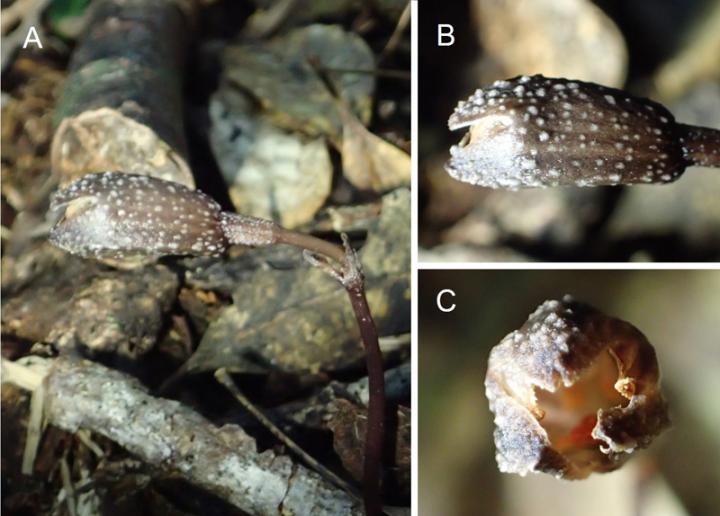
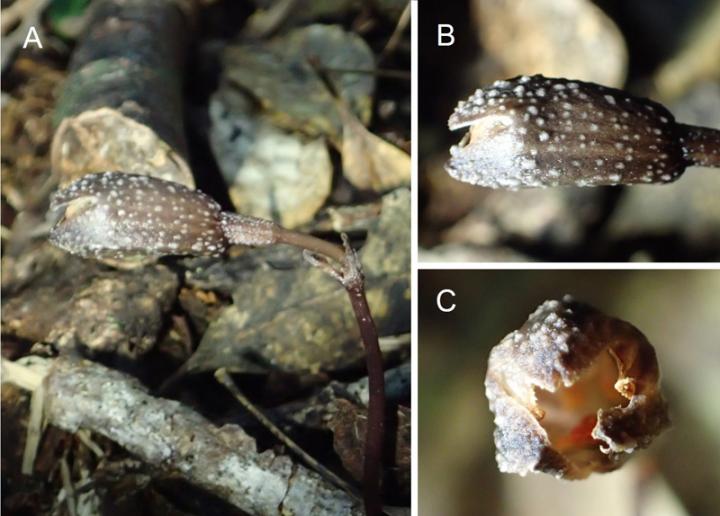
IMAGE

Credit: Kenji Suetsugu

Two new species of parasitic plants have been discovered on the main island of Okinawa, Japan. The discovery was made by Project Associate Professor SUETSUGU Kenji (Kobe University Graduate School of Science), who named them Gastrodia nipponicoides and Gastrodia okinawensis. Details of these findings were published online in Phytotaxa on April 7.

Plants' ability to photosynthesize is often taken as one of their defining features. However, some species choose instead to live a parasitic existence, attaching to the hyphae of fungi and exploiting them for nutrients. These plants are known as mycoheterotrophs. Since they don't engage in photosynthesis, they only appear above ground during the brief period when they are in fruit or flowering. In addition, many of the species are small, making them very hard to find. Even in Japan, one of the most advanced countries in the world in documenting its flora, many mycoheterotrophs remain unclassified. Professor Suetsugu is one of those involved in documenting their distribution and classification.

Professor Suetsugu discovered the two species in March 2012 on the main island of tropical Okinawa, during a joint field survey with independent botanical researchers Mr. NAKAMA Masakazu, Ms. WATANABE Tazuko, and Mr. WATANABE Hiromitsu. This group continued to examine the plants with additional support from independent researchers Mr. TOMA Tsugutaka, Mr. ABE Atsushi (researcher at the Okinawa Churashima Foundation), and Professor MORIGUCHI Mitsuru (Okinawa University Faculty of Humanities).

Their investigation revealed that both species are related to Gastrodia nipponica of the Orchidaceae family, but they can be distinguished by differences in the "lips" on their petals and in the column (an organ found in orchids that fuses the male and female parts, the stamen and the pistil).

The plants were recorded as new species and named Gastrodia nipponicoides and Gastrodia okinawanesis. G. nipponicoides reaches 3-6cm in height with 1-4 blackish brown flowers, each about 15mm long (see figure 1). G. okinawanesis is taller at 10-17cm, with 1-4 light brown flowers, each about 20mm in length (see figure 2).

Mycoheterotrophs live a parasitic existence within forest ecosystems. As parasites, they can only survive in rich, stable ecosystems with resources to spare. The existence of these species is evidence of far-reaching underground ecosystems that include a network of fungi that cannot be seen by the naked eye. Last year the Yanbaru forests were designated as the Yanbaru National Park, and the discovery of these two species further demonstrates the importance of this habitat.

###

Media Contact

Eleanor Wyllie
[email protected]
@KobeU_Global

http://www.kobe-u.ac.jp/en/

############

Story Source: Materials provided by Scienmag

Share12Tweet8Share2ShareShareShare2

Related Posts

Tracking Lanthanide-Labeled Microplastics in Plants

June 25, 2026

POSTECH Researchers Slash Cost of Reconstituted Cell-Free Systems by 95%

June 25, 2026

AI and Physics Collaborate to Design Advanced Hydrogen Storage Materials

June 25, 2026

Natural Hallucinogens: Evolution’s Ecological Tools, Not Mere Chemical Byproducts

June 25, 2026
Please login to join discussion

POPULAR NEWS

  • Saying Goodbye to PGY-6: Pediatric Fellowship Realities

    103 shares
    Share 41 Tweet 26
  • Multi-Hospital Study Reveals Long Covid Burden Is Twice as High as Current Estimates

    92 shares
    Share 36 Tweet 23
  • Detection of EDCs in Breast Milk and Infant Urine Up to Six Months Highlights Early Exposure Risks

    77 shares
    Share 31 Tweet 19
  • New Drug Candidate Developed at McMaster Shows Potential for Treating Brain Cancer

    58 shares
    Share 23 Tweet 15

About

We bring you the latest biotechnology news from best research centers and universities around the world. Check our website.

Follow us

Recent News

Tracking Lanthanide-Labeled Microplastics in Plants

POSTECH Researchers Slash Cost of Reconstituted Cell-Free Systems by 95%

AI and Physics Collaborate to Design Advanced Hydrogen Storage Materials

Subscribe to Blog via Email

Success! An email was just sent to confirm your subscription. Please find the email now and click 'Confirm' to start subscribing.

Join 82 other subscribers
  • Contact Us

Bioengineer.org © Copyright 2023 All Rights Reserved.

Welcome Back!

Login to your account below

Forgotten Password?

Retrieve your password

Please enter your username or email address to reset your password.

Log In
No Result
View All Result
  • Homepages
    • Home Page 1
    • Home Page 2
  • News
  • National
  • Business
  • Health
  • Lifestyle
  • Science

Bioengineer.org © Copyright 2023 All Rights Reserved.