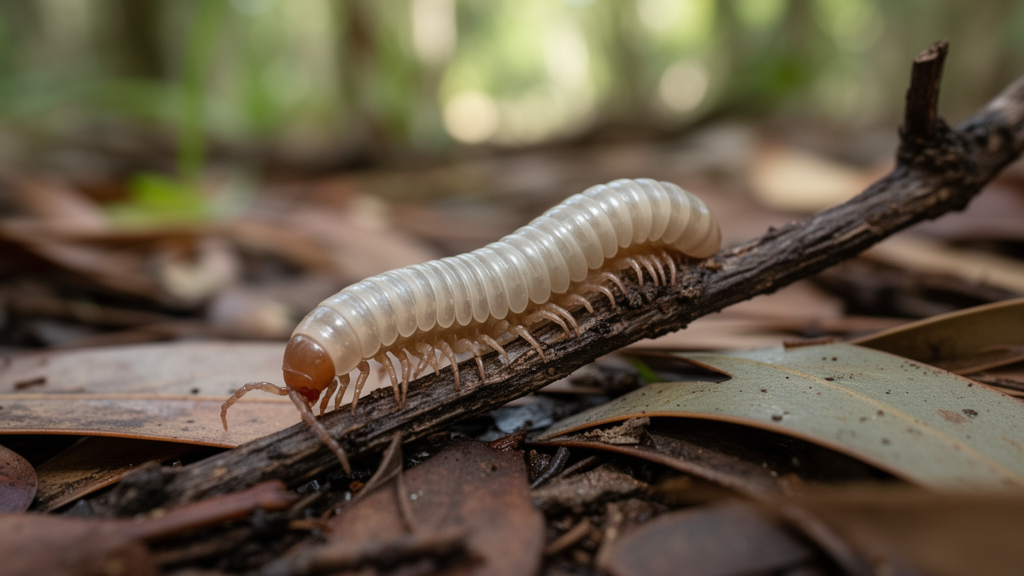
Two previously unknown millipede genera and species have been described from the northwestern portion of Kangaroo Island, South Australia, in a paper published in the journal ZooKeys. One of them, a small dalodesmid millipede now named Colobothrix deckeri, has a collection history stretching back nine decades: a single male was picked up on the lower Yorke Peninsula in 1936 and sat unidentified in museum collections until the new description finally made sense of it. The other, a larger and darker spirostreptidan named Notonesocambala adoceta, surprised its describer when dissection revealed it to be a cambalid rather than the iulomorphid its size and habitat had suggested. Both species were collected recently within a small part of northwestern Kangaroo Island, and the new dalodesmid genus also carries the 1936 mainland record as its oldest known occurrence.
The new dalodesmid belongs to a family with a strikingly incomplete Australian distribution. Polydesmidan millipedes of the family Dalodesmidae had previously been described only from higher-rainfall areas in the east and southwest of the continent, leaving a distribution gap more than 2000 kilometres wide between western Victoria and southwest Western Australia. Most of the southern half of Australia within this gap receives less than 400 millimetres of annual rainfall. The wettest portion of the gap lies in South Australia’s Adelaide Hills, where parts of the landscape receive around 1110 millimetres a year, yet the only native Polydesmida recorded from the Hills so far have belonged to the families Haplodesmidae and Paradoxosomatidae. The description of Colobothrix deckeri from Kangaroo Island and the lower Yorke Peninsula now reduces that long-standing “dalodesmid gap.”
Colobothrix deckeri is defined by a distinctive combination of anatomical features. The genus carries sphaerotrichomes — specialised sensory structures on the legs — whose setal shafts are reduced to very short, blunt processes, and its gonopod telopodites are long, thin, straight and closely appressed, divided at the tips into short processes. Among the three other described Australasian dalodesmid genera with similarly slender, appressed telopodites, the two species of Noteremus from Tasmania have clusters of closely packed rod-like structures at the telopodite tips that are absent in Colobothrix, and Noteremus species also lack sphaerotrichomes on male legs. In Setoisenoton, also Tasmanian, the posterior telopodite process is flat, narrow and directed distally, the solenomere points distally and the sphaerotrichome setae are long and pointed, whereas in Colobothrix the posterior process is thickened, distally expanded and directed posteriorly, the solenomere is directed laterally and the setae are short and blunt. Polydactylogonus, from alpine eastern Victoria, has five apical processes and a long, thin, pointed seta on each sphaerotrichome, against two apical processes in the new genus.
The genus name Colobothrix combines the Greek words for “stunted” and “hair,” a reference to the shortened setal shafts on the sphaerotrichomes. Previously noted variations in the setal shaft portion of dalodesmid sphaerotrichomes included forms described as gently tapered, sharply pointed, slightly expanded at the tip, or wholly absent; the new species adds a fifth variant, a shaft reduced to a short, blunt process. The function of polydesmidan sphaerotrichomes is currently unknown, so the significance of this stunted form remains an open question. The species name deckeri honours Peter Decker, who identified the 1936 specimen as a dalodesmid and recognised its significance.
The physical description of the species is now detailed. Males and females have a head plus 19 body rings, with overall lengths of roughly 19 and 20 millimetres respectively and midbody vertical diameters of about 1.4 and 1.6 millimetres. The colour is yellowish-brown with reddish-brown speckling that is denser dorsally and concentrated at tergal and metatergal margins, around the ozopores and distally on the antennae. The antennae are clavate and slender, the collum is reniform in dorsal view, and the diplosegments show a pronounced waist with smooth prozonites and metazonites lacking sculpturing and metazonital setae. The limbus, the fringe along the body ring margin, consists of a single row of thin, flat, multi-pointed projections. Brush setae and sphaerotrichomes are present on all but the most posterior legs, with the brush setae long, slightly tapering and densely clustered on the prefemur, femur and postfemur.
The gonopods, the modified legs that male millipedes use to transfer sperm and the primary basis for species identification in the order, show equally distinctive architecture. The telopodites are slender and straight, not tapering, just reaching the leg 5 bases when retracted, medially appressed but not fused, and bent slightly anteriorly at about a quarter of their height. At roughly seven-eighths of the telopodite height sits a thick, tab-like, posteriorly directed process with a rounded, deeply excavate posteromedial margin. The apex is T-shaped: the medial arm of the T is short and tapers to a sharp point directed posterobasally, while the lateral arm, the solenomere, is short, flattened, directed distolaterally and curving basally, with a twisted apex. The prostatic groove runs from the medial to the anteromedial surface of the telopodite before turning abruptly laterally to enter the solenomere. Females are larger than males with thinner legs, and the epigynum is narrow and subrectangular.
The species’ known distribution spans five sites within a range envelope of roughly 60 square kilometres in northwestern Kangaroo Island, plus one disjunct site at the southern end of the Yorke Peninsula. The type material was collected in August 2026 on Snug Cove Road, under rotting wood in low forest, with paratypes from De Mole Estate dating to 2021. Earlier Kangaroo Island material includes two males and seven females collected in May 2010 by arachnologists Danilo Harms and Michael Rix as by-catch from a spider search, deposited in the Western Australian Museum and later identified as Dalodesmidae by myriapodologist Catherine Car. The 1936 mainland specimen was collected by entomologist Herbert Womersley near Marion Bay on the lower Yorke Peninsula during a little-known scientific expedition, roughly 50 kilometres from Kangaroo Island. Searches by the author in the winters of 2016 and 2017 within about 20 kilometres of Marion Bay failed to rediscover the species there, though the area yielded a new paradoxosomatid species. No strong smell of defensive secretion was detected in living or preserved specimens, suggesting any secretion is only weakly cyanogenic rather than phenolic or vinyl ketone based as in some other dalodesmids.
The second new species, Notonesocambala adoceta, is a far larger animal. Males are dark gray with pale dorsolateral mottling and pale prozonites on most rings, with up to 62 podous rings, a midbody vertical diameter of about 3 millimetres and an overall length reaching roughly 50 millimetres. The genus is distinguished by the structure of the anterior gonopod: the coxal process bears a wide, lamellar, marginally rounded apex bent medially and carrying minute irregular projections with pointed edges, an anteriorly directed tab at the base of the lamella, and a flat, anteromedially directed spine. This separates it from species in the seven described Australasian cambalid genera, and it further differs from Dimerogonus, Euryischiogonus and Stenischiogonus in having the telopodite longer than the coxal process. The flagellum curves smoothly behind the telopodite, reaching about half the gonopod height, with a bifurcate tip bearing a smooth pointed lateral branch and a flattened roughened medial branch. The species name, from the Greek adoketos, means “unexpected”: the author collected the holotype and two paratype males in well-rotted leaf litter at the base of a eucalypt tree near a small stream, and the microhabitat and the animals’ large size both suggested Iulomorphidae until dissection revealed cambalids. The female remains unknown.
Notonesocambala adoceta is known from only two sites about 10 kilometres apart in northwestern Kangaroo Island, one within Flinders Chase National Park and the other on private property. The species is longer, more slender and darker in live colouring than undescribed Cambalidae occurring elsewhere on the island, and it walks quickly when disturbed rather than curling up and freezing. Its type locality is the same site where the assassin spider Zephyrarchea austini was described from a single record and where the 2010 Colobothrix material was found. That rare spider, feared threatened by fire, vegetation dieback and climate change, was recovered in two additional specimens on private property about 4 kilometres west of its type locality in a targeted survey by Jessica Marsh following the 2020 Kangaroo Island bushfires, with both new millipede species and other litter invertebrates as by-catch in the survey.
The rainfall pattern may explain the species’ disjunct ranges. Modelled mean annual rainfall data for 1976 to 2005 show that northwestern Kangaroo Island is considerably wetter than the lower Yorke Peninsula, at roughly 600 to 800 millimetres per year against about 450 millimetres near Marion Bay, while the modelled mean annual rainfall at the Colobothrix type locality is about 810 millimetres. If the species still occurs on the much drier lower Yorke Peninsula, it may be living in voids in the limestone that outcrops extensively in the area. On Kangaroo Island it has been found on flat, slow-draining land and in stream gullies, in both cases with native woodland cover. The species may once have been more widely distributed in the wetter western half of the island: agricultural clearing and frequent bushfires over the past two centuries have removed or degraded much of the original native woodland, and the millipede fauna in native vegetation remnants on and near farms is now overwhelmingly dominated by introduced European Julidae. The most widespread native polydesmidan over much of Kangaroo Island is currently the paradoxosomatid Somethus inflatus, which also occurs on the nearby Fleurieu Peninsula, where dalodesmids may yet persist in wetter forest remnants and in deep gullies in Deep Creek Conservation Park.
Subject of Research: Taxonomic description of two new millipede genera and species from Kangaroo Island, South Australia
Article Title: Two new millipede genera and species from Kangaroo Island, South Australia ( Polydesmida , Dalodesmidae , Spirostreptida , Cambalidae )
Article References: Mesibov, R. (2026). Two new millipede genera and species from Kangaroo Island, South Australia (Polydesmida, Dalodesmidae, Spirostreptida, Cambalidae). ZooKeys, 1295, 277-291. https://doi.org/10.3897/zookeys.1295.214938
Image Credits: AI Generated
DOI: 10.3897/zookeys.1295.214938
Keywords: millipedes, Kangaroo Island, new species, Dalodesmidae, Cambalidae, taxonomy, South Australia, sphaerotrichomes, Yorke Peninsula, ZooKeys, biodiversity, millipede
News Source: Drew Townsend. (October 29, 2026). Two New Millipede Genera Discovered on Kangaroo Island After 90-Year Wait. Scienmag.