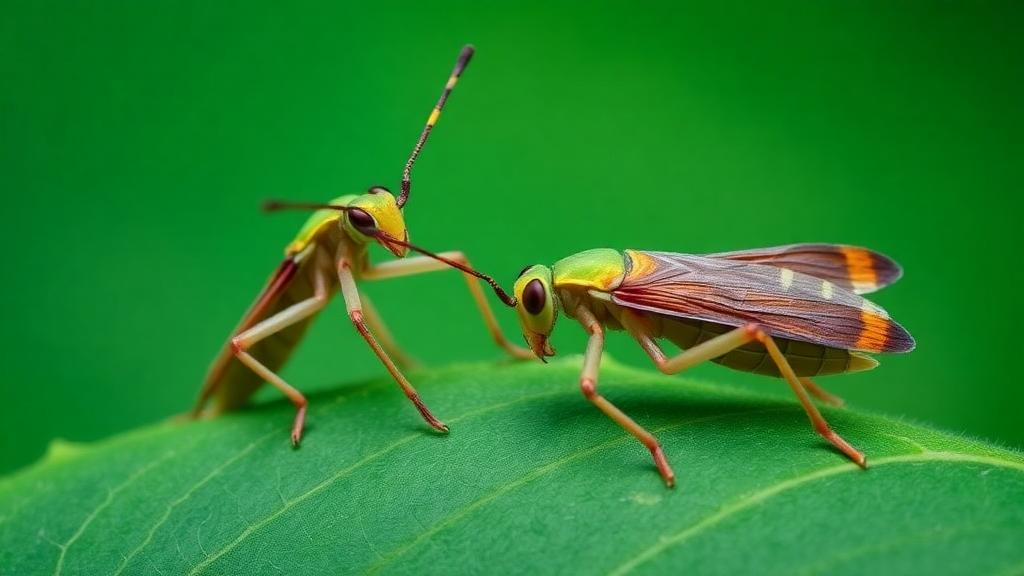
Deep in the mountain forests of southwestern China, two tiny insects have been hiding in plain sight for years. Collected by sweep-net and preserved in museum drawers, they have now been formally recognized as species new to science — and one of them is so unusual that it has forced the creation of an entirely new genus. The discovery, published in the Deutsche Entomologische Zeitschrift, adds a new branch to the family tree of leafhoppers, the sap-sucking insects best known to gardeners as the tiny pale-green wedges that explode from grass on every summer walk.
The new taxa belong to the tribe Empoascini, a group of small leafhoppers in the family Cicadellidae and the subfamily Typhlocybinae. Empoascini species measure a mere 2 to 6 millimeters long, with pale green or yellow bodies, and can be told apart from relatives by subtle wing architecture: their forewings lack an appendix, and their hindwings carry well-developed marginal veins extending to the tips of the R+M veins. With 108 valid genera and 1,401 valid species worldwide, Empoascini is the second largest tribe in Typhlocybinae, surpassed only by the Erythroneurini. That such a well-surveyed group still yields surprises underscores how much undiscovered diversity remains in the world’s leafhopper fauna.
Entomologists Yao, Yu and Yang described the new genus Conjunctus together with its type species, Conjunctus decussatus, from Chongqing Municipality, and an additional new species, Inflatopina pilosa, from Guizhou and Sichuan provinces. Both species are known only from male specimens so far; females remain unknown. All type and voucher specimens are deposited at the Institute of Entomology, Guizhou University, in Guiyang, China, joining a growing archive of Chinese Typhlocybinae that has made the region one of the most productive frontiers in leafhopper taxonomy.
Conjunctus decussatus is a striking insect by leafhopper standards. Its crown is orange-red with a large black pentagonal spot at the posterior margin of the vertex, its eyes are black, and its pronotum carries reddish-brown elevated portions behind a trapezoidal transverse depression. The species measures 4.6 to 4.9 millimeters from the apex of the vertex to the forewing tips. Only two males are known: a holotype collected at Chengkou on 5 July 2008 by Yang Zaihua, and a single paratype from the same locality and date. The species name, from the Latin adjective decussatus, meaning crossed, refers to the male’s ventral pygofer appendages, which cross one another — a feature visible in the genitalia illustrations that accompany the description.
What makes Conjunctus worthy of generic rank lies in its male genitalia, the standard currency of leafhopper classification. The new genus resembles Ishiharella and Mahmoodia in having subgenital plates fused basally — the character that inspired the name Conjunctus, referring to the fusion of the plates at their basal articulation. But it differs from Ishiharella in two decisive ways: the base of the aedeagus is slightly curved and lacks paired protuberances on the shaft, and the aedeagal shaft carries a vertical tubular gonoduct whose gonopore opens distinctly above the inflated part of the shaft, rather than within it. Compared with Mahmoodia, Conjunctus has very thick parameres and a penis lacking a large pre-atrium with appendages.
The wing venation tells a parallel story of affinity and divergence. Conjunctus shares with Wolvletta, Theasca and Radicafurcus the combination of forewings in which the RP and MP′ veins are connate basally, forming a triangular third apical cell, and hindwings with an unbranched CuA vein. Yet it stands apart from each: from Wolvletta by a laminar enlargement on the subterminal portion of the aedeagal shaft and a distinctly unforked shaft apex; from Theasca by very short, slender abdominal apodemes and a penis bearing tuberculous subterminal appendages; and from Radicafurcus by an aedeagus that bears a ventral apodeme and remains unbranched in its ventral third. In taxonomy, such combinations of shared and unique traits are what justify drawing a new branch on the tree rather than squeezing an oddball into an existing genus.
The second newcomer, Inflatopina pilosa, extends a genus established in 2017 with the type species Inflatopina intonsa and five species formerly placed in the Alebroides sohii species group. Three more species followed in 2019, and with the new species the genus now comprises 10 species distributed across the Oriental and Palaearctic Regions. The new species is known from 17 males collected between 2010 and 2012, including a holotype from Kuankuoshui in Guizhou collected on 11 August 2010 by Dai Renhuai, with paratypes from the same site and from Lamahe in Sichuan. It is a stout insect of 5.0 to 5.2 millimeters, smoky yellow on the vertex, with brown frontoclypeus and anteclypeus marked by an irregular longitudinal yellow median stripe.
The species name pilosa, from the Latin for hairy, refers to the fine bristles covering the ventral projection of the caudal segment — a feature that also helps separate it from close relatives. Inflatopina pilosa resembles I. chiasmatica, I. paravictor and I. longistria in having a well-developed aedeagal pre-atrium with paired protuberances on the atrium and an aedeagus lacking a dorsal apodeme but with a tubular shaft. It differs from I. chiasmatica in having male abdominal apodemes reaching the sixth abdominal segment, a ventral pygofer appendage that does not exceed the pygofer, and an enlarged portion of the aedeagus spanning roughly half its total length. From I. paravictor it differs by a dorsal bridge occupying almost one-fourth of the pygofer lobe length, atrial processes shorter than the shaft, and a trapezoidal connective; from I. longistria by the brown lateral frontoclypeus with its yellow median stripe, a subgenital plate with 49 marginal setae, and the absence of four small teeth along the aedeagus ventral margin.
Because the new species runs to I. longistria in the identification key published in 2019, the authors modified that key so the two can be separated cleanly: species with a smooth, non-pubescent ventral pygofer appendage are then split by whether the connective’s caudal margin is hardly notched, as in I. longistria, or distinctly notched, as in I. pilosa. Such key revisions are the quiet infrastructure of biodiversity science — without them, the next researcher encountering one of these insects in a sweep sample would have no reliable way to put a name to it.
The methods behind the descriptions reflect the modern toolkit of insect morphology. Specimens were collected by sweep-netting, and external features were examined, imaged and measured with a KEYENCE VHX-6000 digital imaging system; body lengths were recorded from the apex of the vertex to the forewing apices in millimeters. Male genitalia were imaged with a Nikon Eclipse Ni-E compound microscope running NIS-Elements software, and morphological terminology follows the established frameworks for leafhoppers, with wing venation terminology following Dworakowska’s 1993 scheme and subgenital plate setae terminology following Xu and colleagues’ 2021 treatment. Every character cited above — the connate wing veins, the fused subgenital plates, the crossed pygofer appendages, the hairy bristles — is documented in high-resolution figures at scales of 200 to 500 micrometers, turning two small insects from China’s mountains into permanent, verifiable additions to the catalogue of life.
Subject of Research: Taxonomy and biodiversity of leafhoppers
Article Title: A new genus and two new species in the tribe Empoascini ( Hemiptera , Auchenorrhyncha , Cicadellidae ) from China
Article References: Yao, Q., Ding, Y., Yang, M., & Yu, X. (2025). A new genus and two new species in the tribe Empoascini (Hemiptera, Auchenorrhyncha, Cicadellidae) from China. Deutsche Entomologische Zeitschrift, 72(2), 251-257. https://doi.org/10.3897/dez.72.156715
Image Credits: AI Generated
Keywords: genus, species, tribe, Empoascini, Hemiptera, Auchenorrhyncha, Cicadellidae, China, scientific research
News Source: Drew Townsend. (October 18, 2026). Two new leafhopper species and a brand-new genus discovered in China. Scienmag.