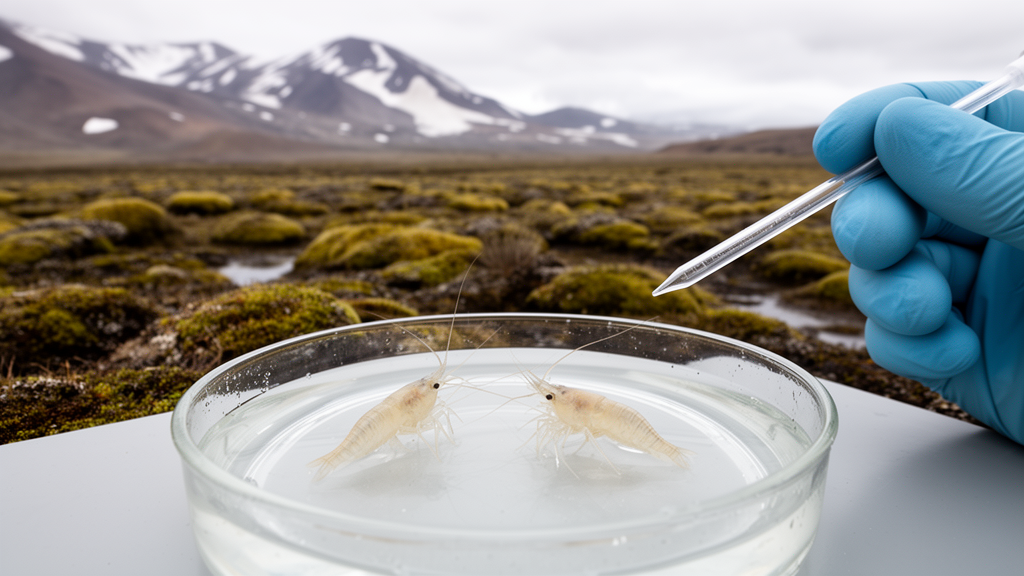
High in the Puna and High Andes of northwestern Argentina, where peatlands sit between 3,400 and 4,000 meters above sea level in one of the driest climates on the continent, researchers have identified two previously unknown species of freshwater amphipods. The tiny crustaceans, now formally named Hyalella portaesolis and Hyalella rodriguezi, were described in the journal Evolutionary Systematics using an integrative approach that combines detailed anatomical study with DNA-based species delimitation. The discovery raises the number of described species in the genus Hyalella to 132 and adds weight to a growing realization: the biodiversity of these high-altitude wetlands is far greater, and far more fragile, than scientists once assumed.
The genus Hyalella is unusual among amphipods. The family Hyalellidae is found exclusively in the Nearctic and Neotropical regions, stretching from southern Patagonia all the way to Alaska, and contains only a single genus. Roughly 130 species had been described before this study, 104 of them in South America. Brazil leads the count with 59 recorded species, followed by Argentina with 18 and Chile with seven. Yet despite this recent surge in taxonomic knowledge, driven largely by specialists working in southern Brazil and the central Andes, the amphipod fauna of high-altitude peatlands has only begun to be explored in the last few years.
That gap matters because these wetlands punch far above their weight ecologically. Puna and High Andean peatlands supply water, sustain grazing resources, and maintain cultural landscapes for local communities. Hyalella amphipods dominate the crustacean fauna in these systems and, because of their high relative biomass, serve as a crucial energy source for aquatic birds. Understanding how many species actually live there, and how they are distributed, is a prerequisite for protecting them, particularly as mining activity expands across the region.
Identifying Hyalella species is notoriously difficult. The genus shows considerable morphological diversity, but marked similarities between species have repeatedly confounded classification, leading researchers to recognize several species complexes. No single anatomical character reliably distinguishes one species from another, and analyses based on traditionally diagnostic traits have sometimes proven insufficient, suggesting some features have been overemphasized while other informative ones were overlooked. Molecular approaches, particularly analyses of the mitochondrial COI gene, have become essential tools for untangling these relationships. Recent work on morphospecies from Lake Titicaca demonstrated that identification based on morphology alone is less reliable than previously assumed.
The new study set out to resolve the status of two morphospecies, previously labeled Hyalella sp. 4 and Hyalella sp. 5, that had been collected during limnological campaigns between 2015 and 2017 across roughly 14.2 million hectares of peatlands in the Puna and High Andean ecoregions. The research team, working within the Puna Project of CONICET and the National University of Tucumán, measured water chemistry at each site, preserved specimens in ethanol for genetic analysis, and dissected the largest males and females under a stereomicroscope to document appendages, setae, and cuticular structures in exhaustive detail.
On the molecular side, the researchers assembled a dataset of 22 COI sequences from their own collections, 19 sequences of nominal species from GenBank, and two outgroup sequences from the genus Platorchestia. They built a maximum likelihood phylogeny with IQ-TREE 2 and applied three independent species delimitation methods: Generalised Mixed Yule Coalescent, Bayesian Poisson Tree Processes, and Assemble Species by Automatic Partitioning. All three approaches were highly congruent, recovering 27 molecular operational taxonomic units across the phylogeny. Crucially, both new species were consistently recovered as independent lineages with strong support values, with most delimited lineages showing posterior probabilities at or near 1.00.
The morphological evidence is equally distinctive. Hyalella portaesolis, whose name derives from the Latin for gate of the sun in honor of the village of Antofagasta de la Sierra, reaches 9.75 millimeters in males and can be recognized by a long slender maxilla 1 palp, a hammer-shaped propodus on the first gnathopod, a subtriangular fourth coxal plate with a shallow posterior cavity, and a telson wider than long and densely covered with microscopic surface structures. It was found in waters ranging from 12.59 to 14.08 degrees Celsius, with pH between 6.74 and 8.07 and conductivity from 430 to 1,210 microsiemens per centimeter. Notably, it shows the widest distribution of the two new species, stretching from Catua Arriba peatlands at roughly 24 degrees south to the Antofagasta peatland, across an altitudinal range of 3,417 to 4,008 meters.
Hyalella rodriguezi, named for field collector José Rodríguez, is a more restricted species, known only from the Punta Las Peñas and Peña Colorada peatlands between 3,456 and 3,721 meters. Males reach 7.78 millimeters and display a striking asymmetry in the palps of the first maxillae, along with a sexually dimorphic first uropod bearing a distinctive modified curved seta known as a copulatory spine. Perhaps most intriguingly, the male holotype carried peritrich ciliates resembling Vorticella on its second gnathopod, an epibiotic association that expands what is known about such interactions in Andean freshwater amphipods. Ecologically, this species was found in markedly different water: an average temperature of 16.87 degrees Celsius, a pH of 9.25, and conductivity of just 100 microsiemens per centimeter.
That contrast in water chemistry may be more than coincidence. The authors suggest that hydrochemical gradients act as critical drivers of ecological speciation in Andean peatlands. While the broad conductivity tolerance of H. portaesolis aligns with the documented plasticity of the genus in the Puna, the restriction of H. rodriguezi to hyperfresh environments points to a narrower ecological niche, possibly reflecting an evolutionary trade-off in which adaptation to low-mineralization waters grants a competitive advantage in specific habitats. High-altitude Hyalella, in other words, are not a homogeneous ecological group but a complex radiation shaped by habitat specialization.
The molecular analyses also revealed patterns that complicate the picture. Some nominal species, including H. kochi, H. krolli, and H. fatimae, were each split into multiple distinct lineages, hinting at considerable intraspecific genetic divergence and possible cryptic species. Conversely, H. nefrens and H. longipalma were consistently grouped as a single unit, and H. kochi and H. simplex showed low genetic divergence despite subtle morphological differences. The authors attribute such patterns to the turbulent hydrological history of the Andean plateau, where rapid fluctuations in the Titicaca-Desaguadero-Poopó-Salar de Coipasa basin over the last three million years may have repeatedly created and destroyed ecological niches, promoting recent divergences not yet fully reflected in mitochondrial DNA. Incomplete lineage sorting and historical hybridization may further blur species boundaries. With nine Hyalella species now identified across 41 sampled sites, including records that extend the known range of H. fossamancinii toward 24 degrees south in northern Argentina, the study makes clear that the true diversity of these unique wetlands remains substantially underestimated, and that integrative taxonomy combining morphology, molecules, ecology, and biogeography will be essential for documenting and conserving freshwater fauna in a region under increasing pressure from human activity.
Subject of Research: Integrative taxonomy and species delimitation of Hyalella amphipods in South American high-altitude peatlands
Article Title: Amphipod diversity in South American high-altitude peatlands: two novel Hyalella species supported by morphological and molecular evidence ( Amphipoda , Hyalellidae )
Article References: Isa-Miranda, Á. V., Peralta, M. A., & Nieto, C. (2026). Amphipod diversity in South American high-altitude peatlands: two novel Hyalella species supported by morphological and molecular evidence (Amphipoda, Hyalellidae). Evolutionary Systematics, 10(2), 303-325. https://doi.org/10.3897/evolsyst.10.204482
Image Credits: AI Generated
DOI: 10.3897/evolsyst.10.204482
Keywords: Hyalella, amphipods, Andean peatlands, Puna, integrative taxonomy, COI barcode, species delimitation, freshwater biodiversity, Argentina, high-altitude wetlands, cryptic species, new species
News Source: Drew Townsend. (October 16, 2026). Two New Amphipod Species Emerge From High-Altitude Andean Peatlands. Scienmag.