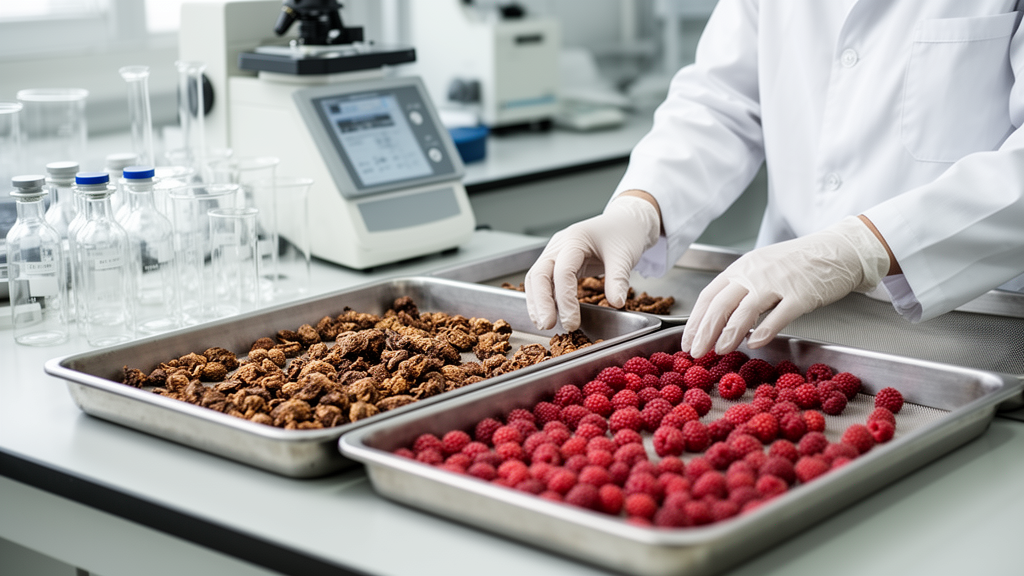
Commercial dried fruits of Rubus chingii Hu — the aggregate berry traded across eastern China as the traditional medicine fupenzi, or Rubi Fructus — carry a stubborn traceability problem. Once the fruit is picked, dried and distributed, its harvest maturity is effectively lost. Yet fruit development, drying and storage can each reshape the aroma volatiles, amino acids and flavonoids that define the berry’s compositional and sensory profile. An apparent difference between two producing regions may therefore reflect nothing more than a different stage mixture at harvest or a different drying regime, rather than genuine provenance. A new study in Food Chemistry: X confronts this ambiguity head-on, asking which chemical differences in commercial lots actually exceed the variation attributable to fruit development — and which deserve promotion to candidate authenticity markers.
The research team, led by Wenkai Duan and Lingyao Peng, assembled volatile, flavonoid-feature, amino-acid and electronic-sensing profiles across nine commercial dried-fruit groups: seven sampling groups spanning six Zhejiang county-level areas plus two Anhui counties, including both cultivated and wild material from Pan’an. Zhejiang material is traded as a representative authentic (daodi) medicinal product within the Zhe Ba Wei group, making it a natural test case for chemical authenticity. But the compiled chemical data were not generated de novo for the study; they were aggregated as location-level summaries from vendor and laboratory reports, with historical sampling records referring to three biological replicates per group whose replicate-level observations were not preserved. The authors are explicit about these metadata limits: plant-level sampling, harvest date, genotype, maturity criteria and drying history cannot be resolved from the available records.
Four analytical platforms contributed to the chemical landscape. Headspace solid-phase microextraction gas chromatography–mass spectrometry profiled 124 volatile feature rows, all treated as library- and retention-index-supported putative annotations because raw spectra and a complete match ledger were unavailable. Nine laboratory reports quantified 17 amino acids in submitted dried material, with tryptophan reported as not detected in all nine — a method-limited result, since prolonged acid hydrolysis compromises tryptophan recovery. A targeted HPLC-UV method captured 12 characteristic flavonoid peaks, while an LC-MS/MS dataset on a QTRAP platform yielded 318 location-level feature rows, again treated as putative unless authentic-standard support was explicit. Electronic-nose and electronic-tongue measurements added holistic fingerprints, but the authors treated electronic-nose data as technical repeats only and retained electronic-tongue vendor outputs as report-level records rather than reanalysing them as independent geographic evidence.
The descriptive chemistry is striking. Benzaldehyde was highest in Shengxian (F4) and lowest in Pan’an cultivated (F8); linalool was highest in Yuanqiao (F2) and lowest in Bozhou (F1). The sum of quantified amino acids was highest in Yuanqiao at 83,537.9 mg/kg and lowest in Pan’an wild material at 63,751.2 mg/kg, with glutamate and aspartate pools dominating — interpreted as combined Glu+Gln and Asp+Asn because acid hydrolysis converts glutamine and asparagine. Putative rutin was highest in Pan’an cultivated and lowest in Pan’an wild. But the authors refuse to treat any of these rankings as marker evidence. Instead, they introduce a prespecified attribution gate: a feature could be prioritised only when its observed nine-location range exceeded the developmental range measured in an independent four-stage dataset.
That independent dataset came from a public NCBI project (PRJNA671545) containing 12 paired-end fruit RNA-seq libraries — three biological replicates at each of four publication-defined stages: big green, green to yellow, yellow to orange and red — plus a developmental metabolite table with 24 samples and 21 features. For each of 11 name- or formula-level overlaps between the location and developmental datasets, the team compared the nine-location log2 range (Rloc) with the four-stage developmental log2 range (Rdev). Developmental-envelope coverage was defined as C = min(Rdev/Rloc, 1), and residual range excess as E = max(Rloc − Rdev, 0). Positive E values identify candidates whose location range exceeds the observed developmental envelope. Twenty of 21 public metabolites showed a stage effect after Benjamini-Hochberg correction, and all 11 overlaps were stage-sensitive. Eight overlaps had developmental ranges equal to or exceeding location ranges, giving C = 1 and no residual excess.
Three candidates retained positive E: gallic acid (Rloc 3.40, Rdev 3.00, E 0.41 log2 units), kaempferol 3-O-glucoside (1.30, 0.92, E 0.38) and ellagic acid (1.49, 0.57, E 0.92). Robustness was assessed by deleting each location once and recalculating E — gallic acid retained positive E in 8 of 9 leave-one-location-out analyses, while ellagic acid and kaempferol 3-O-glucoside did so in 9 of 9. Scenario sensitivity was then evaluated with 30,000 Monte Carlo runs per setting, each generating nine synthetic lots from Dirichlet stage mixtures (α = 0.5, 1 or 2), bootstrapping the six public observations per stage and applying an assumed lot-level drying factor on the log2 scale (SD = 0, 0.25 or 0.5). Tier 1 required positive full-data E, retention in at least 8 of 9 leave-one-location-out analyses and an observed range above the simulated 95th percentile in all three settings at moderate drying SD. Gallic acid and ellagic acid met Tier 1; kaempferol 3-O-glucoside exceeded the scenario threshold in only one of three settings and was assigned Tier 2. With an assumed drying SD of 0.5, no candidate was robust across all mixture settings — a sobering quantification of how much unmeasured commercial-lot structure can matter.
The second evidence gate turns to the genome. The chromosome-scale R. chingii reference genome (v1.0) had reported terpene-synthase activity among expanded gene functions but never provided a sequence-resolved terpene-synthase catalogue. The team scanned all 33,130 predicted proteins with the PF00201 UDP-glycosyltransferase profile using PyHMMER, identifying 178 protein models. Only 55 of these (30.9%) carried a UGT-related KEGG orthology label, one carried a discordant non-UGT label and 122 had no KO assignment at all. The family-profile catalogue recovered all 172 published RchUGT loci — an expected consistency check, since that catalogue was itself built by a family-profile search of the same genome — plus six additional profile-defined candidates that may include fragments or split gene models pending transcript-supported curation.
A species-matched positive-control benchmark quantified the sensitivity gained over KO-only screening. Three publicly deposited and experimentally cloned R. chingii UGT coding sequences — RcUGT75L20, RcUGT75T4 and RcUGT85A57 — were used as controls. The PF00201 scan recovered all three, whereas the prespecified KO-only flavonol-glycosyltransferase screen and the PF00201-plus-UGT-related-KO intersection each compiled none. Across 10,000 random three-protein sets sampled from the proteome, the mean number of PF00201 hits was 0.0171 and no set had three; the exact hypergeometric probability was 1.53 × 10⁻⁷. The authors caution that this benchmark largely restates how few proteins the profile hits, and should be read as a sensitivity check rather than specificity evidence. On the terpene-synthase axis, Pfam screening detected 67 protein models containing at least one TPS domain, of which 32 combined a C-terminal domain with a class-I or class-II catalytic motif. These motif-supported candidates were non-randomly distributed: LG03 contained 17 of 32, a 3.3-fold enrichment over expectation (hypergeometric P = 1.52 × 10⁻⁶), with a median adjacent physical distance of 54.8 kb compared with 1.41 Mb across 10,000 random 17-gene sets.
The most specific genome result concerns one focal gene model. LG03.2235 encoded a 1234-amino-acid model with both TPS domains and catalytic motifs but carried an MRE11 DNA-repair KO — an annotation conflict. Transcript evidence showed ordinary junction support for 21 of 26 annotated junctions, yet the 22,832-bp composite boundary received zero exact junction reads in all 12 fruit libraries. Comparative genomics then resolved the concern: in red raspberry (Rubus idaeus cultivar Varnes), the LG03.2235 N-terminal and TPS segments occupied two non-overlapping, same-strand homologous blocks separated by 4.5 kb; in black raspberry (Rubus occidentalis v3.0), the same segments mapped at 95.2% and 90.5% identity to two separate proteins 46.7 kb apart. By contrast, LG02.1599 — an unusually long ent-copalyl diphosphate synthase model — mapped to one continuous homologous interval in both near relatives, supplying an internal negative comparator. The agreement among annotation conflict, transcript non-support and cross-species separation supports a specific fused-model annotation concern requiring re-curation, though the corrected transcript must still be established by transcript long reads or targeted splice-aware curation.
The study’s practical output is a two-gate prioritisation framework rather than a validated origin classifier. No geographic classifier was fitted to the location-summary matrices, and the authors specify the sample matrix, grouped resampling, held-out predictions and calibration outputs that a reproducible future evaluation would require. Environment-metabolite associations tested at the location level (n = 9) found no reproducible signal: altitude was not associated with linalool (permutation P = 0.409) or rutin (P = 0.882), and sunshine hours were not associated with linalool (P = 0.880), with all adjusted q values at 0.882. With nine independent locations, approximate 80% power is limited to correlations near |ρ| = 0.84, so moderate associations remain unresolved — and province and altitude are structurally entangled because both Anhui locations are low altitude. The four-stage expression-metabolite coupling audit across 247 unique candidate genes and 21 metabolites (3,087 pairs) nominated trajectories but established no regulation: the minimum attainable exact two-sided P was 0.0833, no pair survived correction and the minimum q was 0.411. The framework’s value lies in converting two common uncertainties — missing maturity metadata and incomplete functional labels — into auditable validation priorities. Gallic acid and ellagic acid begin targeted standard confirmation and stage-controlled commercial-lot replication first, followed by kaempferol 3-O-glucoside, while the remaining eight overlaps are retained as development-sensitive quality descriptors rather than discarded. The workflow can transfer to other processed fruits in which harvest stage is missing or incompletely recorded, provided candidates first pass authentic-standard confirmation and moisture-aware quantification, then independent lots with recorded maturity, drying and storage. Only after those gates should location-grouped classification or locus-specific expression be considered — and any such classifier must fit every preprocessing and feature-selection step inside location-grouped training folds, reporting per-location held-out predictions, calibration and uncertainty.
Subject of Research: Food Chemistry
Article Title: Developmental-envelope screening and genome-annotation audit prioritize chemical authenticity candidates in commercial Rubus chingii fruit
Article References: Duan, W., Wei, Z., Gao, W., & Peng, L. (2026). Developmental-envelope screening and genome-annotation audit prioritize chemical authenticity candidates in commercial Rubus chingii fruit. Food Chemistry: X, 40, Article 104635. https://doi.org/10.1016/j.fochx.2026.104635
Image Credits: AI Generated
DOI: 10.1016/j.fochx.2026.104635
Keywords: food authenticity, Rubus chingii, developmental envelope, genome annotation, UGT, TPS, fupenzi, metabolomics, Developmental-envelope, screening, genome-annotation, audit
News Source: Bethany Barker. (October 17, 2026). Two-Gate Screening Separates Maturity Noise From Real Chemistry in Commercial Fupenzi Fruit. Scienmag.