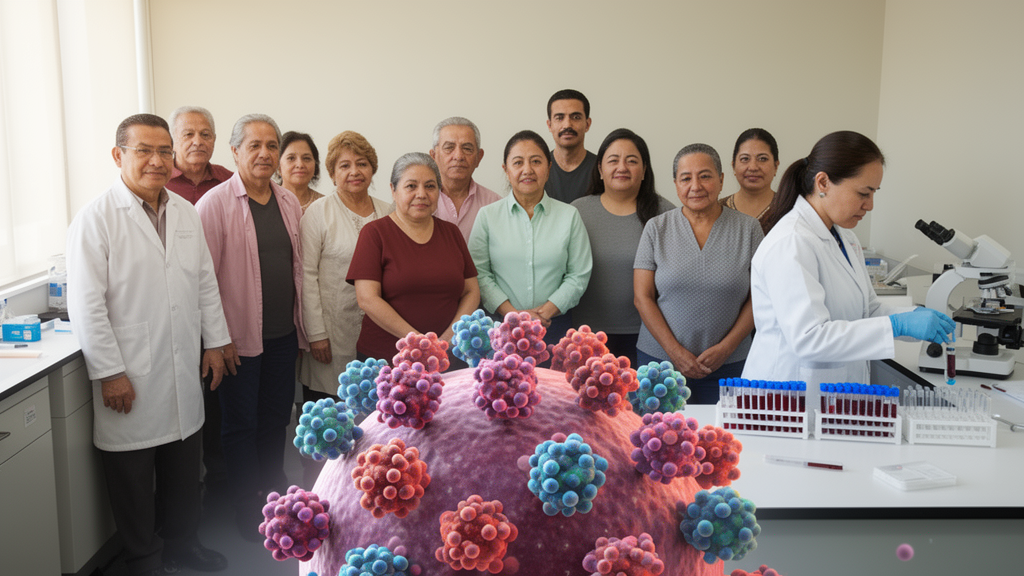
A retrospective study of 606 unrelated people referred for histocompatibility testing in northeastern Mexico identified 231 two-field HLA alleles across four loci. Only four inferred four-locus haplotypes exceeded 1% frequency, providing a high-resolution regional dataset that may complement population-based studies but does not represent all people in the region.
Researchers analyzed blood samples collected from January 2019 through December 2024 by the Hospital Universitario “Dr. José Eleuterio González” and collaborating hospitals and laboratories across northeastern Mexico. Participants had been referred for possible solid-organ or hematopoietic progenitor cell transplantation, and inclusion required complete high-resolution results for HLA-A, HLA-B, HLA-C and HLA-DRB1. The researchers therefore classified the sample as a clinically referred cohort rather than a population-based cohort.
High-resolution typing was performed with sequencing-based Sanger methods for 468 samples, or 77.2%, collected from January 2019 through January 2024. The remaining 138 samples, or 22.8%, collected from February through December 2024, were typed by next-generation sequencing. Allele assignments were standardized to two-field resolution. Frequencies were calculated by direct counting, while four-locus haplotypes were inferred using an expectation–maximization algorithm with bootstrap resampling.
The most frequent alleles at HLA-A were HLA-A*02:01 at 23.76%, HLA-A*24:02 at 14.44% and HLA-A*03:01 at 6.52%. At HLA-B, the leading alleles were HLA-B*35:01 at 7.43%, HLA-B*40:02 at 6.44% and HLA-B*51:01 at 6.11%. The most frequent HLA-C alleles were HLA-C*04:01 at 17.16%, HLA-C*07:02 at 14.77% and HLA-C*07:01 at 8.25%. At HLA-DRB1, HLA-DRB1*08:02 occurred at 11.88%, HLA-DRB1*04:07 at 9.41% and HLA-DRB1*07:01 at 8.33%.
The two most frequent inferred haplotypes each accounted for 1.24%: HLA-A*03:01–HLA-B*07:02–HLA-C*07:02–HLA-DRB1*15:01 and HLA-A*68:03–HLA-B*39:05–HLA-C*07:02–HLA-DRB1*04:07. Two additional haplotypes exceeded 1%: HLA-A*24:02–HLA-B*39:06–HLA-C*07:02–HLA-DRB1*14:06 at 1.16% and HLA-A*29:02–HLA-B*44:03–HLA-C*16:01–HLA-DRB1*07:01 at 1.07%. All remaining inferred haplotypes occurred below 1%.
HLA-A, HLA-B and HLA-DRB1 did not depart significantly from Hardy–Weinberg equilibrium, with p values of 0.40519, 0.64448 and 0.27685, respectively. HLA-C showed a modest, statistically significant departure associated with a slight heterozygote excess: observed heterozygosity was 0.92409, expected heterozygosity was 0.91903 and p was 0.03804. The heterozygosity-weighted global inbreeding coefficient, FIS, was 0.00886, while locus-specific values were close to zero. The study was not designed to test selection, and the researchers said the HLA-C result could not be attributed to selection from these data alone.
Linkage disequilibrium was significant for all six pairs of loci in likelihood-ratio permutation tests with 10,100 permutations, producing empirical p values below 0.0001. The strongest disequilibrium occurred between HLA-B and HLA-C; the other locus pairs showed less pronounced but still significant associations. D′ values approached positive or negative 1 for many allele combinations, whereas r² values varied more widely. The authors noted that this distinction means limited historical recombination does not necessarily mean that one allele strongly predicts another.
Pairwise fixation-index comparisons with 22 population datasets from the Americas showed the lowest differentiation from admixed populations. The Brazilian, Central American Mestizo, Colombian cord blood and San Diego cohorts each had FST values below 0.003. Greater differentiation was observed for Indigenous and Amerindian reference populations, with FST values ranging from 0.0045 to 0.0494. The largest difference was from Colombia’s North Chimila Amerindian population at FST = 0.0494, followed by the Colombian North Wiwa population at FST = 0.0246. All pairwise comparisons with the northeastern Mexican cohort were statistically significant at p below 0.05.
The dataset offers regional allele and haplotype frequencies for interpreting histocompatibility and donor-search research, but referral-related sampling effects cannot be excluded and it is not a definitive description of northeastern Mexico’s population. Some rare alleles and haplotypes were represented by small counts, the analysis covered only four loci, and the study did not evaluate transplantation outcomes or the effects of specific HLA mismatches. The authors said population-based studies with broader geographic sampling, additional HLA loci and registry information would be needed to define the region’s diversity more comprehensively.
Subject of Research: High-resolution HLA-A, HLA-B, HLA-C and HLA-DRB1 diversity in a clinically referred northeastern Mexican cohort
Article Title: High-resolution HLA genetic diversity in a Northeastern Mexican clinical cohort
Article References: Ayala-Verdugo, J. A., Jaime-Pérez, J. C., Mendoza-Ibarra, S. I., Cancela-Murrieta, C. O., García-Valdez, A. J., Solis-Estrada, J., Salazar-Riojas, R., Gómez-De León, A., Colunga-Pedraza, P. R., Cantú-Rodríguez, O., Gómez-Almaguer, D., & Moncada-Saucedo, N. K. (2026). High-resolution HLA genetic diversity in a Northeastern Mexican clinical cohort. Frontiers in Genetics, 17, Article 1960786. https://doi.org/10.3389/fgene.2026.1960786
Image Credits: AI Generated
DOI: 10.3389/fgene.2026.1960786
Keywords: HLA diversity, northeastern Mexico, two-field typing, allele frequencies, HLA haplotypes, Hardy–Weinberg equilibrium, linkage disequilibrium, population genetics, histocompatibility, next-generation sequencing, High-resolution, genetic
News Source: Juliet Wilcox. (October 21, 2026). Two-field HLA typing maps diversity in 606 clinically referred northeastern Mexicans. Scienmag.