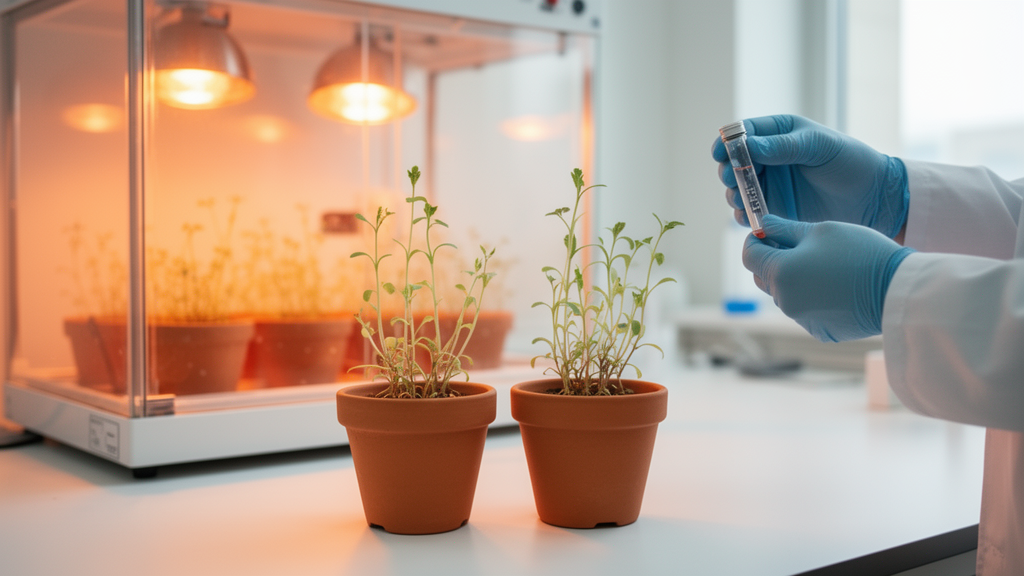
Arabidopsis thaliana has earned its place as the workhorse of plant biology for good reasons: it grows quickly, carries a compact genome, and benefits from decades of accumulated genetic and genomic resources. But the plant’s greatest experimental strength—its wealth of naturally occurring varieties—also creates a quiet methodological problem. When researchers publish stress-response data from a single accession, the so-called wild type behind the numbers is really just one genetic background among hundreds. A new comparative study now asks whether two of the most heavily used laboratory strains, Columbia-0 and Columbia-4, actually behave the same way at the level of their metabolites when the temperature climbs, and the answer is reassuring with an important caveat.
The research, published as an open-access brief report in Discover Plants, was led by José Carlos Páez-Franco and Manuel Gutiérrez-Aguilar of the Universidad Nacional Autónoma de México together with Hilda Sánchez-Vidal and Imelda Cecilia Zarzoza-Mendoza of the Instituto Nacional de Ciencias Médicas y Nutrición Salvador Zubirán. Rather than testing whether one strain tolerates heat better than the other, the team set out to determine whether the two Columbia derivatives show conserved or divergent metabolic responses under normal growth conditions and after an acute heat shock. The distinction matters, because metabolomic baselines can differ between accessions and quietly shape how stress experiments are interpreted.
The experimental design was deliberately straightforward. Seeds of Col-0 and Col-4 were obtained from the Arabidopsis Biological Resource Center at Ohio State University, sterilized, and germinated on half-strength Murashige and Skoog medium before transfer to soil. Plants were grown at 22 degrees Celsius under a 16-hour light, 8-hour dark photoperiod. When the plants reached four weeks of age, half of them were subjected to an acute heat-stress regime of 45 minutes at 42 degrees Celsius, while the control plants remained at 22 degrees under the same lighting conditions. Leaves were then harvested for untargeted metabolomic profiling by gas chromatography coupled to mass spectrometry, a technique that separates volatile derivatives of small molecules and identifies them by their mass fragmentation patterns.
The analytical workflow was built around rigorous quality control. Roughly 0.15 grams of fresh leaf tissue from each sample was homogenized in cold methanol and water, spiked with two internal standards—tridecanoic acid and 5α-cholestane—and dried before chemical derivatization with methoximation and trimethylsilylation to make the metabolites amenable to gas chromatography. A quality control sample was injected every four runs to track instrument stability, and only metabolites showing less than 30 percent relative standard deviation across those QC injections were retained. The relative standard deviations for the two internal standards came in at 8.3 and 7.6 percent, indicating a stable analytical platform. Data were processed in MZmine, and putative annotations were assigned by comparison with the NIST spectral library, with the authors careful to note that these assignments, made without authentic standards or retention-index measurements, should not be treated as definitive metabolite identifications.
From 23 biological samples—six Col-0 controls, six heat-stressed Col-0 plants, six Col-4 controls, and five heat-stressed Col-4 plants—the profiling pipeline detected 54 metabolic features. Under control conditions, the two accessions proved strikingly similar. Only a small set of features met the nominal statistical thresholds of a P value below 0.05 and an absolute log2 fold change greater than 1 in the direct comparison between Col-0 and Col-4. Among these, features putatively annotated as maleic acid and a sinapic acid derivative were more abundant in Col-4, with log2 fold changes of +1.40 and +1.19 respectively, while a feature putatively annotated as phytol, a chlorophyll-derived metabolite, was lower in Col-4 with a log2 fold change of −1.11 and a nominal P value of 0.0053. In other words, the baseline metabolic fingerprints of the two Columbia strains overlap almost completely.
Heat stress told a more interesting story. When the researchers compared each accession against its own unstressed control, they found partly overlapping sets of features meeting the nominal criteria. Some features, including putative maleic acid, Arabino-Hexos-2-ulose, and a sinapic acid derivative, met the criteria only in Col-0, while others—putatively threonine, a second threonic acid feature, ribitol, and psicose—met the criteria only in Col-4. Crucially, the authors emphasize that membership in only one within-accession list does not demonstrate that the two accessions respond differently to heat. Ten features, however, met the nominal criteria in both accessions and shifted in the same direction: succinic acid, serine, 3,4-dihydroxytetrahydro-2-furanone, 4-ketoglucose, an aspartic acid feature, threonic acid, glutamic acid, indole-3-acetonitrile, fructose, and galactinol. This shared panel spans organic acids, amino acids, sugars, and phenylpropanoid-related compounds, sketching a common metabolic signature of acute heat response in the Columbia background.
Principal component analysis reinforced that picture of shared response. In this descriptive visualization, the first principal component explained 32.2 percent of total variance and the second explained 13.4 percent, and control and heat-stressed samples separated primarily along the first component. That pattern identifies heat treatment, not genotype, as the dominant source of metabolic variation in the dataset. The heat-stressed Col-0 and Col-4 groups showed partially overlapping distributions in the PCA space, consistent with substantial overlap in their global metabolic profiles, though the authors caution that a descriptive PCA cannot by itself establish statistically significant genotype-dependent differences.
The decisive test came from a two-way factorial model fitted to each metabolite, with genotype, treatment, and their interaction as fixed factors. Because the design was slightly unbalanced—five rather than six stressed Col-4 plants—the team used Type II sums of squares and heteroscedasticity-consistent HC3 covariance estimates for inference, then applied Benjamini–Hochberg correction separately to the genotype, treatment, and interaction P values across all 54 metabolites. Two features, putatively annotated as phytol and a sinapic acid derivative, showed nominal genotype-by-treatment interaction effects below 0.05, but neither survived correction for multiple testing. The authors also acknowledge that the modest sample sizes may have limited statistical power to detect subtle interaction effects, so the null result should be read with appropriate caution rather than as proof of perfect equivalence.
Why does this matter beyond the Arabidopsis community? The 1001 Genomes Project and related surveys have revealed extensive worldwide genetic diversity in the species, and previous work has documented accession-specific proteomic signatures as well as differences in photosynthetic organization and pigment composition. Closely related laboratory strains are sometimes treated as interchangeable controls, yet the new data suggest that even two derivatives of the same Columbia lineage can show small, accession-associated differences in specific metabolic features—here involving an organic acid, a phenylpropanoid-related intermediate, and a chlorophyll-derived metabolite—under identical growth conditions. Those differences were nominal and unconfirmed by authentic standards, but they serve as a reminder that genetic background can leave measurable traces in molecular datasets even when plants look identical on the bench.
The practical takeaway for researchers is twofold. First, the broadly shared heat-associated metabolic patterns in Col-0 and Col-4 provide a concise comparative reference, suggesting that results obtained in one Columbia derivative are likely to translate reasonably well to the other for acute heat-stress metabolomics. Second, the study models a level of statistical transparency that metabolomics as a field increasingly demands: nominal thresholds for descriptive heatmaps, false-discovery-rate correction for inferential claims, QC injections excluded from biological statistics, and public deposition of raw data, metadata, and analysis code on Zenodo. As heat waves intensify and crop resilience becomes a global research priority, knowing exactly which wild type sits behind every data point—and how far its metabolic behavior can be generalized—is no longer a technical footnote. It is part of the result.
Subject of Research: Comparative untargeted metabolomics of the Arabidopsis thaliana accessions Col-0 and Col-4 under control and acute heat stress conditions
Article Title: Accession-associated metabolomic variation in wild type Arabidopsis thaliana under control and heat shock conditions
Article References: Páez-Franco, J. C., Sánchez-Vidal, H., Zarzoza-Mendoza, I. C., & Gutiérrez-Aguilar, M. (2026). Accession-associated metabolomic variation in wild type Arabidopsis thaliana under control and heat shock conditions. Discover Plants, 3(1), Article 448. https://doi.org/10.1007/s44372-026-00931-3
Image Credits: AI Generated
DOI: 10.1007/s44372-026-00931-3
Keywords: Arabidopsis thaliana, metabolomics, heat stress, Col-0, Col-4, GC-MS, natural variation, genetic background, principal component analysis, false discovery rate, plant physiology, stress response
News Source: Alexandra Wallace. (October 8, 2026). Two Famous Lab Strains of Arabidopsis React Alike to Heat, Metabolomics Study Finds. Scienmag.