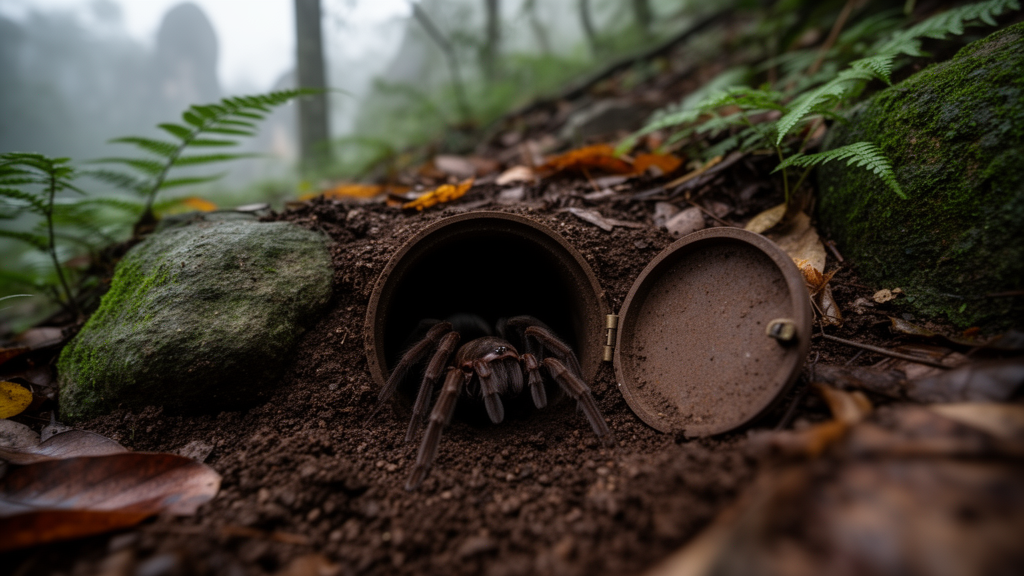
A team of Chinese arachnologists has described twelve brand-new species of some of the most evolutionarily ancient spiders on Earth, all unearthed from the karst hills and forested valleys of Guizhou Province in southern China. The spiders belong to the genus Songthela, a group of primitively segmented trapdoor spiders in the family Liphistiidae that scientists regard as living relics of the earliest branches of the spider tree of life. With the new additions, published in the journal Zoosystematics and Evolution, the genus now encompasses 55 described species, nearly all of them confined to the mountains of southern China and a single outlier in northern Vietnam.
Mesothelae, the suborder to which Songthela belongs, is the sister group to all other spiders, and its members retain features that disappeared from their modern relatives hundreds of millions of years ago. Perhaps the most striking of these is the segmented abdomen: unlike the familiar fused opisthosoma of orb weavers or wolf spiders, these animals carry a series of twelve distinct dorsal plates, or tergites, each paired with thick bristles, recalling the segmented ancestors of the entire arachnid lineage. They also typically possess seven or eight spinnerets clustered in the middle of the underside of the abdomen, rather than the terminal arrangement seen in almost every other spider alive today. Liphistiids live in silk-lined burrows fitted with hinged trapdoors, from which they ambush passing prey with astonishing speed.
The new species were diagnosed primarily through genital anatomy, the gold standard for spider taxonomy. In males, the researchers focused on the intricate architecture of the pedipalp, the modified leg-like appendage that functions as an intromittent organ. Its components, including the contrategulum with its serrated margins, the tegulum with its helicoid marginal apophysis and thumb-like terminal apophysis, and the conductor bearing a distinctive apical spine, provide a suite of characters that reliably separate even closely related species. In females, the shape and position of the receptacular clusters on the bursa copulatrix, along with the length of the tubular genital stalks and the presence of sclerotized patches, proved equally decisive.
All twelve newcomers were assigned to the multidentata-group, one of three species groups within the genus, characterized by the number and arrangement of spines and teeth on the male palpal conductor and by the configuration of the female genitalia. The groupings, first proposed on morphological grounds, have been corroborated by molecular data in earlier studies. The newly named species are S. chenjiapian, S. cuantang, S. fengxiang, S. fuyan, S. nanqiao, S. parallela, S. qingganglin, S. tianba, S. tudiao, S. yanhe, S. yinchiba, and S. yuhu, with most epithets honoring the villages or landmarks near which the spiders were found.
Fieldwork in Guizhou was painstaking. The spiders spend virtually their entire lives inside burrows, so the collectors manually excavated adults and immatures from their sealed tunnels across localities spanning Tongren and Zunyi cities, at elevations ranging from roughly 343 to 961 meters. Adult specimens had four right legs removed and preserved in pure ethanol at minus 80 degrees Celsius for DNA work, while the rest of the body was kept in 80 percent ethanol as a morphological voucher. Subadults were raised in the laboratory until they matured, allowing the team to link juvenile field collections to identifiable adults.
In the laboratory, the taxonomic work turned to high-resolution imaging. Female genitalia were dissected after digesting the soft tissues with pancreatin solution, a technique that clears away muscle and glandular material to reveal the sclerotized receptacular structures in exquisite detail. Male palps and vulvae were photographed through an Olympus BX53 compound microscope with a mounted CCD camera, and the resulting image stacks were combined with focus-stacking software into fully sharp composite micrographs that accompany the paper.
One of the most biologically interesting results of the study is the sheer degree of intraspecific variation the authors documented, especially in the female vulva. In S. chenjiapian, for example, the median genital stalks may be fused, partially fused, or entirely separate at the base, and the median receptacular clusters can be larger or smaller than the lateral ones depending on the individual. Spinneret number itself varies within species, with individuals of the same population carrying seven or eight. These observations matter for conservation genetics and species delimitation, because they warn that single specimens should not be treated as representatives of a species’ full morphological range.
To anchor each species unambiguously, the team sequenced the mitochondrial cytochrome c oxidase subunit I gene, the standard animal DNA barcode, from the holotype of every new species and deposited the sequences in GenBank. These barcodes will allow future researchers to match unknown specimens to named species even when morphological characters are ambiguous, and they open the door to broader molecular analyses of diversification across the rugged, dissected topography of Guizhou, where isolated karst ridges and river valleys likely promoted the allopatric speciation that produced this remarkable radiation.
The Guizhou discoveries also underscore how much undocumented biodiversity remains hidden in the mountains of southern China. Before this study, only seven Songthela species had been recorded from the province; the twelve new descriptions more than triple that count in a single publication. Because liphistiids are long-lived, sedentary, and poor dispersers, individual species often occupy extremely restricted ranges, sometimes a single valley or forest park. Such narrow endemism makes them sensitive indicators of habitat health and potentially vulnerable to land-use change, even as their ancient lineage has persisted through mass extinctions that wiped out countless other arthropod groups.
For evolutionary biologists, each new liphistiid species is more than a name in a catalog. These segmented spiders provide a living window into the morphology of the spider common ancestor, and their geographic patterns trace how mountain building and Pleistocene climate fluctuations sculpted diversity across East Asia. With detailed diagnoses, photographs, distribution maps, and DNA barcodes now available for all twelve species, the study offers both a foundation for future phylogeographic work and a compelling reminder that some of the planet’s oldest predators are still quietly guarding their trapdoors, waiting to be counted.
Subject of Research: Taxonomic description of twelve new species of segmented trapdoor spiders in the genus Songthela from Guizhou Province, China
Article Title: Species diversity in the segmented spider genus Songthela ( Mesothelae , Liphistiidae ), with descriptions of 12 new species from Guizhou Province, China
Article References: Xu, X., Zhang, Y., & Li, D. (2026). Species diversity in the segmented spider genus Songthela (Mesothelae, Liphistiidae), with descriptions of 12 new species from Guizhou Province, China. Zoosystematics and Evolution, 102(5), 1265-1293. https://doi.org/10.3897/zse.102.216113
Image Credits: AI Generated
Keywords: Songthela, Liphistiidae, Mesothelae, trapdoor spiders, new species, Guizhou, taxonomy, China, genital morphology, DNA barcoding, COI, species diversity
News Source: Drew Townsend. (October 16, 2026). Twelve New Species of Living-Fossil Trapdoor Spiders Discovered in Guizhou, China. Scienmag.