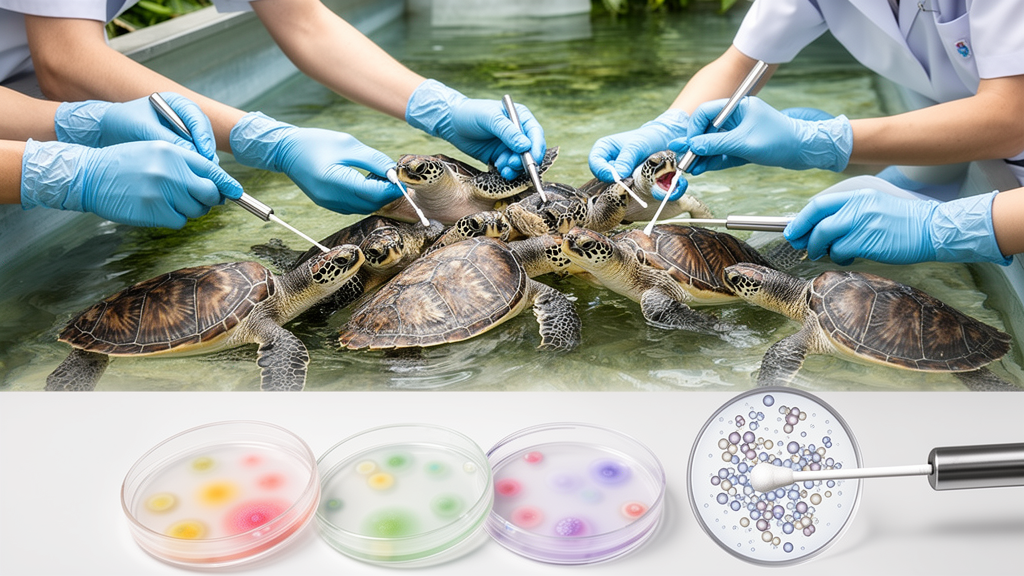
Freshwater turtles from native-only, non-native-only and mixed assemblages showed differences in their host-associated microbiomes, while the body site from which a sample was collected emerged as the strongest and most consistent influence on microbial community structure. The study compared external-shell and cloacal samples using 16S rRNA metabarcoding, assessing microbial diversity, composition and abundance patterns in native and non-native freshwater turtles held in isolated and mixed assemblages. The results associate turtle assemblage composition with differences in microbial communities, but the evidence does not establish that invasion caused those differences or that any turtle or person was harmed by them.
Researchers evaluated alpha diversity in relation to body site, turtle assemblage composition, sex and body size. Body site consistently produced different alpha-diversity patterns between shell surfaces and cloacas. Assemblage composition was associated with Shannon diversity, whereas no association was detected for Simpson diversity or Faith’s phylogenetic diversity. Thus, the relationship between the kinds of turtles in an assemblage and microbial diversity depended on the diversity measure used. The study did not report a consistent assemblage effect across all three measures, and the supplied findings do not identify the mechanisms responsible for the observed patterns.
Beta-diversity analyses showed significant differences between body sites and among native-only, non-native-only and mixed turtle assemblages across all distance metrics used. A body-site-by-assemblage interaction was detected for Bray–Curtis dissimilarity, showing that the relationship between assemblage composition and microbial community structure was not identical at the two sampled body sites. This interaction was specifically reported for the Bray–Curtis measure rather than uniformly across every beta-diversity analysis. The taxonomic composition of the most represented microbial taxa also differed markedly between external shells and cloacas, with body site consistently emerging as the main driver of the observed community structure.
Differential-abundance analyses supported the body-site pattern by identifying several phyla and genera that were significantly more abundant in one sampled site than the other. The analysis also identified 19 microbial taxa closely related to human-associated pathogens. These taxa were absent from microbial communities containing only non-native turtles but were present in native-only and mixed assemblages. The observation is limited to the sampled microbial communities: it does not demonstrate that the turtles became infected, that non-native turtles caused the organisms to be present, or that the close relatives of human-associated pathogens created a clinical risk. Likewise, the study assessed host-associated microbiomes rather than directly measuring disease outcomes in people or animals.
Overall, the research shows that body site and turtle assemblage composition were associated with the structure of freshwater-turtle microbiomes, with body site providing the more consistent signal. The analysis also demonstrates that alpha diversity, beta diversity, taxonomic composition and differential abundance did not all yield the same pattern of assemblage effects. In the reported scope—external-shell and cloacal samples from native-only, non-native-only and mixed freshwater-turtle assemblages—the findings provide evidence of microbial differences linked to community context and sampling site. They also leave the mechanisms behind those differences unresolved, because the reported results establish associations rather than causal effects of invasion, sex, body size or any other examined factor.
Subject of Research: Associations between freshwater-turtle assemblage composition, body site and host-associated microbiomes
Article Title: Turtle Assemblage Composition and Body Site Shape Microbiome Structure in Native and Non-Native Freshwater Turtles
Article References: Rato, J., Vasconcelos, D. S., Xavier, R., Harris, D. J., Banha, F., & Anastácio, P. (2026). Turtle Assemblage Composition and Body Site Shape Microbiome Structure in Native and Non-Native Freshwater Turtles. Microbial Ecology. https://doi.org/10.1007/s00248-026-02916-x
Image Credits: AI Generated
DOI: 10.1007/s00248-026-02916-x
Keywords: freshwater turtles, turtle microbiomes, 16S rRNA metabarcoding, biological invasions, body-site variation, microbial diversity, microbial composition, host-associated microbiota, cloacal microbiome, shell microbiome, Turtle, Assemblage
News Source: Morgan Morrow. (October 22, 2026). Turtle Assemblage Composition and Body Site Shape Microbiome Structure. Scienmag.