• HOME
  • NEWS
  • EXPLORE
    • CAREER
      • Companies
      • Jobs
    • EVENTS
    • iGEM
      • News
      • Team
    • PHOTOS
    • VIDEO
    • WIKI
  • BLOG
  • COMMUNITY
    • FACEBOOK
    • INSTAGRAM
    • TWITTER
Thursday, July 9, 2026
BIOENGINEER.ORG
No Result
View All Result
  • Login
  • HOME
  • NEWS
  • EXPLORE
    • CAREER
      • Companies
      • Jobs
        • Lecturer
        • PhD Studentship
        • Postdoc
        • Research Assistant
    • EVENTS
    • iGEM
      • News
      • Team
    • PHOTOS
    • VIDEO
    • WIKI
  • BLOG
  • COMMUNITY
    • FACEBOOK
    • INSTAGRAM
    • TWITTER
  • HOME
  • NEWS
  • EXPLORE
    • CAREER
      • Companies
      • Jobs
        • Lecturer
        • PhD Studentship
        • Postdoc
        • Research Assistant
    • EVENTS
    • iGEM
      • News
      • Team
    • PHOTOS
    • VIDEO
    • WIKI
  • BLOG
  • COMMUNITY
    • FACEBOOK
    • INSTAGRAM
    • TWITTER
No Result
View All Result
Bioengineer.org
No Result
View All Result
Home NEWS Science News Health

Turning on the switch for plasticity in the human brain

Bioengineer by Bioengineer
January 29, 2021
in Health
Reading Time: 2 mins read
0
IMAGE
Share on FacebookShare on TwitterShare on LinkedinShare on RedditShare on Telegram

IMAGE

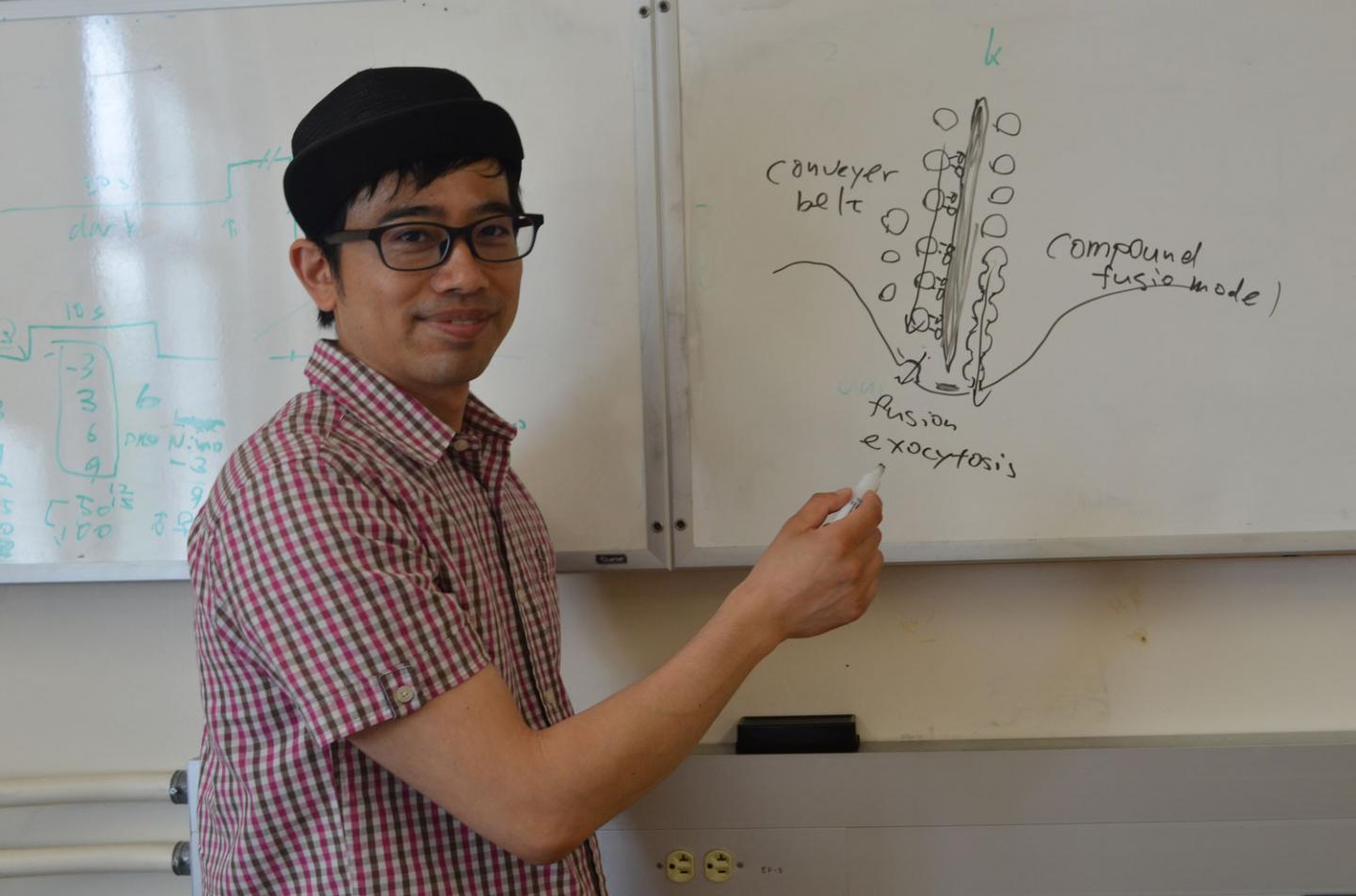
Credit: Diana Kenney

WOODS HOLE, Mass. — The most powerful substance in the human brain for neuronal communication is glutamate. It is by far the most abundant, and it’s implicated in all kinds of operations. Among the most amazing is the slow restructuring of neural networks due to learning and memory acquisition, a process called synaptic plasticity. Glutamate is also of deep clinical interest: After stroke or brain injury and in neurodegenerative disease, glutamate can accumulate to toxic levels outside of neurons and damage or kill them.

Shigeki Watanabe of Johns Hopkins University School of Medicine, a familiar face at the Marine Biological Laboratory (MBL) as a faculty member and researcher, is hot on the trail of describing how glutamate signaling works in the brain to enable neuronal communication. In a paper last fall, Watanabe (along with several MBL Neurobiology course students) described how glutamate is released from neural synapses after the neuron fires. And today, Watanabe published a follow-up study in Nature Communications.

“With this paper, we uncover how signals are transmitted across synapses to turn on the switch for plasticity,” Watanabe says. “We demonstrate that glutamate is first released near AMPA-type glutamate receptors, to relay the signal from one neuron to the next, and then near NMDA-type receptors immediately after the first signal to activate the switch for synaptic plasticity.”

This new study was also partly conducted in the MBL Neurobiology course, where Watanabe is a faculty member. “It began in 2018 with (course students) Raul Ramos and Hanieh Falahati, and then we followed up in 2019 with Stephen Alexander Lee and Christine Prater. Shuo Li, the first author, was my teaching assistant for the Neurobiology course for both years,” Watanabe says. He will be returning to the MBL this summer to teach in the course — and discover more.

###

The Marine Biological Laboratory (MBL) is dedicated to scientific discovery – exploring fundamental biology, understanding marine biodiversity and the environment, and informing the human condition through research and education. Founded in Woods Hole, Massachusetts in 1888, the MBL is a private, nonprofit institution and an affiliate of the University of Chicago.

Media Contact
Diana Kenney
[email protected]

Original Source

https://social.mbl.edu/turning-on-the-switch-for-plasticity-in-the-human-brain

Related Journal Article

http://dx.doi.org/10.1038/s41467-021-21004-x

Tags: BiologyMedicine/Healthneurobiology
Share12Tweet8Share2ShareShareShare2

Related Posts

Insilico Medicine Reports First Half 2026 Positive Profit Alert

July 9, 2026

BET inhibition reveals glycolytic vulnerability via HIF1α in triple-negative breast cancer

July 9, 2026

Common Drugs Provide Limited Relief for Long Covid Fatigue

July 9, 2026

New NIR fluorotag CETIF6a enhances tumor labeling and protein profiling

July 9, 2026
Please login to join discussion

POPULAR NEWS

  • Detection of EDCs in Breast Milk and Infant Urine Up to Six Months Highlights Early Exposure Risks

    77 shares
    Share 31 Tweet 19
  • New Drug Candidate Developed at McMaster Shows Potential for Treating Brain Cancer

    58 shares
    Share 23 Tweet 15
  • KTU Researchers Explore Ultrasound’s Role in Enhancing Blood Flow Beyond Diagnostics

    53 shares
    Share 21 Tweet 13
  • 高齢者の骨粗鬆症治療の持続性比較

    51 shares
    Share 20 Tweet 13

About

We bring you the latest biotechnology news from best research centers and universities around the world. Check our website.

Follow us

Recent News

Cement Production Linked to Microplastic Pollution in Groundwater, Study Finds

Olaparib Benefits HR-Deficient TNBC and Platinum-Sensitive Ovarian Cancers

Scientists Quantify Substances Extracted by Cupping Therapy from Skin

Subscribe to Blog via Email

Enter your email address to subscribe to this blog and receive notifications of new posts by email.

Join 83 other subscribers
  • Contact Us

Bioengineer.org © Copyright 2023 All Rights Reserved.

Welcome Back!

Login to your account below

Forgotten Password?

Retrieve your password

Please enter your username or email address to reset your password.

Log In
No Result
View All Result
  • Homepages
    • Home Page 1
    • Home Page 2
  • News
  • National
  • Business
  • Health
  • Lifestyle
  • Science

Bioengineer.org © Copyright 2023 All Rights Reserved.