• HOME
  • NEWS
  • EXPLORE
    • CAREER
      • Companies
      • Jobs
    • EVENTS
    • iGEM
      • News
      • Team
    • PHOTOS
    • VIDEO
    • WIKI
  • BLOG
  • COMMUNITY
    • FACEBOOK
    • INSTAGRAM
    • TWITTER
Saturday, July 11, 2026
BIOENGINEER.ORG
No Result
View All Result
  • Login
  • HOME
  • NEWS
  • EXPLORE
    • CAREER
      • Companies
      • Jobs
        • Lecturer
        • PhD Studentship
        • Postdoc
        • Research Assistant
    • EVENTS
    • iGEM
      • News
      • Team
    • PHOTOS
    • VIDEO
    • WIKI
  • BLOG
  • COMMUNITY
    • FACEBOOK
    • INSTAGRAM
    • TWITTER
  • HOME
  • NEWS
  • EXPLORE
    • CAREER
      • Companies
      • Jobs
        • Lecturer
        • PhD Studentship
        • Postdoc
        • Research Assistant
    • EVENTS
    • iGEM
      • News
      • Team
    • PHOTOS
    • VIDEO
    • WIKI
  • BLOG
  • COMMUNITY
    • FACEBOOK
    • INSTAGRAM
    • TWITTER
No Result
View All Result
Bioengineer.org
No Result
View All Result
Home NEWS Science News Chemistry

Tunable rainbow light trapping in ultrathin resonator arrays

Bioengineer by Bioengineer
December 1, 2020
in Chemistry
Reading Time: 2 mins read
0
IMAGE
Share on FacebookShare on TwitterShare on LinkedinShare on RedditShare on Telegram

IMAGE

Credit: by Nazir Kherani

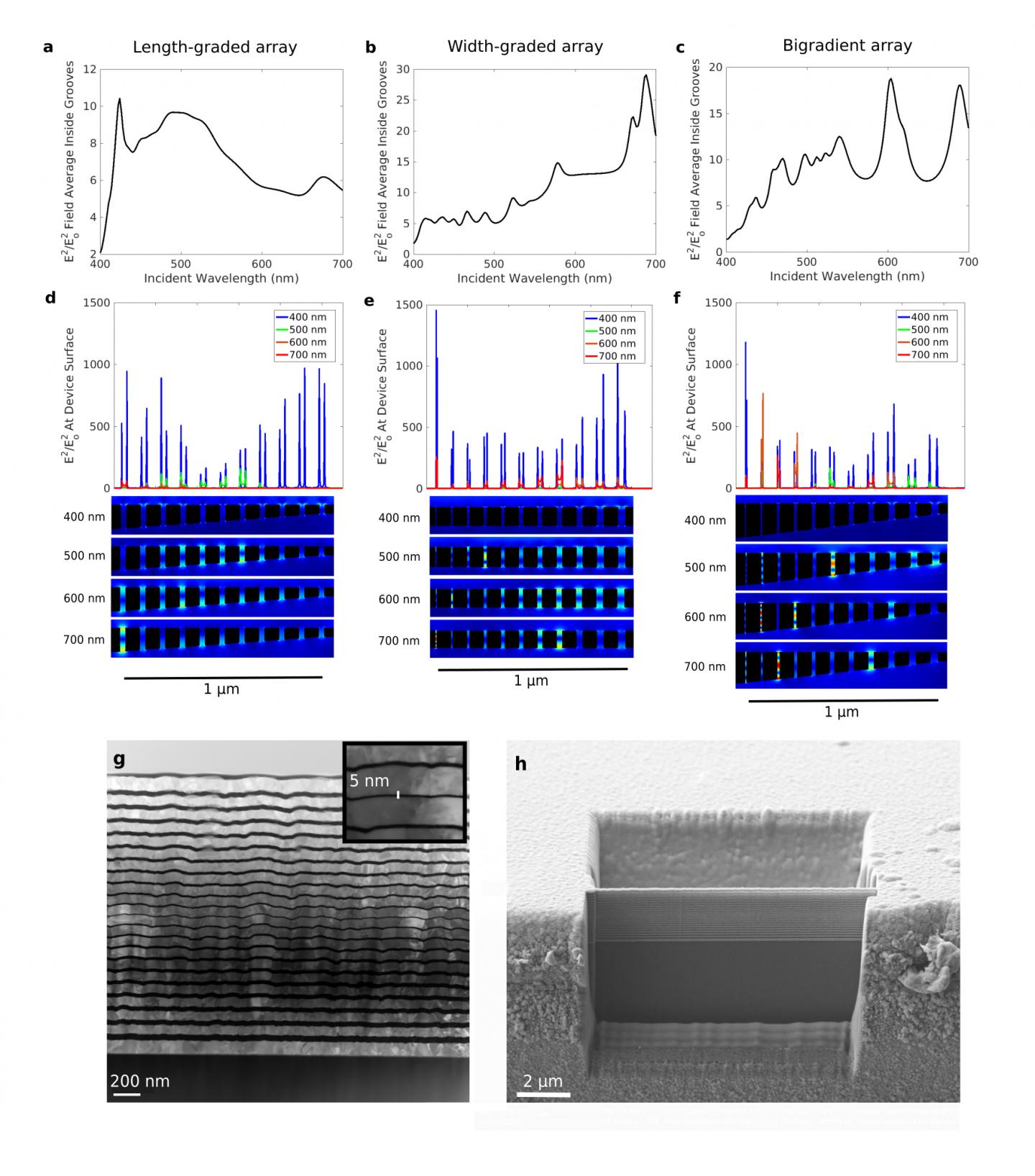
Through the manipulation of quasiparticles known as surface plasmon polaritons (SPPs) metallic nanostructures can control light at the nanoscale, confining it to ultrathin gaps and magnifying the light intensity up to 1000 times. This light localization amplifies light-matter interactions and has wide ranging applications in nanoscale optics including low concentration molecular sensing, enhanced photocatalysis and super-resolution optics. However, current systems for designing and fabricating these nanostructures lack control over the device’s optical response and often suffer from poor light confinement, limiting the applications which can benefit from this light trapping effect.

A new paper published in Light Science & Applications from a team of scientists led by Professor Nazir Kherani at the University of Toronto outlines novel design and fabrication techniques optimized for light localization across the visible spectrum, also known as rainbow light trapping. The nanostructures consist of a series of grooves grouped into arrays with gradients in the groove geometry in various configurations providing broadband electromagnetic field enhancement. Using an analytical model combinations of these grooves are designed to produce devices which can control both the spectral and spatial distribution of localized light. The team demonstrated the capabilities of their device design by creating various arrays of ultrathin metallic grooves with groove-widths down to 5 nm, allowing for extreme light confinement. The combination of precise analytical design along with versatile device fabrication and extreme field localization will allow for the ubiquitous application of these structures for the enhancement of many phenomena.
The researchers highlight the versatility of their techniques as key to the significance of their work. “The analytical design approach significantly reduces the time required to develop new devices as compared to the numerous iterative simulations which are currently used. Additionally, the bottom up fabrication technique can be easily modified to create nanostructures for any application while producing very strong electric fields” the scientists state. The researchers hope that this versatility will allow their work to have a wide-ranging impact in the field of nanoscale optics.

###

Media Contact
Nazir Kherani
[email protected]

Related Journal Article

http://dx.doi.org/10.1038/s41377-020-00428-y

Tags: Chemistry/Physics/Materials SciencesOptics
Share12Tweet8Share2ShareShareShare2

Related Posts

Blue Light and Chemistry Simplify Complex Drug Production Steps

Blue Light and Chemistry Simplify Complex Drug Production Steps

July 10, 2026
New Discovery Promises Brighter, More Energy-Efficient Digital Displays

New Discovery Promises Brighter, More Energy-Efficient Digital Displays

July 10, 2026

New Crystalline 3D Frameworks Linked by Spiroborates Developed

July 10, 2026

IBEC Joins Major European Grant on Living Matter Physics

July 10, 2026
Please login to join discussion

POPULAR NEWS

  • Detection of EDCs in Breast Milk and Infant Urine Up to Six Months Highlights Early Exposure Risks

    77 shares
    Share 31 Tweet 19
  • New Drug Candidate Developed at McMaster Shows Potential for Treating Brain Cancer

    58 shares
    Share 23 Tweet 15
  • KTU Researchers Explore Ultrasound’s Role in Enhancing Blood Flow Beyond Diagnostics

    53 shares
    Share 21 Tweet 13
  • 高齢者の骨粗鬆症治療の持続性比較

    51 shares
    Share 20 Tweet 13

About

We bring you the latest biotechnology news from best research centers and universities around the world. Check our website.

Follow us

Recent News

Akkermansia massiliensis and FcRL3 Gene Linked to Multiple Sclerosis Protection

Calcineurin/NFAT Pathway Links Calcium Stress to Neurodegeneration Timing

Pycnogenol Reduces Neurobehavioral and Liver Damage from Thioacetamide Exposure

Subscribe to Blog via Email

Enter your email address to subscribe to this blog and receive notifications of new posts by email.

Join 85 other subscribers
  • Contact Us

Bioengineer.org © Copyright 2023 All Rights Reserved.

Welcome Back!

Login to your account below

Forgotten Password?

Retrieve your password

Please enter your username or email address to reset your password.

Log In
No Result
View All Result
  • Homepages
    • Home Page 1
    • Home Page 2
  • News
  • National
  • Business
  • Health
  • Lifestyle
  • Science

Bioengineer.org © Copyright 2023 All Rights Reserved.