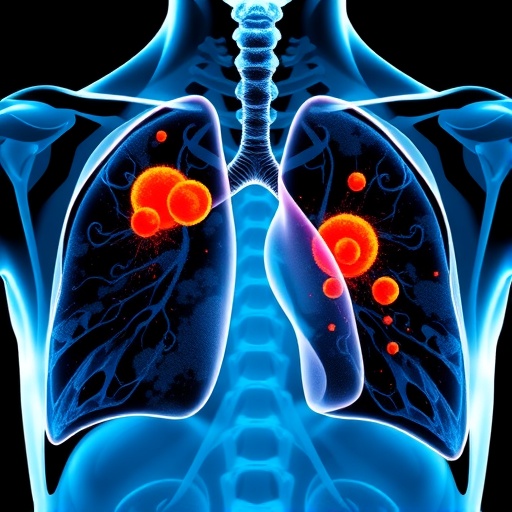
In the ongoing pursuit to optimize treatments for locally advanced non-small cell lung cancer (NSCLC), concurrent chemoradiotherapy (cCRT) has long stood as a cornerstone of therapeutic intervention. Despite its pivotal role in managing this aggressive malignancy, the nuances influencing the efficacy of cCRT remain inadequately explored, particularly the impact of tumor location within the thoracic cavity. A groundbreaking study published in the British Journal of Cancer now illuminates this critical dimension, offering new insights that could reshape approaches to personalized cancer therapy.
Concurrent chemoradiotherapy, a combination of chemotherapy and radiotherapy administered simultaneously, aims to enhance the cytotoxic effects on cancer cells while minimizing the probability of resistance. Its application in locally advanced NSCLC has been validated through numerous clinical trials, demonstrating significant improvements in survival rates compared to radiotherapy alone. However, the heterogeneous nature of lung tumors, especially regarding their anatomical positioning, introduces variability in treatment response that this latest investigation has meticulously examined.
The research led by Ozawa and colleagues undertook a comprehensive analysis of patient outcomes stratified by tumor location, revealing a striking correlation between the site of the primary tumor and the overall effectiveness of cCRT. Tumors situated in certain lung lobes exhibited differential radiosensitivity and chemotherapy responsiveness, suggesting that microenvironmental factors intrinsic to tumor positioning may influence therapeutic success. This revelation underscores the necessity for a more tailored approach to treatment planning, one that transcends the traditional one-size-fits-all methodology.
At the histopathological level, tumor location has been identified as a determinant of vascularization, hypoxia, and cellular heterogeneity—factors intricately linked to radiotherapy resistance. Tumors located in the upper lobes, for instance, were observed to have distinct oxygenation profiles compared to those in the lower lobes, impacting the generation of DNA-damaging free radicals during radiation exposure. Consequently, these microenvironmental disparities may partly explain the varying treatment outcomes documented in the study.
Furthermore, the study delves into the dynamics of chemotherapy drug distribution in the lung parenchyma, positing that anatomical differences could affect pharmacokinetics and drug delivery efficiency to the tumor site. This spatial variation introduces an additional layer of complexity, as chemotherapeutic agents may fail to reach optimal concentrations in certain lobar regions, thereby diminishing the synergy expected from concurrent treatment modalities.
Importantly, the researchers employed advanced imaging techniques and radiobiological modeling to quantify these phenomena, providing robust data to support their conclusions. Incorporating state-of-the-art positron emission tomography (PET) scans alongside computed tomography (CT) allowed precise mapping of tumor metabolic activity and volume, which were cross-referenced with clinical outcomes to validate the impact of tumor location on treatment efficacy.
This innovative approach opens avenues for integrating tumor site considerations into radiotherapy planning software, potentially enabling dose adjustments that compensate for anatomical and physiological challenges. Adaptive radiotherapy, guided by real-time imaging and tumor localization data, might enhance dose conformity and sparing of surrounding healthy tissues while intensifying treatment to resistant tumor zones.
Additionally, the investigation highlights the potential for molecular profiling of tumors based on their location within the lung. Given that the tumor microenvironment can influence gene expression and mutation patterns, location-dependent molecular signatures might emerge as biomarkers for predicting response to cCRT and selecting candidates for adjunct therapies such as immunotherapy or targeted agents.
In clinical practice, these findings urge oncologists to reevaluate conventional paradigms of lung cancer treatment by incorporating tumor location as a key variable in multidisciplinary discussions. Personalized therapeutic regimens might consider lobar involvement and adjacent anatomical structures to optimize both efficacy and safety, ultimately improving patient prognosis and quality of life.
Moreover, the study prompts further exploration into how respiratory mechanics and tumor motion during the breathing cycle affect radiotherapy delivery. Tumors in different lung regions experience variable displacement, influencing dose distribution and necessitating sophisticated motion management strategies to ensure persistent tumor targeting throughout treatment sessions.
The implications extend beyond NSCLC, as this research paradigm could be applied to other thoracic malignancies, enriching the understanding of how anatomical context shapes treatment response. Such insights spotlight the intricate interplay between tumor biology, physical location, and therapeutic intervention, reinforcing the value of a holistic view in cancer care.
As precision medicine continues to evolve, integrating spatial tumor characteristics with molecular and clinical data stands poised to revolutionize cancer treatment protocols. Future clinical trials designed with stratification by tumor location may yield more nuanced evidence, guiding the development of bespoke treatment algorithms that maximize efficacy and minimize adverse effects.
Ultimately, this study by Ozawa et al. marks a significant leap forward by delineating how an often-overlooked factor—tumor location—can decisively influence the success of concurrent chemoradiotherapy in locally advanced NSCLC. Harnessing these insights could translate into more intelligent and responsive treatment strategies, offering renewed hope for patients confronted with one of the deadliest forms of cancer.
In light of these findings, the oncology community faces a clarion call to integrate tumor anatomical context into future research and clinical practice. Whether through refining imaging modalities, enhancing drug delivery systems, or tailoring radiotherapy dosing, acknowledging the pivotal role of tumor location promises to uplift the therapeutic landscape for lung cancer patients worldwide.
As the field advances, collaborations across radiobiology, oncology, imaging sciences, and pharmacology will be essential to fully harness the potential revealed by this new understanding. Cross-disciplinary efforts could expedite the translation of these insights into clinical tools, sparking a paradigm shift toward treatment personalization that leverages both biological and spatial tumor attributes.
This study’s profound implications also raise intriguing questions regarding the underlying mechanisms driving the observed location-dependent variations. Delineating these pathways may uncover novel therapeutic targets or resistance mechanisms, further broadening the armamentarium against NSCLC.
Taken together, the evidence presented paints a compelling picture: tumor location is not merely a descriptive clinical feature but a critical determinant influencing concurrent chemoradiotherapy outcomes. Recognizing and exploiting this dimension could ultimately refine lung cancer management, improving survival rates and fostering innovation in cancer therapeutics.
Subject of Research: The impact of tumor location on the efficacy of concurrent chemoradiotherapy in locally advanced non-small cell lung cancer.
Article Title: Impact of tumor location on the efficacy of concurrent chemoradiotherapy for locally advanced non-small cell lung cancer.
Article References:
Ozawa, Y., Yamamoto, K., Sugawara, S. et al. Impact of tumor location on the efficacy of concurrent chemoradiotherapy for locally advanced non-small cell lung cancer. British Journal of Cancer (2026). https://doi.org/10.1038/s41416-026-03406-0
Image Credits: AI Generated
DOI: 09 April 2026
Tags: chemotherapy response variabilityconcurrent chemoradiotherapy efficacyimproving chemoradiotherapy outcomeslocally advanced NSCLC managementlung cancer survival rateslung cancer tumor lobesnon-small cell lung cancer treatmentpersonalized therapy in lung cancerradiosensitivity of lung tumorsthoracic cavity tumor positioningtumor anatomical influence on treatmenttumor location impact on chemoradiotherapy