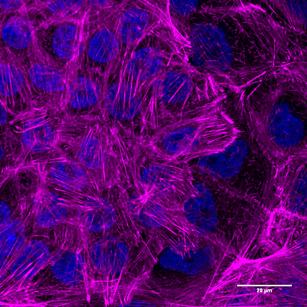
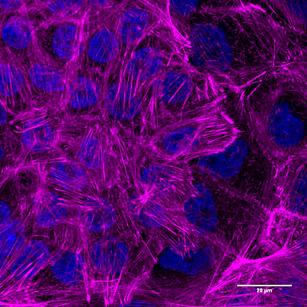
Credit: Sandra Tavares, IGC.
A study published now on Nature Communications* shows that breast cancer cells undergo a stiffening state prior to acquiring malignant features and becoming invasive. The discovery made by a research team led by Florence Janody, from Instituto Gulbenkian de Ciencia (IGC; Portugal), identifies a new signal in tumor cells that can be further explored when designing cancer-targeting therapies.
The progression of breast cancer disease takes several stages, from a benign lesion to an invasive carcinoma, possibly with metastasis. But actually, only 20 to 50% of benign tumors end up as invasive cancer. Predicting what lesions are within this group could result in a better use of therapeutics accordingly to the severity of the disease.
Florence Janody's group has been looking for signals inside the cells that could help predicting benign tumors that will progress to invasive carcinoma. Their attention focus on the cell skeleton – the cytoskeleton –, an intricate network of fibers that can either exert or resist forces, and that may have an impact on tumor invasion and malignancy. These fibers can be organized into distinct architectures to confer cells a more rigid or soft structure.
"Previously, it had been shown that cancer cell invasion requires cell softening. What we observed now is that prior to becoming invasive cells undergo a transient stiffening state caused by the accumulation of cytoskeleton fibers ", explains Sandra Tavares, first author of this study.
The research team discovered that cell stiffening induces the activity of proteins that promote cell proliferation, driving the growth of benign tumors. Most importantly, this cell rigidity state also triggers the subsequent progression into invasive cancer. The proteins involved in this mechanism were identified by studies on a human breast cell line, which recapitulates the multistep development of breast cancer, and biopsies of breast cancers. The importance of these proteins for the formation of tumors was further confirmed in the fruit fly.
Florence Janody says: "Our work adds an important piece to the intricate puzzle of breast tumor progression. Knowing what happens inside the cell before a cell becomes pre-invasive and acquires malignant features may help us predict, in the future, which tumors may result in metastasis. Also, it may help designing therapeutics better tailored for each type of lesion."
###
This study was conducted at the IGC in collaboration with the Instituto de Investigacao e Inovacao em Saude (i3S), Instituto de Patologia e Imunologia Molecular da Universidade do Porto (IPATIMUP), Faculty of Medicine of the University of Porto (Portugal), Biotechnology Center from the Technische Universitat Dresden (Germany), and Ophiomics – Precision Medicine (Portugal). Fundacao para a Ciencia e a Tecnologia, Liga Portuguesa contra o Cancro/Pfizer and Laco Grant in Breast Cancer 2015 funded this research.
*Tavares, S., Vieira, A.F., Taubenberger, A.V., Araujo, M., Martins, N.P.S., Bras-Pereira, C., Polonia, A., Herbig, M., Barreto, C., Otto, O., Cardoso, J., Pereira-Leal, J.B., Guck, J., Paredes, J., Janody, F. (2017) Actin stress fiber organization promotes cell stiffening and proliferation of pre-invasive breast cancer cells. Nature Communications. DOI: 10.1038/NCOMMS15237
Media Contact
Ana Mena
[email protected]
351-214-407-959
@IGCiencia
http://www.igc.gulbenkian.pt
Related Journal Article
http://dx.doi.org/10.1038/NCOMMS15237