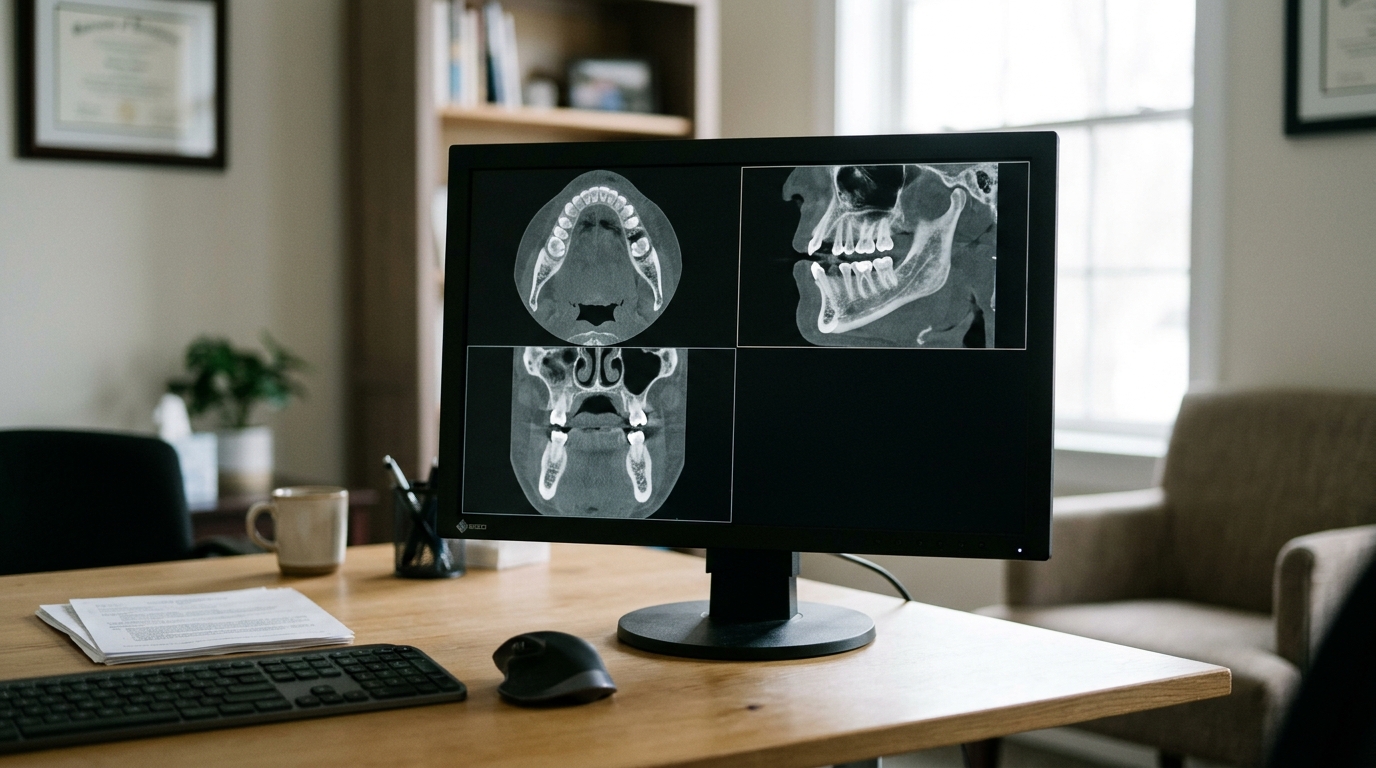
Dental clinicians and maxillofacial surgeons preparing complex interventions must obtain precise anatomical models of the oral cavity to prevent irreversible operative complications, particularly when working in close proximity to critical neural structures. Delineating the pathway of the inferior alveolar canal, which carries the inferior alveolar nerve, artery, and vein through the mandible, represents an indispensable prerequisite for dental implant placement, third molar extractions, and corrective jaw reconstructions. When surgical instruments inadvertently traumatize or sever this nerve branch, patients frequently suffer severe sequelae ranging from persistent hemorrhage and protracted neurogenic pain to permanent facial numbness or paralysis. While three-dimensional cone-beam computed tomography serves as the prevailing clinical standard for visual inspection due to its high spatial resolution and reduced radiation dose compared with conventional fan-beam computed tomography, manual tracing of the mandibular canal across hundreds of volumetric cross sections remains exceptionally labor-intensive. Skilled human annotators routinely require up to thirty minutes per patient scan to segment these delicate anatomical boundaries, an operational bottleneck compounded by substantial inter-annotator and intra-annotator variability that compromises surgical consistency across clinical dental workflows.
To overcome the operational throughput barriers and subjective inconsistencies inherent in manual anatomical tracing, researchers have developed an automated segmentation framework leveraging a triplanar ensemble of two-dimensional convolutional neural networks. The investigative team, building directly upon the self-configuring no-new-U-Net framework, engineered a deep learning pipeline designed to segment the inferior alveolar nerve from volumetric cone-beam computed tomography scans by extracting complementary spatial representations across three orthogonal planes. Rather than relying on computationally burdensome fully three-dimensional convolutional architectures or rigid statistical shape models that require separate segmentations of both mandibular bone and nerve pathways, the proposed methodology splits the primary three-dimensional volume into independent two-dimensional image slices oriented along the axial, coronal, and sagittal anatomical axes. By processing these planar projections through dedicated neural networks tailored to each anatomical vantage point, the system reconstructs the three-dimensional volume and harmonizes spatial boundaries through consensus voting, achieving an automated segmentation workflow designed to assist pre-surgical digital planning.
The mathematical and architectural construction of the triplanar ensemble relies on the heuristic optimization principles established by the no-new-U-Net architecture, which systematically adapts hyperparameter configurations based on empirical dataset characteristics. Each of the three independent models processes its assigned orthogonal plane using sequential blocks of standard two-dimensional convolutions, instance normalization, and leaky rectified linear unit activation functions. Feature down-sampling across successive network stages is executed through strided convolutions, whereas spatial up-sampling within the decoding pathway is conducted through transposed convolutions. Every planar model initiates feature extraction utilizing thirty-two kernels in its first layer, progressively doubling the feature map capacity at each down-sampling juncture until reaching an architectural ceiling of five12 feature channels. This structural rule generated seven distinct encoder stages for the axial and coronal networks, alongside six encoder stages for the sagittal network, with each individual stage incorporating two consecutive convolution-normalization-activation operational blocks.
Prior to network ingestion, input three-dimensional scans underwent standardized data preprocessing procedures to stabilize intensity values across distinct imaging acquisitions. The raw volumetric datasets were systematically decomposed into discrete two-dimensional slices across all three orthogonal orientations, after which voxel intensity values were clipped between the 0.5th and 99.5th percentiles to eliminate extreme peripheral artifacts. The researchers then implemented a Z-score-like intensity normalization protocol, utilizing the empirical mean and standard deviation calculated exclusively across the labeled foreground voxels representing the inferior alveolar nerve across the training instances. Model optimization was conducted over one hundred twenty epochs per planar architecture, with each training epoch defined as two hundred fifty iterations. The computational batch sizes were tailored to the slice dimensions of each axis, incorporating twenty-two slices for the axial plane, forty-four slices for the coronal plane, and forty-eight slices for the sagittal plane under stochastic gradient descent with a Nesterov momentum coefficient of 0.99.
Training progression was regulated using a poly-learning-rate decay policy initialized at an initial rate of 0.01, which systematically attenuated the optimization step size across training iterations according to the exponential factor of one minus the ratio of the current step to the total planned steps raised to the power of 0.9. Network loss was monitored using the composite default objective function of the no-new-U-Net framework, structured as an unweighted linear sum of the soft Dice loss and binary cross-entropy loss with equal weightings. The Dice loss component directly penalizes discrepancies in volumetric spatial overlap between the algorithmic prediction and the reference standard, whereas the binary cross-entropy formulation evaluates voxel-wise probabilistic alignment between predicted foreground likelihoods and empirical ground-truth label distributions across the image grid. To synthesize the final anatomical decision from the multi-view system, the researchers evaluated several spatial combination rules, confirming that majority voting among the reconstructed axial, coronal, and sagittal volume predictions marginally outperformed softmax probability averaging.
The empirical training and validation of the triplanar pipeline utilized data curated for the ToothFairy Challenge hosted during the twenty-sixth International Conference on Medical Image Computing and Computer Assisted Interventions in 2023. The foundational dataset, assembled by investigators at the University of Modena and Reggio Emilia, comprised one hundred forty-five cone-beam computed tomography scans furnished with dense ground-truth manual annotations. This cohort was partitioned into one hundred thirty scans reserved for algorithm training and fifteen scans set aside for preliminary algorithmic validation. To mitigate overfitting, the authors expanded the initial training pool through data augmentation techniques, applying horizontal axis reflections across all instances and introducing random Gaussian kernel blurring with standard deviations between one and two across twenty percent of the images. This augmentation yielded comprehensive training pools comprising 24,278 axial slices, 40,836 coronal slices, and 38,710 sagittal slices, enabling robust feature extraction across distinct mandibular cross sections.
When evaluated across the fifteen designated validation scans, the triplanar ensemble achieved a mean Dice similarity coefficient of 0.76 with a standard deviation of 0.09, alongside an average 95th percentile Hausdorff distance of 6.91 millimeters with a standard deviation of 8.93 millimeters. Individual case evaluations illustrated noticeable performance dispersion across diverse anatomical presentations, with the optimal validation scan reaching a Dice score of 0.87 and a tight boundary error of 1.41 millimeters, whereas the least successful validation case recorded a Dice score of 0.65 and an extensive Hausdorff boundary discrepancy of 24.37 millimeters. For independent external validation, the researchers packaged their algorithmic pipeline into a standardized Docker container and submitted it to the official ToothFairy Challenge testing platform, where it was blind-tested against a non-public benchmark of fifty independent cone-beam computed tomography scans.
On the competitive evaluation test cohort of fifty independent scans, the triplanar convolutional ensemble attained an overall mean Dice similarity coefficient of 0.66 with a standard deviation of 0.14, accompanied by a mean 95th percentile Hausdorff distance of 8.63 millimeters. In the official challenge rankings, the team secured fourteenth position when assessed by the spatial overlap metric of the Dice similarity coefficient, yet achieved third place overall in boundary precision as quantified by the 95th percentile Hausdorff distance. This conspicuous divergence between the two evaluation metrics provided critical insight into the structural characteristics of the algorithmic predictions, indicating that while the model localized the peripheral trajectory of the inferior alveolar nerve with high geometric proximity to true anatomical boundaries, it exhibited local volumetric omissions that reduced the relative overlap score.
Qualitative inspection of three-dimensional reconstructions confirmed that the primary operational vulnerability of the triplanar architecture stemmed from structural discontinuities along the longitudinal course of the nerve canal. Because the triplanar formulation decomposes three-dimensional space into independent two-dimensional planar slices, the network models operate under an inherent inductive bias that deprives them of contextual continuity across adjacent parallel planes. Consequently, each slice is segmented in relative isolation, leaving the network vulnerable to localized image artifacts where anatomical boundaries become obscured. This limitation manifested acutely in areas where tooth roots directly bordered or indented the mandibular canal, producing hypointense acoustic regions that interrupted the continuous visibility of the nerve sheath. Lacking explicit three-dimensional spatial awareness, the planar convolutional models frequently failed to bridge these localized signal voids, fragmenting the predicted nerve into disjointed segments despite accurate regional localization.
The study also revealed a pronounced generalization challenge caused by cross-institutional imaging variations, as reflected by the drop from a validation Dice score of 0.76 to a test score of 0.66 across datasets acquired on different imaging hardware. In addressing these findings, the authors observed that top-performing challenge competitors mitigated scanner-induced domain shifts by enforcing strict intensity windowing between minus one hundred and nine hundred Hounsfield units and employing extensive test-time data augmentations. To rectify anatomical fragmentation, the authors highlighted potential methodological pathways borrowed from tubular structure segmentation in cardiovascular imaging, including topology-preserving loss functions calculated on skeletonized segmentations and regularized walk algorithms that reconnect disconnected segments via centerline probability tracking and vector cosine directional constraints. These structural insights delineate clear engineering trajectories for refining automated deep learning tools prior to widespread integration into clinical dental workflows.
Subject of Research: Deep learning triplanar ensemble segmentation of the inferior alveolar nerve in dental cone-beam computed tomography
Article Title: A triplanar 2D convolutional network ensemble for infra-alveolar nerve segmentation
Article References: Caselles-Ballester, V., Piedra, W., Casas-Roma, J., Burgos-Artizzu, X. P., & Prados, F. (2024). A triplanar 2D convolutional network ensemble for infra-alveolar nerve segmentation. Discover Imaging, 1(1), Article 3. https://doi.org/10.1007/s44352-024-00003-w
Image Credits: AI Generated
DOI: 10.1007/s44352-024-00003-w
Keywords: Cone-Beam Computed Tomography, Deep Learning, Neural Network Ensemble, Inferior Alveolar Nerve, Image Segmentation, nnU-Net, Digital Dentistry, MICCAI ToothFairy Challenge, triplanar, convolutional, network, ensemble
News Source: Blake Davidson. (November 13, 2026). Triplanar Convolutional Network Ensemble Improves Mandibular Nerve Segmentation in Dental Scans. Scienmag.