A three-arm randomized trial will test whether combining scalp acupuncture with transcutaneous auricular vagus nerve stimulation at the same time produces different cognitive and neurophysiological outcomes from delivering the two treatments in sequence among adults with post-stroke cognitive impairment. The prospective, open-label, single-center study at the Affiliated Hospital of Shandong University of Traditional Chinese Medicine in Jinan, China, plans to enroll 96 patients and assign 32 to each of three groups. The protocol is designed to investigate treatment timing rather than test whether the combination is effective: all participants will receive both interventions, conventional care, neurological rehabilitation and standardized cognitive training. It is also designed to explore whether the timing of the two interventions is associated with changes across several biological measurement systems, rather than to produce a clinical prediction tool or establish a mechanism.
Participants will be adults aged 30 to 80 who have experienced their first stroke, are between one and six months after onset, have Chinese as their native language and can cooperate with treatment and assessment. Stroke must be confirmed by computed tomography or magnetic resonance imaging and meet Chinese diagnostic criteria for cerebral infarction or hemorrhage. Cognitive impairment will be established under a 2021 expert consensus and confirmed with the Montreal Cognitive Assessment and Mini-Mental State Examination, with thresholds adjusted for education. The MoCA threshold is below 26 points, with one additional point for people with 12 years or fewer of education, while MMSE cutoffs vary by educational level. People with unstable vital signs, severe aphasia, significant visual or hearing impairment, serious carotid disease, implanted devices, certain bleeding or neurological disorders, or pre-existing neurodegenerative cognitive disease will be excluded.
All three groups will follow the same treatment schedule: interventions once daily, five days per week, for four weeks. The synchronous group will receive scalp acupuncture while taVNS is applied during the needle-retention period. Control Group 1 will receive scalp acupuncture first and taVNS afterward, while Control Group 2 will receive taVNS before scalp acupuncture. The two sequential groups will have at least three hours between treatments. Conventional care will include management of blood pressure, blood glucose, lipids and atherosclerotic plaques, as well as therapeutic exercise, occupational therapy, physical-agent modalities and 30-minute sessions of individualized cognitive training. Because all three groups receive both active treatments, the design can compare the temporal sequence of delivery but cannot determine whether the combination is better than either intervention alone.
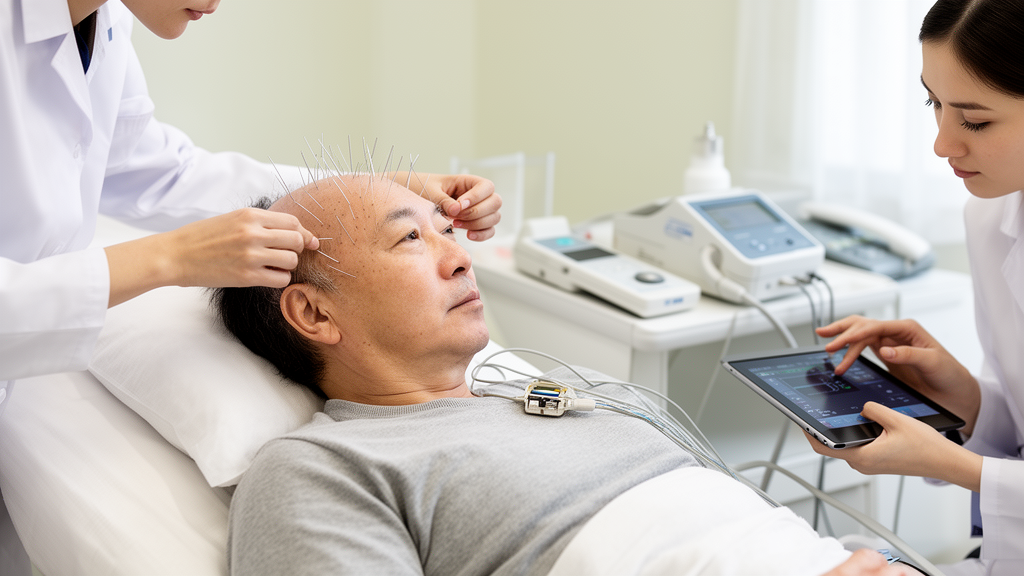
For taVNS, a single electrode will be placed in the left auricular concha, an area supplied by the auricular branch of the vagus nerve. Stimulation will be continuous at 25 Hz, with a pulse width of 200 microseconds and a current amplitude of 1.0 to 5.0 milliamperes adjusted daily to just below the participant’s pain threshold. Each session will last 30 minutes. Scalp acupuncture will target Baihui, Shenting and Sishencong. Disposable needles measuring 0.35 by 40 millimeters will be inserted obliquely at 15 to 30 degrees to a depth of 20 to 25 millimeters, reaching the subgaleal space. The needles will remain in place for 30 minutes, with two minutes of twirling every 10 minutes at 150 twists per minute. The acupuncture sensation known as de qi, described in the protocol as soreness, numbness, distension or heaviness, will be sought and recorded. A dedicated team of certified acupuncturists and rehabilitation therapists will provide the treatments, and an independent monitor will randomly check about 10% of sessions for adherence.
The primary outcome will be the change in MoCA score between baseline and the end of treatment at week 4. The MoCA covers visuospatial skills, executive function, memory, language, attention and concentration, calculation, abstract thinking and orientation, with a maximum score of 30. To reduce practice effects from repeated testing, alternate validated equivalent Chinese versions will be used at the assessment time points. Secondary outcomes include the MMSE for global cognitive status and the Modified Barthel Index for activities of daily living. The Barthel Index measures bowel and bladder control, dressing, toileting, feeding, bathing, grooming, transfers, walking and stair climbing; higher scores indicate greater independence. Assessments will occur before treatment, at the end of the four-week intervention period and at an eight-week follow-up, allowing the protocol to capture both short-term change and a short post-treatment observation period.
Alongside behavioral scales, the study will collect resting-state functional magnetic resonance imaging, auditory event-related potentials and transcranial Doppler ultrasonography. Resting-state fMRI will examine functional connectivity, amplitude of low-frequency fluctuation and regional homogeneity, providing exploratory measures of brain-network activity. Event-related potentials will record the P300 component during a target-tone counting task, with amplitude and latency extracted from a predefined 250-to-500-millisecond window. The protocol will require at least 30 valid target trials after artifact rejection and will maintain electrode impedance below 5 kilohms. Transcranial Doppler ultrasound will measure systolic, end-diastolic and mean flow velocities in the bilateral middle cerebral arteries. The researchers describe these imaging, electrophysiological and hemodynamic measures as exploratory mechanistic endpoints, whereas the trial is powered specifically for the clinical MoCA comparison.
The statistical plan will use mixed-effects models for repeated measurements as the primary confirmatory analysis, following the intention-to-treat principle. Models will include group, time and their interaction as fixed effects, with baseline MoCA score as a covariate. The principal contrasts are adjusted differences at week 4 between the synchronous group and each sequential group, with Holm correction for the two comparisons. The likelihood-based model will handle incomplete data under a missing-at-random assumption, while multiple imputation by chained equations will be used as a sensitivity analysis. Baseline neurological severity and affected hemisphere will also be examined in additional sensitivity analyses. The sample-size calculation was based on an expected MoCA change of 4.9 points in the synchronous group and 1.5 points in each sequential group, a difference of 3.4 points; the trial is planned for 32 participants per group to retain at least 29 completers per group after an assumed 10% attrition rate. These figures are hypotheses for powering the study, not observed treatment effects.
Multimodal machine learning will be used only for hypothesis generation. After normalizing the MoCA and MMSE scores, investigators plan to build an initial pool of roughly 250 candidate features derived principally from regional fMRI measures, P300 parameters and cerebral blood-flow velocities. Support vector machine and random forest models will use the magnitude of cognitive improvement as the prediction target. To reduce the risk of overfitting in a cohort of 96, the complete analytical pipeline will be nested within five-fold cross-validation. Missing-value models will be fitted only on training folds, principal component analysis and recursive feature elimination will remain inside those folds, and hyperparameter tuning will occur exclusively in inner loops. Performance will be evaluated in held-out outer folds using root mean square error and mean absolute error. The authors explicitly state that the machine-learning component is not intended to produce a deployable or fully generalizable clinical prediction system.
Several design limitations could constrain the conclusions. The trial is open-label, and the distinctive nature of acupuncture and electrical stimulation makes participant and practitioner blinding impossible, leaving potential expectation effects despite blinded outcome assessors, imaging staff and statisticians. Recruitment from one hospital and a relatively homogeneous Chinese-speaking population may limit generalizability. The absence of a sham or single-intervention group prevents the trial from separating the effects of combination, the physiological action of each treatment and natural recovery after stroke. Four weeks of treatment also cannot establish long-term benefit, and the multimodal model will need validation in larger, multicenter cohorts. Safety will nevertheless be monitored closely: potential acupuncture events include syncope, hematoma, a stuck or broken needle and subcutaneous bleeding, while taVNS may cause skin irritation, headache or bradycardia. Serious events will be reported immediately to the ethics committee, and affected participants will be withdrawn. The study was approved by the hospital’s ethics committee and prospectively registered with the Chinese Clinical Trial Registry, but its clinical and mechanistic benefits remain untested until the planned outcomes are reported.
Subject of Research: A randomized trial protocol comparing concurrent and sequential neuromodulation timing for post-stroke cognitive impairment.
Article Title: Effects of synchronous versus sequential scalp acupuncture and transcutaneous auricular vagus nerve stimulation on post-stroke cognitive impairment based on multimodal assessments: a single-center randomized controlled trial protocol
Article References: Wei, J., Liu, X., Pan, Z., Wei, C., Wang, R., Wang, X., & Ma, S. (2026). Effects of synchronous versus sequential scalp acupuncture and transcutaneous auricular vagus nerve stimulation on post-stroke cognitive impairment based on multimodal assessments: a single-center randomized controlled trial protocol. Frontiers in Neurology, 17, Article 1931213. https://doi.org/10.3389/fneur.2026.1931213
Image Credits: AI Generated
DOI: 10.3389/fneur.2026.1931213
Keywords: post-stroke cognitive impairment, scalp acupuncture, auricular vagus nerve stimulation, neuromodulation, randomized controlled trial, resting-state fMRI, event-related potentials, cerebral blood flow, multimodal data, Effects, synchronous, versus
News Source: Cassandra Pierce. (October 20, 2026). Trial will test timing of acupuncture and vagus nerve stimulation after stroke. Scienmag.