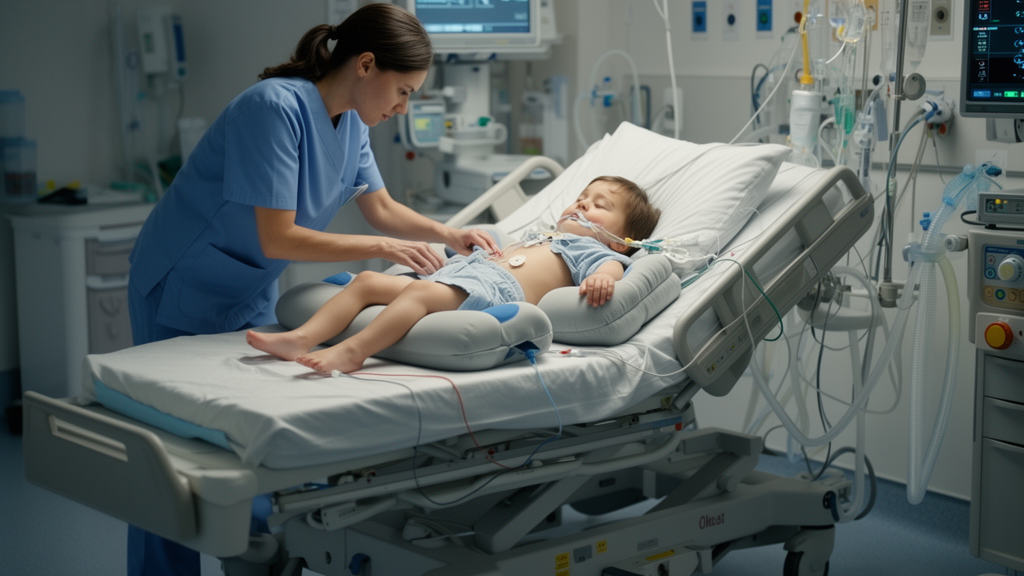
A randomized controlled trial of mechanically ventilated children recovering from congenital heart disease surgery found that oxygenation improved over time at all three tested head-elevated prone-positioning angles, while the angles differed in respiratory mechanics, enteral nutrition tolerance and complications. The 10-degree group showed the greatest early improvement in oxygenation, the 30-degree group had the most favorable overall results for lung compliance, airway resistance and respiratory rate, and the 45-degree group produced the greatest reduction in gastric residual volume but had more pressure-injury events. The researchers randomly assigned 102 children after congenital heart disease surgery to prone positioning at 10, 30 or 45 degrees.
Ninety-eight children completed the protocol and were analyzed. The oxygenation results did not identify one angle as consistently superior across every outcome. The 10-degree position produced the largest early improvement in the PaO₂/FiO₂ ratio, but the 30-degree group recorded the strongest combined performance across the trial’s three respiratory-mechanics measures.
The supplied abstract does not provide exact effect sizes, confidence intervals or between-group p-values, so the numerical magnitude and statistical precision of the differences cannot be assessed from the reported summary. It also does not specify the timing of the respiratory-mechanics advantage beyond describing the 30-degree group’s overall performance, so the findings should not be characterized as a later effect. Nutrition tolerance and safety added other dimensions to the comparison.
The 45-degree group had the largest reduction in gastric residual volume, a secondary measure assessed in relation to tolerance of enteral feeding, but it also experienced more pressure injuries. The 30-degree group combined the most favorable respiratory-mechanics findings with the trial authors’ assessment that it represented a reasonable option when respiratory function, enteral nutrition tolerance and safety were considered together. This was an interpretation of the combined benefit-risk profiles rather than evidence that the 30-degree position improved every postoperative outcome.
Although hemodynamic parameters were included among the secondary outcomes, the abstract does not report the direction or magnitude of changes in those measurements or provide the full range of complications observed. Based on the trial’s findings, the authors concluded that a 30-degree head-elevated prone position may be a reasonable intervention for mechanically ventilated children after congenital heart disease surgery. They also described the approach as a possible strategy for nurse-led prone positioning in the cardiac intensive care unit, where standardized practice may support safer postoperative recovery.
Those statements remain implications of the reported trial rather than proof of universal benefit. The study compared three angles in a defined population of pediatric postoperative patients, and the supplied evidence does not establish whether the same pattern would occur at other degrees, in other postoperative populations or under different protocols. The practical takeaway is therefore comparative rather than categorical: 30 degrees produced the strongest overall respiratory-mechanics results in this trial, 10 degrees led early oxygenation improvement, and 45 degrees yielded the greatest reduction in gastric residual volume alongside more pressure-injury events.
Subject of Research: Effects of prone-positioning angles on cardiopulmonary and safety outcomes after pediatric congenital heart surgery
Article Title: The effects of different prone positioning angles on cardiopulmonary function in children after congenital heart disease surgery: a randomized controlled trial
Article References: Huang, X., Han, J., Wang, Y., Huang, J., Hou, Z., Wang, S., Qiu, H., Jing, X., & Yan, F. (2026). The effects of different prone positioning angles on cardiopulmonary function in children after congenital heart disease surgery: a randomized controlled trial. BMC Pediatrics. https://doi.org/10.1186/s12887-026-07570-3
Image Credits: AI Generated
DOI: 10.1186/s12887-026-07570-3
Keywords: pediatric heart surgery, prone positioning, oxygenation, respiratory mechanics, enteral nutrition, pressure injuries, randomized controlled trial, cardiac intensive care, effects, different, prone, positioning
News Source: Ophelia Keating. (October 24, 2026). Trial compares prone positioning angles after pediatric heart surgery. Scienmag.