Biochemical engineers evaluating renewable agro-industrial residues have demonstrated that cellulosic matrices derived from sugarcane bagasse can serve as effective platforms for the oriented immobilization of recombinant enzymes tagged with a cellulose-binding domain. In a study published in Bioprocess and Biosystems Engineering, researchers developed both particulate and spherical cellulosic supports from raw sugarcane bagasse using alkaline and sequential acid-alkaline chemical hydrolyses. Using a recombinant beta-galactosidase fused to a cellulose-binding domain as a model biocatalyst, the team found that sequential chemical processing selectively eliminated non-cellulosic constituents, producing a highly purified cellulosic material. When crude bacterial extracts were incubated directly with this sequential particulate support at an enzyme loading of ten units per gram, the resulting biocatalytic derivative achieved an immobilization efficiency of approximately one hundred and sixty percent and a recovered enzymatic activity exceeding one hundred and fifteen percent. This marked increase in catalytic turnover relative to initial soluble activity demonstrates that residue-derived cellulosic matrices can induce enzymatic hyperactivation without requiring prior chromatographic purification.
Industrial bioprocesses reliant on enzymatic catalysis offer environmentally sustainable routes to high-value goods, but the widespread commercial application of free enzymes remains constrained by prohibitive production expenses, operational vulnerability, and an inability to recover the biocatalyst after reaction cycles. Recombinant DNA technology permits the heterologous production of customized enzymes, yet downstream purification represents a substantial proportion of overall operational expenditure. Enzymatic immobilization offers a established pathway to address operational stability and facilitate catalyst reuse, but conventional techniques such as random physical adsorption or covalent cross-linking frequently disrupt the functional configuration of proteins. These unguided methods can partially occlude the active site or induce detrimental conformational alterations that diminish catalytic throughput. In contrast, oriented immobilization guides the attachment of the protein through an affinity tag, thereby directing the catalytic center toward the surrounding solvent. By engineering enzymes with a cellulose-binding domain, researchers can exploit the natural affinity of the peptide tag for cellulosic matrices, potentially isolating and immobilizing the target enzyme directly from crude lysates in a single step.
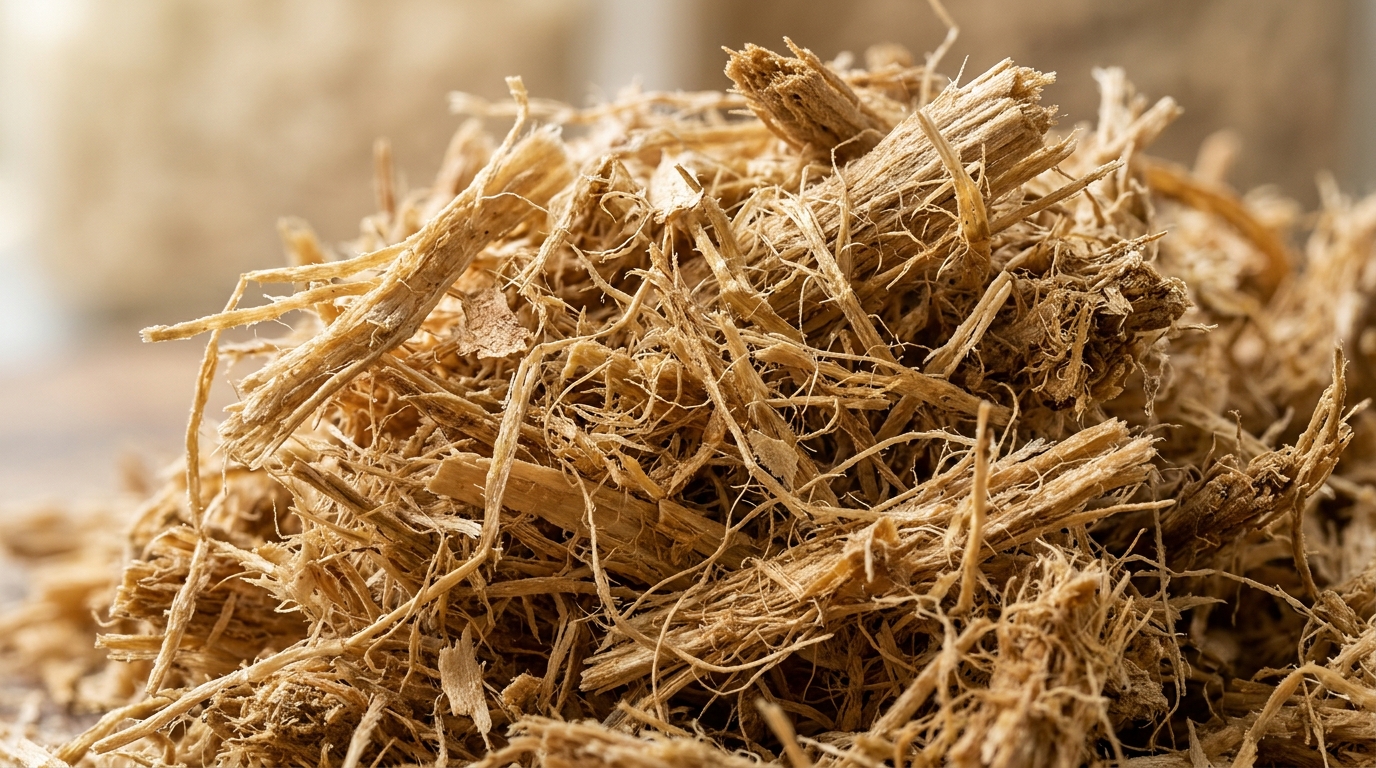
The choice of solid carrier strongly dictates the technical and economic success of oriented immobilization, driving interest in abundant lignocellulosic agro-industrial residues as sustainable carrier materials. Sugarcane processing yields massive volumes of lignocellulosic byproduct, generating approximately two hundred and eighty kilograms of bagasse for every metric ton of crushed sugarcane. While sugar and ethanol mills routinely burn a portion of this residual fibrous material to generate operational heat and electrical power, substantial surpluses persist as an underutilized biomass stream. However, native bagasse cannot be directly deployed as an efficient cellulose-binding matrix due to its recalcitrant heteropolymer architecture. The intricate presence of lignin and hemicellulose forms a dense structural barrier that physically shields internal cellulose microfibrils, preventing tagged recombinant enzymes from interacting freely with specific binding sites. Overcoming this barrier requires chemical fractionation protocols that selectively degrade and solubilize protective matrix polymers while leaving the primary cellulose scaffold accessible for subsequent peptide interactions.
To evaluate the effect of fractionation severity on carrier properties, the researchers prepared three distinct bagasse powder materials: untreated bagasse, bagasse subjected to alkaline hydrolysis with fifteen percent sodium hydroxide at ninety degrees Celsius, and bagasse subjected to sequential acid hydrolysis with dilute hydrochloric acid followed by alkaline saponification. Quantitative compositional testing demonstrated that processing intensity progressively enriched the relative cellulose content, culminating in a 2.4-fold increase from the raw residue to the sequentially treated material, which attained a final cellulose purity of 71.50 percent. Concurrently, lignin content dropped significantly from native levels, showing a 1.65-fold decrease after basic hydrolysis alone and a 2.3-fold decrease following the sequential protocol. The combined chemical regimen successfully removed approximately fifty-seven percent of initial lignin and fifty-three percent of hemicelluloses. Furthermore, initial hydrothermal washings and subsequent treatments extracted water-soluble and lipophilic compounds, lowering extractive impurities from 6.43 percent down to 0.32 percent and cutting inorganic ash content from 2.30 percent to 0.47 percent through extensive leaching.
Structural and physical analyses verified that chemical pretreatments exposed the internal cellulosic fibrils while preserving beneficial amorphous domains. Fourier-transform infrared spectroscopy revealed a progressive attenuation of absorption bands at 1730 reciprocal centimeters, associated with hemicellulose acetyl carbonyl vibrations, as well as reductions at 1510 and 1238 reciprocal centimeters corresponding to aromatic lignin structures. Conversely, the carbohydrate band at 897 reciprocal centimeters grew in relative prominence, and the overall spectral profile of sequentially processed bagasse achieved an 87.6 percent match with high-purity microcrystalline cellulose reference standards. Differential scanning calorimetry profiles confirmed the removal of low-temperature water sorption events and intermediate hemicellulose degradation peaks, concentrating thermal degradation into a main decomposition event near 358.90 degrees Celsius with an elevated enthalpy of 292.11 joules per gram. Colorimetric assessments demonstrated elevated lightness in the sequentially treated material, while scanning electron microscopy exposed severe morphological disruption, surface defibrillation, and exposed microfibrils that sharply contrasted with the smooth, compact architecture of untreated fiber bundles.
Oriented immobilization assays carried out with crude bacterial lysates expressing Kluyveromyces beta-galactosidase fused to a Clostridium cellulovorans cellulose-binding domain established a direct quantitative link between substrate purity and catalytic retention. On particulate supports, immobilization yield increased alongside chemical treatment intensity, confirming that progressive delignification exposed abundant binding sites for the affinity tag. At an initial loading of ten units per gram of support, the sequentially pretreated bagasse achieved an immobilization yield of 72.82 percent, an immobilization efficiency of 158.11 percent, and a net recovered activity of 115.13 percent. This hyperactivation indicates that oriented attachment through the cellulose-binding domain aligned active sites favorably, minimizing steric hindrance and promoting catalytic conformations. However, increasing enzyme loading to thirty units per gram reduced immobilization efficiency across all supports. At higher protein concentrations, steric overcrowding and binding site saturation caused molecules to interact non-specifically with the matrix, restricting substrate diffusion to active pockets and eliminating differences between supports.
To broaden reactor application options, the investigators encapsulated bagasse particles within calcium alginate hydrogel beads via extrusion-based ionic gelation, creating spherical composite biocatalysts designated as WT-Sph, L-Sph, and LH-Sph alongside a plain alginate control. The control alginate beads lacking cellulosic material exhibited the lowest immobilization values across most conditions, confirming that binding was driven by specific affinity interactions with embedded bagasse fibers rather than unguided physical entrapment within the hydrogel. Peak performance for composite beads occurred at three hours with one unit per bead, although spherical matrices displayed lower recovered activity than bare powder supports. This reduction was primarily attributed to mass transfer limitations, as the external polymeric hydrogel network hindered the intraparticle diffusion of substrate toward entrapped enzyme sites.
While the experimental outcomes validate the efficacy of bagasse-derived supports, the researchers emphasized important methodological and physical constraints when contextualizing their findings against existing literature. Previous work immobilizing the identical recombinant enzyme onto commercial microcrystalline cellulose yielded an efficiency of 103.31 percent and a recovered activity of 78.51 percent, but that benchmark study employed an enzyme loading tenfold higher than the ten units per gram tested here. The authors acknowledged that omitting an identical microcrystalline cellulose control tested under equivalent low-loading conditions prevents definitive separation of bagasse-specific structural effects from standard cellulose behavior. Furthermore, while the severe chemical fractionation of sequential acid and alkaline processing proved highly successful for exposing binding microfibrils, extensive delignification degrades the structural matrix of natural biomass. This profound polymer removal creates porous, delaminated fibers that may suffer from reduced mechanical integrity and elevated susceptibility to attrition or erosion when subjected to continuous hydrodynamic shear inside industrial bioreactors.
To assess commercial scale-up prospects, the study modeled the theoretical economic feasibility of deploying the particulate sequentially pretreated biocatalyst within a seventy-five cubic meter per month industrial plant producing low-lactose milk using a rotating basket reactor. Total capital expenditure was estimated at approximately 215,000 United States dollars, driven predominantly by boiler installations, centrifuges, and solar energy generation systems. Operating expenditure calculations indicated that raw milk purchases represented over half of all monthly expenses, whereas the sodium hydroxide and hydrochloric acid required to prepare the bagasse carrier accounted for less than 0.5 percent of operating costs under a baseline forty-cycle reuse scenario. Because the empirical investigation focused on carrier characterization and single-step immobilization, operational catalyst reusability was not evaluated experimentally in the laboratory. Instead, the authors evaluated theoretical operational horizons of forty, twenty, ten, and five sequential reuse cycles to determine how catalyst longevity influenced overall financial performance.
Financial modeling across a ten-year operational horizon projected positive net present values and internal rates of return exceeding the adopted fifteen percent minimum attractive rate of return for all evaluated scenarios. Under the theoretical forty-cycle scenario, projected net present value reached 577,979.94 dollars with an internal rate of return of 73.09 percent and a discounted payback period of 1.65 years, declining to 260,436.97 dollars, 42.77 percent, and 2.98 years under the five-cycle scenario. Sensitivity analyses revealed that plant profitability was most vulnerable to fluctuations in retail revenue, followed by operating expenses, while capital expenditure variations exerted minimal influence. The researchers concluded that although sugarcane bagasse matrices present viable economic prospects for low-lactose dairy processing, future investigations must experimentally determine real multi-cycle operational stability, measure mechanical erosion under reactor shear, assess support toxicity for food contact, and compare tagged enzymes directly against wild-type constructs lacking affinity tags.
Subject of Research: Cellulosic supports from sugarcane bagasse for oriented recombinant enzyme immobilization
Article Title: Particulate and spherical cellulosic supports derived from sugarcane bagasse for oriented immobilization of recombinant CBD-tagged enzymes
Article References: Leonhardt, F., Kuhn, D., Schwingel Henn, G., de Andrade, B. C., Gennari, A., de Moraes Pedroso, A. C., Führ, A. J., Gregory, A. M., Renard, G., Chies, J. M., Volpato, G., & Volken de Souza, C. F. (2026). Particulate and spherical cellulosic supports derived from sugarcane bagasse for oriented immobilization of recombinant CBD-tagged enzymes. Bioprocess and Biosystems Engineering. https://doi.org/10.1007/s00449-026-03450-3
Image Credits: AI Generated
DOI: 10.1007/s00449-026-03450-3
Keywords: sugarcane bagasse, enzyme immobilization, oriented immobilization, cellulose-binding domain, beta-galactosidase, enzymatic hyperactivation, bioprocess engineering, lignocellulosic biomass, alkaline hydrolysis, acid hydrolysis, calcium alginate beads, ionic gelation, low-lactose milk, economic feasibility, biocatalysis, value stream mapping, recombinant enzymes
News Source: Denise Maddox. (November 22, 2026). Treated Sugarcane Bagasse Supports Trigger Hyperactivation in Recombinant Oriented Enzymes. Scienmag.