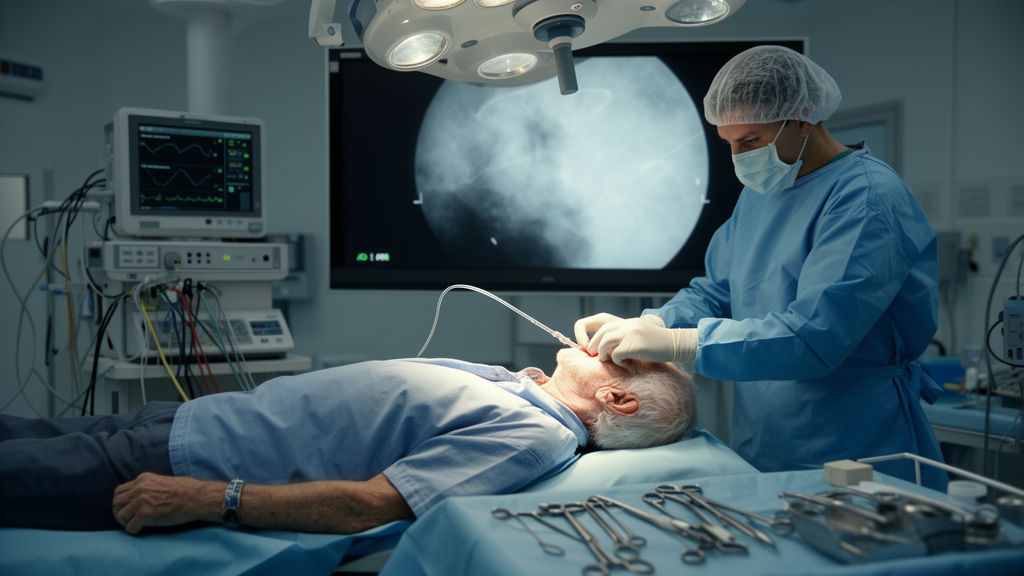
A pacemaker the size of a small capsule has been implanted in a 97-year-old man through a vein in his neck, after his severely curved spine and twisted leg veins made every standard implantation route impossible. The case, published in Frontiers in Cardiovascular Medicine, describes how a team of Chinese cardiologists delivered a leadless pacemaker to the man’s heart while he lay on his side — a position never before documented for this procedure — and sent him home three days later with a device projected to last more than fourteen years.
The patient arrived at Sichuan Provincial People’s Hospital in Chengdu in July 2025 with two years of worsening breathlessness. Routine activities such as walking ten to twenty meters triggered symptoms that resolved only after five to ten minutes of rest. His medical history read like a catalog of geriatric fragility: hypertension, atrial fibrillation, chronic obstructive pulmonary disease, osteoporosis, kidney disease, and gallstones. At 150 centimeters tall and 40 kilograms, his body mass index of 17.7 placed him in the severely underweight category, and a frailty assessment scored 3 out of 5, indicating moderate-to-severe frailty. He needed a wheelchair, and his kyphosis — an exaggerated forward curvature of the thoracic spine — was so pronounced that he could not lie flat on his back at all.
The electrical problem at the heart of his symptoms was equally serious. An electrocardiogram revealed atrial flutter with a ventricular rate of just 37 beats per minute, and twenty-four-hour Holter monitoring confirmed intermittent high-degree atrioventricular block, with pauses between heartbeats exceeding two seconds. In simple terms, the signals from his atria were failing to reach his ventricles, leaving his heart to beat at a dangerously slow rate. Without a pacemaker, he faced recurrent symptoms and the risk of syncope or cardiac arrest. With one, he faced a different problem: getting the device into his heart safely.
Conventional pacemaker implantation relies on two main routes, and both were closed to this patient. The traditional approach involves threading leads through the subclavian vein beneath the collarbone and placing a generator in a pocket under the chest skin — but that requires the patient to lie supine, which his spine deformity made impossible. His profound underweight status and frailty would also have sharply increased the risk of pocket infection and hematoma. The modern alternative, a leadless pacemaker delivered through the femoral vein in the groin, was ruled out for a different reason: duplex ultrasonography showed marked bilateral femoral vein tortuosity, with twisted, irregular vessels that posed an unacceptably high risk of vascular injury, venous dissection, or suboptimal device positioning.
After a multidisciplinary conference involving cardiac electrophysiologists, radiologists, anesthesiologists, and geriatric specialists, the team selected a third route: the right internal jugular vein in the neck. Preprocedural ultrasonography confirmed the vessel was patent, and computed tomography analysis showed it offered a relatively short and straight trajectory to the right ventricle when the patient was positioned on his left side. The team used FluoCT software to simulate catheter paths from multiple potential access sites, effectively building a patient-specific vascular roadmap before the procedure began. This anticipatory, anatomy-based planning represented a deliberate shift from choosing an alternative route out of necessity to selecting the safest path based on predicted ease of navigation.
The intervention took place on 26 August 2025 under local anesthesia. Because the patient could tolerate only the left lateral decubitus position, the entire procedure was performed with him lying on his side — a constraint that forced a fundamental recalibration of standard fluoroscopic imaging. Conventional right and left anterior oblique projections are based on supine anatomy, so the team derived patient-specific angles of 20 and 80 degrees from preprocedural CT reconstructions, approximating functional equivalents of the standard views while compensating for the axial rotation of his body. As a safety measure, a temporary pacing lead was first placed through the right femoral vein, a step completed in roughly fifteen minutes that provided backup pacing and further confirmed the impracticality of that route for permanent delivery.
Ultrasound-guided cannulation of the neck vein was followed by insertion of a 6-French introducer sheath, which was progressively dilated to accommodate a 27-French delivery sheath advanced smoothly into the superior vena cava. The delivery catheter for an Abbott Aveir ventricular response leadless pacemaker was then introduced, activated by telemetry while still in the vena cava, and advanced across the tricuspid valve into the right ventricle. Clockwise rotation facilitated passage through the valve, while counterclockwise rotation directed the catheter toward the low septal region of the ventricular wall. Right ventricular angiography in both oblique projections confirmed appropriate placement, and intracardiac mapping demonstrated a steep QRS slope, an S wave above the baseline, and 3 millivolts of ST-segment elevation — findings consistent with optimal myocardial contact.
Fixation was achieved by slow clockwise rotation of the delivery system at approximately one click per second, completing 1.25 cycles, with electrical testing at intermediate rotations confirming persistent QRS widening and stable ST elevation. A wobble test verified secure fixation before the pacemaker was released by counterclockwise rotation of the release mechanism. Final device parameters were excellent: a sensing amplitude of 8.5 millivolts, a pacing threshold of 0.5 volts at 0.4 milliseconds, and an impedance of 510 ohms. The entire procedure lasted 72 minutes with no perioperative complications — no vascular injury, bleeding, cardiac tamponade, or device malposition. The neck sheath was removed with ten minutes of manual compression, and the patient was monitored in the cardiac intensive care unit for 24 hours before discharge on the third day.
Follow-up evaluations at one week, one month, and four months showed stable device performance and meaningful clinical improvement. The exertional dyspnea that had limited him for two years resolved, and his New York Heart Association functional class advanced from III to II. Device interrogation at four months demonstrated a sensing amplitude of 8.7 millivolts, a pulse amplitude of 2.0 volts, and a pulse width of 0.4 milliseconds, with an estimated device longevity of 14.4 years. Chest radiography confirmed stable device position without migration, and renal function showed no significant change from baseline despite the contrast exposure. Kansas City Cardiomyopathy Questionnaire scores rose from 18 points preoperatively to 26 points at four months, indicating improved health-related quality of life, although the patient remained unable to walk independently and could not complete a six-minute walk test.
The authors emphasize that this specific combination — severe skeletal deformity precluding any supine positioning, use of the internal jugular vein as the access route, and completion of the entire procedure in the lateral decubitus position — has not been previously documented. They argue the case demonstrates that neither advanced kyphoscoliosis nor an inability to lie flat should be considered absolute contraindications to leadless pacing, and they present a reproducible framework of preprocedural CT-based planning, individualized access selection, and adapted fluoroscopic techniques. Anticipated long-term risks of the transjugular route include device migration, thrombus formation, and jugular venous stenosis, though higher flow in the neck vein may make the latter less likely than with femoral access. A structured surveillance strategy of periodic echocardiography and cervical venous Doppler ultrasonography has been implemented. The team calls for multicenter registries to assess long-term outcomes of transjugular leadless pacing, and for continued refinement of delivery systems, including more flexible sheaths, to facilitate such non-standard implantations in carefully selected high-risk populations.
Subject of Research: Leadless pacemaker delivered through neck vein in 97-year-old with severe kyphosis
Article Title: Transjugular implantation of a leadless pacemaker in a 97-year-old patient with severe kyphosis and tortuous femoral veins: a case report
Article References: Fu, M.-H., Tao, X.-F., Gao, J., Shi, Y., Cheng, B., Zhang, W., & Chen, X.-H. (2026). Transjugular implantation of a leadless pacemaker in a 97-year-old patient with severe kyphosis and tortuous femoral veins: a case report. Frontiers in Cardiovascular Medicine, 13, Article 1932808. https://doi.org/10.3389/fcvm.2026.1932808
Image Credits: AI Generated
DOI: 10.3389/fcvm.2026.1932808
Keywords: leadless pacemaker, transjugular implantation, severe kyphosis, case report, cardiac pacing, geriatric cardiology, Frontiers in Cardiovascular Medicine, Transjugular, implantation, leadless, pacemaker, year-old
News Source: Ophelia Keating. (October 17, 2026). Transjugular implantation of a leadless pacemaker in a 97-year-old patient with severe kyphosis and tortuous femoral veins: a case report. Scienmag.