Researchers at the University of Vermont College of Medicine have made a discovery that helps explain how we know when to empty our bladders and may lead to new therapeutic interventions for bladder dysfunction.
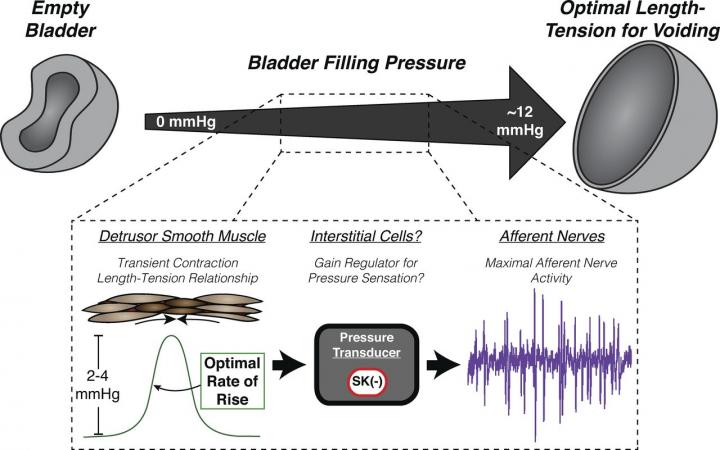
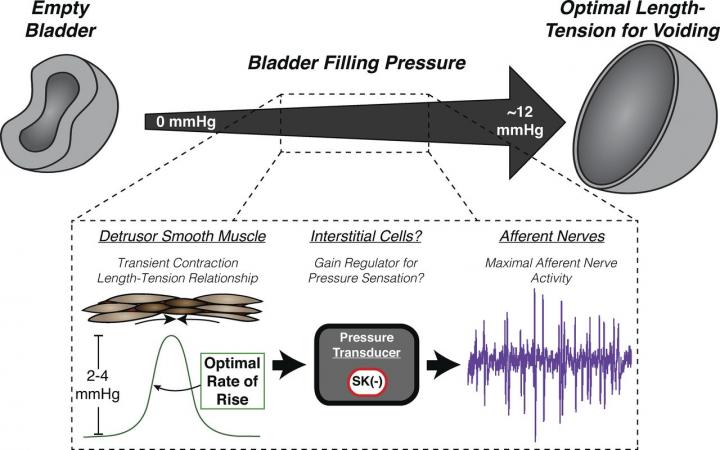
Sensing bladder fullness is seemingly simple. The kidneys send waste and excess water to the bladder, and upon reaching its filling threshold, the bladder tells the central nervous system that it's time to void. However, a team led by Mark T. Nelson, PhD, University Distinguished Professor and Chair of the Department of Pharmacology, found that in addition to filling pressure, the process involves what they call "non-voiding transient contractions (TCs)" of the urinary bladder smooth muscle. The study, "Transient contractions of urinary bladder smooth muscle are drivers of afferent nerve activity during filling," by Thomas J. Heppner et al., appears in the April issue of The Journal of General Physiology.
TCs have a central role in sensing pressure and conveying this information to afferent (sensory) nerves, the researchers note. But not only do TCs provide information about when the bladder is full, they alert us when conditions are ripe for the most efficient voiding experience. This, they conclude, means that TCs could represent a novel target for therapeutic intervention in urinary bladder dysfunction. "The presence or absence of these contractions, and how fast the contractions happen, can contribute to bladder under-activity or over-activity–which are both bad," Dr. Nelson said.
Using an ex vivo mouse bladder preparation, Nelson and his colleagues, Drs. Nathan Tykocki, Tom Heppner and David Hill-Eubanks explored the relative contributions of filling pressure and TC-induced pressure transients to sensory nerve stimulation. They observed that, for a given increase in pressure, TCs evoked an approximately 10-fold greater increase in sensory nerve activity than did the same increase in filling pressure. They concluded that TCs are responsible for a predominant share of bladder sensory output at normal bladder pressures.
Although filling pressure did not affect the frequency of TCs, it did increase the rate at which they reached their maximum pressure (rate of rise). This latter property reflects a change in the length-tension relationship of detrusor smooth muscle, an important biophysical property that determines how efficiently the muscle will contract. "This meant that the rate of rise of the TC tells the brain not only how full the bladder is, but also if the bladder muscle can contract sufficiently for normal voiding," Dr. Nelson said. In addition to this, they found that inhibiting either small- or large-conductance calcium-activated potassium (SK and BK) channels–both of which are important in helping smooth muscle relax–increased TC amplitude and sensory nerve activity.
"We have known for years that BK channels in urinary bladder smooth muscle cells help determine excitability," Dr. Nelson said. "The more the channels are on, the less excitable the bladder smooth muscle becomes, the fewer of these transient contractions you have … But if we block SK channels, we get a much bigger burst of sensory nerve outflow. It looks like SK channels are in an interstitial cell type that is involved in sensing this small, but rapid, change in pressure."
The next step, the researchers note, is looking at the mechanism that determines the frequency and rate of rise of TCs. "Transient contractions seem to vary from bladder to bladder," Dr. Nelson said. "At least in our experiments, the frequency is set for that animal or person. It seems like it is fine-tuned, so that you get the optimal response. Our data suggest that other cell types–non-muscle cell types, non-nerve cell types–are playing a role."
###
Heppner et al. et al. 2016. J. Gen. Physiol.
See the abstract here: http://jgp.rupress.org/content/early/2016/03/08/jgp.201511550
About The Journal of General Physiology
The Journal of General Physiology (JGP) is published by The Rockefeller University Press. All editorial decisions on manuscripts submitted are made by research-active scientists in conjunction with our in-house scientific editors. JGP provides free online access to many article types immediately, with complete archival content freely available online since the journal's inception. Authors retain copyright of their published works, and third parties may reuse the content for non-commercial purposes under a creative commons license. For more information, please visit jgp.org.
Follow us on Twitter at @JGenPhysiol and @RockUPress.
Media Contact
Rory Williams
[email protected]
212-327-8603
@RockUPress
http://www.rupress.org/