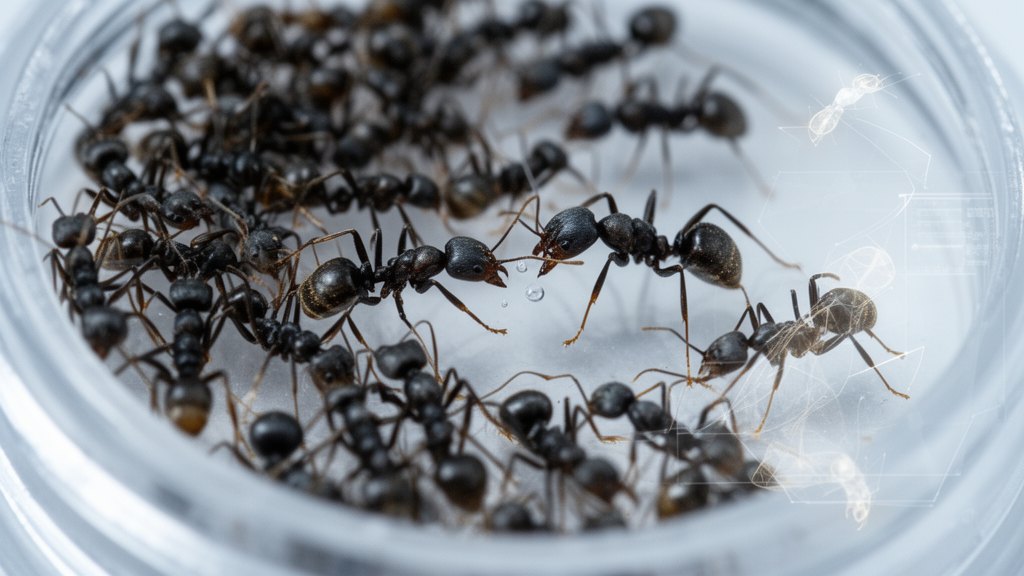
A transformer-based object detector outperformed a convolutional YOLO model at recognizing trophallaxis, the mouth-to-mouth transfer of liquid food, in densely crowded laboratory footage of the ant Camponotus fellah. In the study’s primary 2,511-image benchmark, RF-DETR Small achieved a test mean average precision across IoU thresholds from 0.50 to 0.95 of 0.467, compared with 0.364 for YOLO26n. The result applied to frame-level detection of normal and trophallaxis states in controlled ex situ recordings, not to field deployment or complete interpretation of ant behavior.
The researchers trained and evaluated the models under a shared COCO-style protocol, using 896-pixel inputs and a confidence threshold of 0.25 for the paired comparisons. Their dataset divided into 1,772 training images, 694 validation images and only 45 test images using a track-id-majority policy intended to reduce identity overlap. Of all annotated ant boxes, 14.3% represented trophallaxis and 85.7% represented normal workers, making the biologically important interaction state a minority class. RF-DETR produced 412 true-positive, 77 false-positive and 75 false-negative detections on the test split, while YOLO26n produced 379, 115 and 108, respectively, at an intersection-over-union threshold of 0.5.
The largest improvement appeared in the recognition of rare trophallaxis interactions. On the track-majority test set, average precision for the trophallaxis class rose from 0.245 for YOLO26n to 0.361 for RF-DETR Small, a gain of 0.116. Normal-state average precision also increased. This pattern suggests that RF-DETR was especially sensitive to the close-contact cues needed to distinguish interacting workers, although the experiment cannot establish that any one architectural feature caused the improvement because the detector families used different training schedules, optimization procedures and confidence calibration.
That extra accuracy came with a substantial runtime cost. On the same hardware class, an Nvidia GeForce RTX 4070, YOLO26n ran at about 49 frames per second, while RF-DETR Small processed roughly 18 frames per second. The observed trade-off means YOLO26n was approximately 2.1 times faster in the reported inference benchmark. A complementary Faster R-CNN ResNet-50-FPN model produced intermediate detection quality—better than YOLO26n but below RF-DETR—while recording the lowest throughput, at about 9.5 to 9.6 frames per second. A larger YOLO26s variant also failed to improve on YOLO26n at the chosen operating point.
The study was designed around a reproducible resource rather than a new detection architecture. The authors released the annotated dataset, split manifests, evaluation scripts, trained checkpoints and an interactive visualization tool so that future systems could be assessed using the same definitions and data. Annotators labeled each ant with a tight bounding box and assigned one of two states: normal or trophallaxis. When oral contact was clear and biologically plausible, both workers involved in an exchange were marked as trophallaxis, while ambiguous cases were left in the normal class. Track metadata and TransT-assisted tracking in CVAT helped maintain identity consistency during annotation in crowded scenes.
The recordings came from a laboratory colony and observation arena, filmed with a fixed 48-megapixel camera at 1920 by 1080 pixels and 30 frames per second under constant LED illumination. The dataset covered 29 sessions: 11 containing trophallaxis and 18 showing routine colony activity. Every fifth frame was exported from sequences with trophallaxis, while every tenth frame was selected from routine-activity sequences. A macro lens was used for close-contact interactions. These choices provided interpretable examples of rare exchanges but also restricted the dataset to one species, one colony setting and standardized imaging conditions; the release does not include continuous raw video in its primary COCO bundle.
Because the material originated as video but the benchmark evaluates still frames, the authors also tested a stricter sequence-safe split in which entire clips remained within one partition. RF-DETR retained an advantage in that complementary evaluation, which used 133 test images and therefore should not be compared directly with the 45-image headline test set. The finding supports the interpretation that the result was not solely an artifact of the track-majority arrangement. Even so, both protocols still score independent frames and do not fully measure the discovery, duration or identity continuity of trophallaxis events. The small test partitions also make the size of the reported metric differences uncertain.
Experiments on an auxiliary dataset containing only densely grouped ants showed a similar pattern. RF-DETR improved detection quality by 0.018 mean average precision over YOLO26n on the dense-ant validation split, but delivered about half the throughput. A separate temporal-processing experiment added ByteTrack association, short-track removal and gap filling to optimized RF-DETR predictions. Smoothing improved matched precision by 0.0161 with essentially no change in headline mean average precision, suggesting that temporal consistency may help stabilize video output without materially improving the underlying frame-level detector.
The authors are explicit that their results establish baselines for frame-level interaction-state detection under controlled laboratory conditions. They do not demonstrate field-ready performance, nutrient-flow measurement, identity-aware interaction networks or full behavioral understanding. Future event-level evaluation is planned around manually verified interaction episodes, temporal intersection-over-union and tracking diagnostics. Within the reported benchmark, however, the practical conclusion is clear: RF-DETR Small offered the strongest detection quality and greatest sensitivity to minority trophallaxis states, while YOLO26n offered the best throughput. The publicly released benchmark provides a common foundation for testing which detector should be used when analysis fidelity or real-time processing is the priority.
Subject of Research: Frame-level detection of normal and trophallaxis states in dense laboratory footage of Camponotus fellah ants
Article Title: A reproducible benchmark for trophallaxis state detection in Camponotus fellah using YOLO26 and RF-DETR
Article References: Kushnir, D. (2026). A reproducible benchmark for trophallaxis state detection in Camponotus fellah using YOLO26 and RF-DETR. Discover Artificial Intelligence, 6(1), Article 1042. https://doi.org/10.1007/s44163-026-01953-2
Image Credits: AI Generated
DOI: 10.1007/s44163-026-01953-2
Keywords: Camponotus fellah, trophallaxis, object detection, RF-DETR, YOLO26, COCO metrics, ant behavior, computer vision, benchmark dataset, transformer detectors, reproducible, benchmark
News Source: Blake Davidson. (October 22, 2026). Transformer detector improves trophallaxis detection in dense lab ant footage. Scienmag.