• HOME
  • NEWS
  • EXPLORE
    • CAREER
      • Companies
      • Jobs
    • EVENTS
    • iGEM
      • News
      • Team
    • PHOTOS
    • VIDEO
    • WIKI
  • BLOG
  • COMMUNITY
    • FACEBOOK
    • INSTAGRAM
    • TWITTER
Sunday, May 17, 2026
BIOENGINEER.ORG
No Result
View All Result
  • Login
  • HOME
  • NEWS
  • EXPLORE
    • CAREER
      • Companies
      • Jobs
        • Lecturer
        • PhD Studentship
        • Postdoc
        • Research Assistant
    • EVENTS
    • iGEM
      • News
      • Team
    • PHOTOS
    • VIDEO
    • WIKI
  • BLOG
  • COMMUNITY
    • FACEBOOK
    • INSTAGRAM
    • TWITTER
  • HOME
  • NEWS
  • EXPLORE
    • CAREER
      • Companies
      • Jobs
        • Lecturer
        • PhD Studentship
        • Postdoc
        • Research Assistant
    • EVENTS
    • iGEM
      • News
      • Team
    • PHOTOS
    • VIDEO
    • WIKI
  • BLOG
  • COMMUNITY
    • FACEBOOK
    • INSTAGRAM
    • TWITTER
No Result
View All Result
Bioengineer.org
No Result
View All Result
Home NEWS Science News Health

Traffic jams in the brain

Bioengineer by Bioengineer
July 25, 2018
in Health
Reading Time: 2 mins read
0
Share on FacebookShare on TwitterShare on LinkedinShare on RedditShare on Telegram

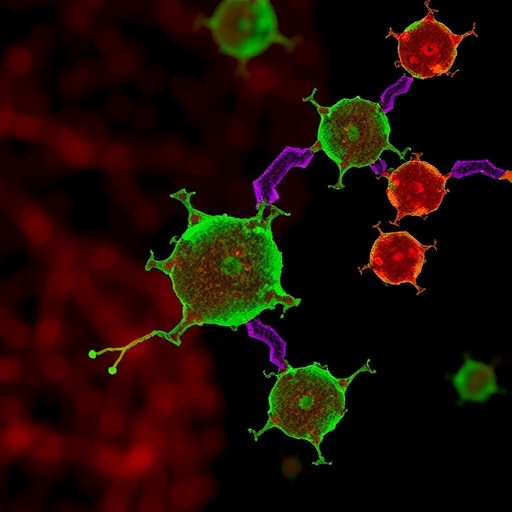
'Traffic jams' can also occur in the brain and they can be damaging. Researchers at Friedrich-Alexander-Universität Erlangen-Nürnberg (FAU) have been able to confirm that this is the case. They have been able to prove that disrupted transportation routes in nerve cells are a significant cause of Parkinson's disease.

Nerve fibres give nerve cells their characteristic long shape. Measuring up to one metre in length, they form the contact points to other nerve cells. In order to carry out the important task of communicating with other nerve cells, the fine branches of these nerve fibres and their ends, called synapses, must be regularly supplied with energy from the cell body. If this energy supply is interrupted, the synapses are destroyed. Connections between nerve cells are then disrupted, which can lead to the cells dying off. This process is typical for the development of brain disorders such as Parkinson's disease.

It is unclear which mechanisms are responsible for the loss of nerve cells in Parkinson's. Researchers at FAU led by Dr. Iryna Prots and Prof. Dr. Beate Winner from the Department of Stem Cell Biology in conjunction with researchers from the Department of Molecular Neurology (Janina Grosch, head: Prof. Dr. Jürgen Winkler) have now succeeded in demonstrating that a type of 'traffic jam' in the nerve cells could be the cause.

The researchers discovered that the traffic jam is triggered by a protein called alpha-synuclein, which is also found in healthy nerve cells. In abnormal nerve cells, the protein forms deposits, or even lumps, leading to a delay, disrupting the energy supply of the nerve fibres and, ultimately, damaging the synapses.

The researchers were also able to demonstrate this mechanism in cell cultures taken from patients with Parkinson's. A small skin sample was taken from affected patients. These skin cells were then converted into stem cells, which can be developed into any type of cell, and in this case, into nerve cells.

In initial trials, the researchers succeeded in suppressing the formation of lumps of alpha-synuclein, thus improving the transportation of information in the nerve fibres. However, the substance they used has not yet passed clinical trials. Nevertheless, the lead author of the study, Dr. Iryna Prots, says 'Our findings mean we can improve our understanding of the mechanisms that cause Parkinson's and push forward new strategies for treatment during the progression of the disease.'

###

Media Contact

FAU Press Office
[email protected]
49-913-185-70229
@FAU_Germany

http://www.uni-erlangen.de

https://www.fau.eu/2018/07/25/news/research/disrupted-transport-routes-in-nerve-cells-are-a-cause-of-parkinsons/

Related Journal Article

http://dx.doi.org/10.1073/pnas.1713129115
Share12Tweet8Share2ShareShareShare2

Related Posts

Physical Resilience Linked to Aging Views in Chinese Elders

May 17, 2026

Tau T205 Phosphorylation Controls Memory and Engrams

May 17, 2026

Phocaeicola dorei Eases Liver Fibrosis via Efferocytosis

May 17, 2026

Boosting Aging Positivity and Activity in Older Couples

May 17, 2026
Please login to join discussion

POPULAR NEWS

  • Research Indicates Potential Connection Between Prenatal Medication Exposure and Elevated Autism Risk

    844 shares
    Share 338 Tweet 211
  • New Study Reveals Plants Can Detect the Sound of Rain

    730 shares
    Share 291 Tweet 182
  • Salmonella Haem Blocks Macrophages, Boosts Infection

    62 shares
    Share 25 Tweet 16
  • Breastmilk Balances E. coli and Beneficial Bacteria in Infant Gut Microbiomes

    58 shares
    Share 23 Tweet 15

About

We bring you the latest biotechnology news from best research centers and universities around the world. Check our website.

Follow us

Recent News

Noncanonical Sulfur Metabolism, Immunity Altered in Down Syndrome

Physical Resilience Linked to Aging Views in Chinese Elders

Tau T205 Phosphorylation Controls Memory and Engrams

Subscribe to Blog via Email

Enter your email address to subscribe to this blog and receive notifications of new posts by email.

Join 82 other subscribers
  • Contact Us

Bioengineer.org © Copyright 2023 All Rights Reserved.

Welcome Back!

Login to your account below

Forgotten Password?

Retrieve your password

Please enter your username or email address to reset your password.

Log In
No Result
View All Result
  • Homepages
    • Home Page 1
    • Home Page 2
  • News
  • National
  • Business
  • Health
  • Lifestyle
  • Science

Bioengineer.org © Copyright 2023 All Rights Reserved.