• HOME
  • NEWS
  • EXPLORE
    • CAREER
      • Companies
      • Jobs
    • EVENTS
    • iGEM
      • News
      • Team
    • PHOTOS
    • VIDEO
    • WIKI
  • BLOG
  • COMMUNITY
    • FACEBOOK
    • INSTAGRAM
    • TWITTER
Saturday, July 4, 2026
BIOENGINEER.ORG
No Result
View All Result
  • Login
  • HOME
  • NEWS
  • EXPLORE
    • CAREER
      • Companies
      • Jobs
        • Lecturer
        • PhD Studentship
        • Postdoc
        • Research Assistant
    • EVENTS
    • iGEM
      • News
      • Team
    • PHOTOS
    • VIDEO
    • WIKI
  • BLOG
  • COMMUNITY
    • FACEBOOK
    • INSTAGRAM
    • TWITTER
  • HOME
  • NEWS
  • EXPLORE
    • CAREER
      • Companies
      • Jobs
        • Lecturer
        • PhD Studentship
        • Postdoc
        • Research Assistant
    • EVENTS
    • iGEM
      • News
      • Team
    • PHOTOS
    • VIDEO
    • WIKI
  • BLOG
  • COMMUNITY
    • FACEBOOK
    • INSTAGRAM
    • TWITTER
No Result
View All Result
Bioengineer.org
No Result
View All Result
Home NEWS Science News Chemistry

Tracking structural regeneration of catalysts for electrochemical CO2 reduction

Bioengineer by Bioengineer
September 10, 2020
in Chemistry
Reading Time: 2 mins read
0
IMAGE
Share on FacebookShare on TwitterShare on LinkedinShare on RedditShare on Telegram

IMAGE

Credit: ©Science China Press

Recent years have witnessed explosive development in electrochemical CO2 reduction into valuable chemicals or fuels. The CO2 electroreduction is considered as a promising route to utilize renewable electricity from intermittent energy, such as solar, winder, geothermal power, etc. Designing high-performance electrocatalysts is pivotal to tune CO2 activation, thus achieving the highly selective CO2 conversion into target products.

However, the rational design of electrocatalysts faces severe challenge, because that most of the catalysts would go through dynamic structural evolution under applied electric field. The ambiguous evolution rules also hinder the uncovering of working mechanism. The established structure-performance relationship based on ex-situ static characterizations does not match realistic catalytic phenomenon. It is highly important yet challenging to operando probe the structural evolution and identify the true catalytically active components under realistic working conditions.

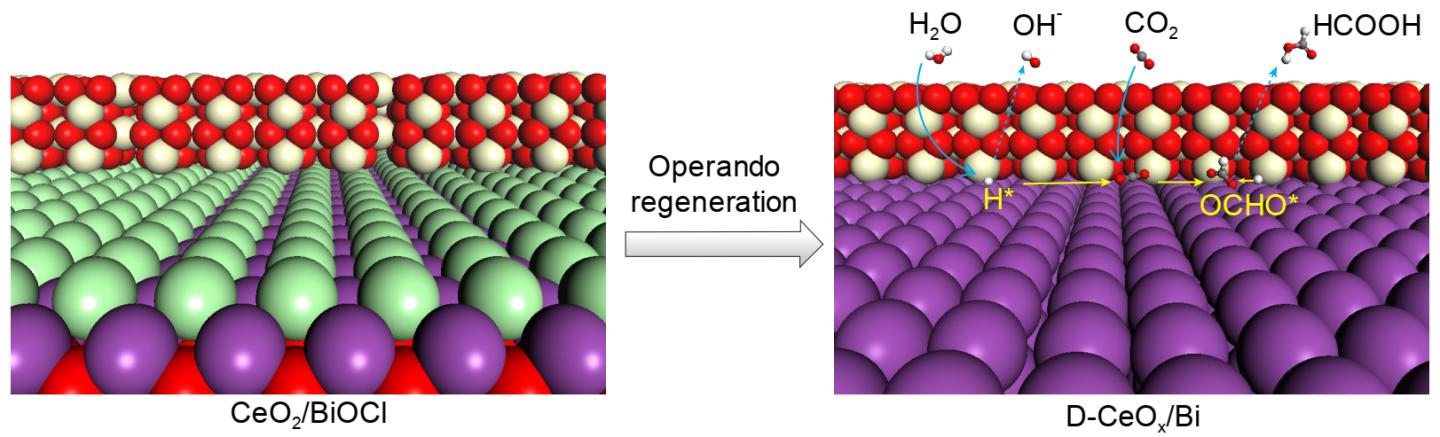
In response to this challenge, in-situ/operando characterization techniques are solid methods to track structural change, identify real active phases and uncover underlying mechanism, thus guiding the structure design of highly active and robust catalysts. In a new research article published in National Science Review, the Li group at East China University of Science and Technology presents a latest advance in comprehensive insights into how the catalyst structure evolves, and how real catalytically active components catalyze CO2 electroreduction by virtue of operando structural identifications at multiscale levels.

“The distinct difference between the operando and ex-situ structural information is displayed, revealing that the real catalytically active phase for CO2 electroreduction is inconsistent with the as-prepared or post-catalyzed catalyst structure. High-performance CO2 electroreduction into formate is actually exhibited onto the operando regenerative structure. More importantly, the operando structural information with atomic level precision is the key to uncover catalytic mechanism,” They state.

This work provides insights into structural evolution and activity origin of catalysts under realistic working conditions, and highlights the importance of mechanism study and catalyst design based operando feedback information. The proposed strategy could be widely extended to unravel the structural evolution and working mechanism of catalysts in most of heterogeneous catalytic processes.

###

This research received funding from the National Natural Science Foundation of China, the Shanghai Scientific and Technological Innovation Project, and the Fundamental Research Funds for the Central Universities.

See the article:

Tracking structural evolution: Operando regenerative CeOx/Bi interface structure for high-performance CO2 electroreduction

Ruichao Pang, Pengfei Tian, Hongliang Jiang, Minghui Zhu, Xiaozhi Su, Yu Wang, Xiaoling Yang, Yihua Zhu, Li Song, Chunzhong Li

Natl Sci Rev 2020; doi: 10.1093/nsr/nwaa187

https://doi.org/10.1093/nsr/nwaa187

The National Science Review is the first comprehensive scholarly journal released in English in China that is aimed at linking the country’s rapidly advancing community of scientists with the global frontiers of science and technology. The journal also aims to shine a worldwide spotlight on scientific research advances across China.

Media Contact
Chunzhong Li
[email protected]

Related Journal Article

http://dx.doi.org/10.1093/nsr/nwaa187

Tags: Chemistry/Physics/Materials Sciences
Share12Tweet8Share2ShareShareShare2

Related Posts

Intelligent Microgrid Management Promises Lower Household Energy Bills and Reduced Diesel Emissions — Chemistry

Intelligent Microgrid Management Promises Lower Household Energy Bills and Reduced Diesel Emissions

July 4, 2026
Graz University of Technology Deciphers the Structural Secrets of MOF Thin Films — Chemistry

Graz University of Technology Deciphers the Structural Secrets of MOF Thin Films

July 2, 2026

Breaking Thermodynamic Limits: Wavelength-Driven Catalysis Advances Ammonia Synthesis

July 2, 2026

From Quantum Mechanics to AI-Powered Materials Discovery: MARVEL Marks 12 Years of Transforming Computational Science

July 2, 2026
Please login to join discussion

POPULAR NEWS

  • Detection of EDCs in Breast Milk and Infant Urine Up to Six Months Highlights Early Exposure Risks

    77 shares
    Share 31 Tweet 19
  • Saying Goodbye to PGY-6: Pediatric Fellowship Realities

    103 shares
    Share 41 Tweet 26
  • New Drug Candidate Developed at McMaster Shows Potential for Treating Brain Cancer

    58 shares
    Share 23 Tweet 15
  • KTU Researchers Explore Ultrasound’s Role in Enhancing Blood Flow Beyond Diagnostics

    53 shares
    Share 21 Tweet 13

About

We bring you the latest biotechnology news from best research centers and universities around the world. Check our website.

Follow us

Recent News

Quasi-Bound States Boost Quantum Well Photoresponse

Lysine Pyruvylation Links Glycolysis to Epigenetics

Multiphysics Coupling: Single vs. Multiple DeepONet Branches

Subscribe to Blog via Email

Success! An email was just sent to confirm your subscription. Please find the email now and click 'Confirm' to start subscribing.

Join 83 other subscribers
  • Contact Us

Bioengineer.org © Copyright 2023 All Rights Reserved.

Welcome Back!

Login to your account below

Forgotten Password?

Retrieve your password

Please enter your username or email address to reset your password.

Log In
No Result
View All Result
  • Homepages
    • Home Page 1
    • Home Page 2
  • News
  • National
  • Business
  • Health
  • Lifestyle
  • Science

Bioengineer.org © Copyright 2023 All Rights Reserved.