A mathematical modeling study in the Bulletin of Mathematical Biology demonstrates that tracking target cell proportions alongside viral titers enables researchers to quantify how differences between host cell types shape influenza virus replication and within-host fitness. Developed by Ada W. C. Yan, Steven Riley, and James M. McCaw, the dynamical framework incorporates distinct cell populations that vary in infection susceptibility, virion production, and innate interferon induction. Within-host mathematical models have historically faced severe parameter identifiability hurdles when attempting to resolve cellular mechanisms using total viral load data alone. The authors showed that total viral load trajectories leave critical parameters governing cellular heterogeneity unidentifiable. However, supplementing viral titers with measurements of the relative proportions of uninfected and infected cell types over time reliably isolates cellular susceptibility differences, providing a quantitative framework to evaluate how viral evolution and cell tropism govern within-host viral dynamics.
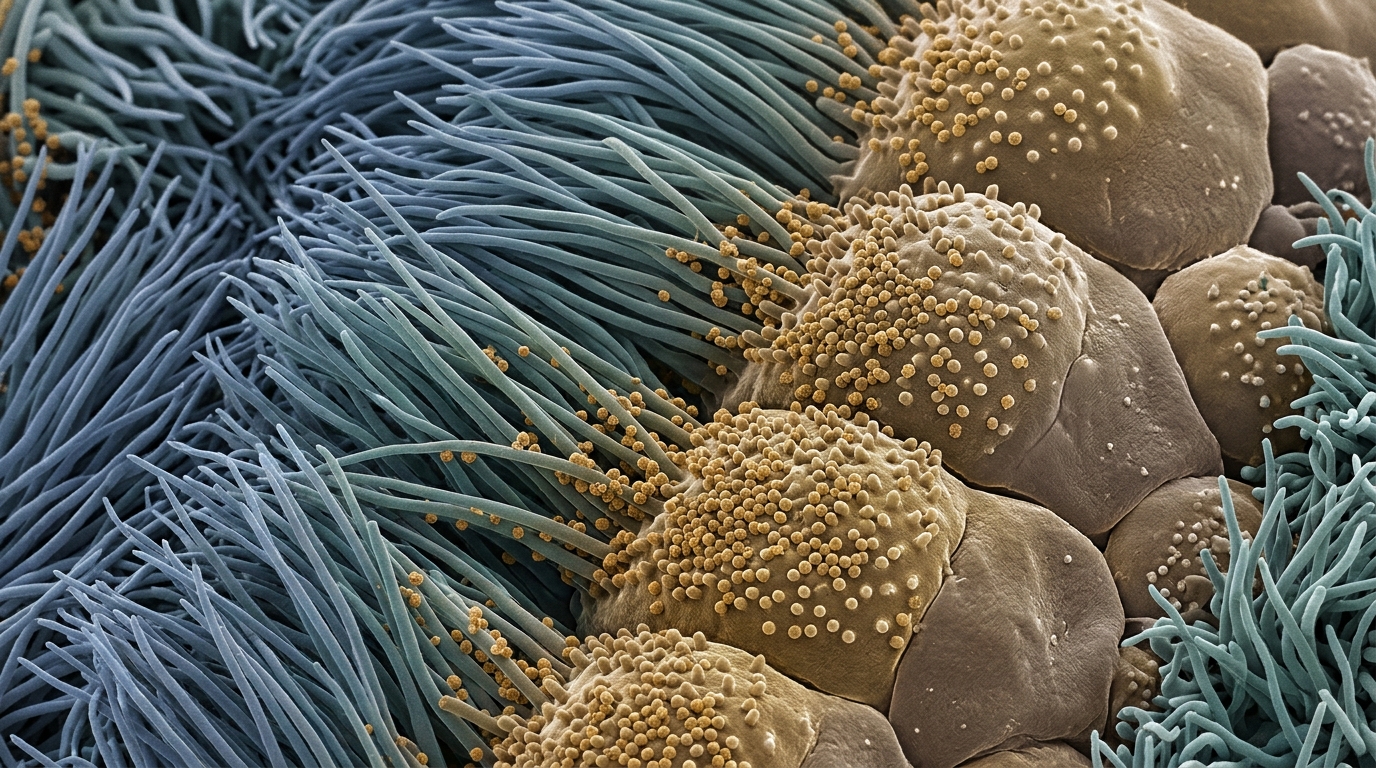
Cell tropism, the preference of a virus to infect specific cell types, plays a pivotal role in viral pathogenesis, transmission efficiency, and evolutionary adaptation. In influenza, viruses triggering human pandemics have historically originated from avian reservoirs, occasionally passing through swine as intermediate hosts. To achieve efficient human-to-human transmission, avian viruses must adapt binding preferences from cells expressing alpha-2,3-linked sialic acid receptors to those bearing alpha-2,6-linked sialic acid receptors. Within the human respiratory tract, non-ciliated cells expressing alpha-2,6 receptors dominate the nasal cavity at roughly eighty percent abundance, whereas ciliated cells expressing alpha-2,3 receptors comprise up to ninety percent of bronchial epithelium. Adapting to infect the more abundant cell type at the initial site provides a clear evolutionary advantage. However, target cell types also differ intrinsically upon infection. In experimental cultures infected with human influenza virus, higher proportions of ciliated cells correlated with increased virus production, showing that tropism and fitness interact through complex mechanisms.
To resolve these interactions, the researchers formulated an ordinary differential equation model incorporating innate and adaptive immunity across multiple cell populations. For each cell type, the model tracks susceptible target cells, refractory cells rendered resistant by interferon, and infected cells producing virions. Susceptible cells become infected at rate beta_i. Infected cells release free virus at rate p_i and secrete interferon at rate q_i before dying at rate delta_i. Interferon converts susceptible cells into a temporary antiviral state at rate phi_i, while resistant cells revert to susceptibility at rate rho_i. Free virus clears at rate c and is neutralized by antibodies at rate k. Antibodies expand logistically at per-capita rate m up to carrying capacity, capturing adaptive control. Free virus is quantified in TCID50 units. Parameters were calibrated against ferret infection data, establishing dynamics where early interferon suppresses peak viral titers and prevents target cell exhaustion, while antibodies drive final clearance.
Because viral fitness spans replication and transmission, the researchers evaluated three distinct summary metrics. To quantify initial replication, they derived expressions for the within-host basic reproduction number and exponential growth rate using next-generation matrix linearization around the uninfected equilibrium. The basic reproduction number represents secondary infected cells generated by a single infected cell in an uninfected pool, formulated as the sum across compartments of initial abundance, susceptibility, and virion production divided by cell death and clearance terms. When cell death rates are uniform across types, initial growth varies monotonically with reproduction number. To capture host transmissibility, the authors evaluated total shedding using the area under the viral load trajectory. In sensitivity analyses, they compared this linear area under the curve with two alternative functions: cumulative log-transformed shedding and a saturating dose-response relationship where transmission plateaued at higher viral loads.
To isolate the effects of cellular heterogeneity, the team simulated scenarios where the sum of cell-specific infection rates remained constant while their difference varied. This ensured that fitness changes reflected between-cell differences rather than arbitrary shifts in mean infectivity. In scenarios where cells differed in one property, model predictions matched theoretical expectations. In scenario A, where non-ciliated cells accounted for eighty percent of abundance, shifting tropism toward the abundant cell type increased initial growth, elevated peak viral load, expanded the reproduction number, and enlarged shedding. In scenario B, where one cell type produced eighty percent of virions, shifting tropism toward that compartment similarly boosted growth rate, peak titer, reproduction number, and cumulative shedding. Conversely, in scenario C, where cell types differed solely in interferon induction rates, shifting tropism toward the low-interferon-inducing cell type increased peak viral load and total shedding without altering growth rate or reproduction number, as early reproduction occurs before interferon accumulates.
When simulated cell types differed across multiple characteristics simultaneously, evolutionary tradeoffs emerged between within-host replication and overall shedding. When the cell type with higher viral production was less abundant, the basic reproduction number depended strictly on whether the product of viral production and abundance in the first compartment exceeded that of the second. When those products were equal, shifting tropism had no impact on the basic reproduction number. Furthermore, when the cell type generating more virus also triggered higher interferon secretion, cumulative viral shedding displayed three distinct responses depending on parameter values. If higher viral output outweighed interferon induction, preferentially infecting that cell type increased total shedding. If enhanced interferon secretion dominated, preferring the lower-producing cell type maximized shedding. Under intermediate interferon production rates, cumulative shedding peaked at a balanced tropism targeting both cell types. Throughout these scenarios, the within-host basic reproduction number increased monotonically toward the higher-producing cell type because interferon does not enter early reproductive calculations.
The study also revealed that transmission predictions are highly sensitive to model immunological structure. In the full model with innate and adaptive immunity, increasing viral tropism toward the more abundant cell type produced consistent increases across all three transmission summary statistics. In contrast, when the authors tested the standard target cell-limited model lacking innate interferon and adaptive antibodies, qualitative discrepancies surfaced. Shifting tropism toward more abundant cells increased linear area under the curve but decreased logarithmic area under the curve and the dose-response metric. This divergence occurred because target cell depletion governed infection resolution in the reduced model. Rapid initial viral replication quickly exhausted susceptible cells, causing an earlier, higher peak followed by abrupt viral clearance. Because logarithmic and dose-response summary statistics depend heavily on infection duration rather than peak height, target cell depletion imposed an artificial penalty on transmission that contradicts empirical animal transmission studies showing positive correlations between early viral peaks and secondary transmission.
To determine whether cellular heterogeneity can be inferred in practice, the investigators conducted a simulation-estimation study examining parameter identifiability. They generated five thousand candidate parameter sets using Latin hypercube sampling, filtering them to one hundred plausible sets that generated initial daily viral growth between three and five orders of magnitude. Infection parameters were reparameterized into a weighted mean susceptibility and a bounded heterogeneity parameter ranging from negative one to positive one, where zero represents identical susceptibility. For each parameter set, simulations generated synthetic viral loads sampled daily across seven days with lognormal noise and a detection limit of ten infectious units. Synthetic cell proportion data were simulated for uninfected and infected cells across both compartments at days one and two. Cell proportions were drawn from a Dirichlet-multinomial distribution assuming five thousand cells per sample and an overdispersion parameter of 0.01, recognizing that experimental assays cannot easily distinguish susceptible from resistant uninfected cells.
Bayesian inference was conducted using the No-U-Turn sampler in Stan, evaluating whether the heterogeneity parameter could be recovered from synthetic datasets. When models were calibrated using viral load trajectories alone, posterior credible intervals for the heterogeneity parameter spanned the entire prior distribution, confirming that total viral titers cannot identify cell-type-specific susceptibilities. In sharp contrast, incorporating cell proportion data alongside viral loads enabled precise parameter recovery. When synthetic data reflected strong tropism toward cell type one, inference correctly detected heterogeneity in eighty-three percent of simulated cohorts. When true tropism favored cell type two, heterogeneity was detected in seventy-five percent of cohorts. The pipeline maintained high specificity, generating a false-positive rate of only 3.5 percent when true cellular susceptibility was identical between compartments. A sensitivity analysis estimating virion production rates and infected cell death rates alongside susceptibility demonstrated that inferring cellular heterogeneity remained robust against uncertainty in viral production and cell clearance.
The statistical identifiability of cellular heterogeneity directly dictated the model’s ability to extrapolate trajectories across anatomical compartments. When posterior parameter distributions inferred from dual viral load and cell proportion data were used to forecast dynamics in tissues possessing different initial cell ratios, the model accurately reproduced true peak viral loads and replication trajectories. Conversely, parameter sets fitted solely to viral load data produced wide, overlapping intervals that failed to predict how shifting cell proportions alter infection time courses. The authors noted several limitations, including the assumption of a well-mixed compartment omitting spatial barriers, directional apical budding, and localized epithelial organization. The baseline formulation also excluded cytotoxic CD8-positive T cells, natural killer cells, defective interfering particles, and cell-type differences in infected cell lifespans. Nevertheless, because within-host reproduction number formulas remain independent of downstream adaptive responses, the authors concluded that integrating cell proportion measurements with dynamical modeling offers a robust foundation for quantifying viral evolution and tropism in respiratory infections.
Subject of Research: Mathematical modeling of cell-type heterogeneity and viral fitness in within-host influenza infection
Article Title: Modelling Between-Cell-Type Heterogeneity in Within-Host Influenza Virus Infection
Article References: Yan, A. W. C., Riley, S., & McCaw, J. M. (2026). Modelling Between-Cell-Type Heterogeneity in Within-Host Influenza Virus Infection. Bulletin of Mathematical Biology, 88(10), Article 189. https://doi.org/10.1007/s11538-026-01759-4
Image Credits: AI Generated
DOI: 10.1007/s11538-026-01759-4
Keywords: mathematical modeling, influenza A virus, cell tropism, within-host dynamics, basic reproduction number, viral load kinetics, target cell heterogeneity, interferon response, viral fitness, sialic acid receptors, flow cytometry, single-cell RNAseq, parameter identifiability, adaptive immunity, ciliated epithelial cells, non-ciliated epithelial cells, transmissibility modeling, Dirichlet-multinomial distribution
News Source: Kristina Jarvis. (November 27, 2026). Tracking Cell Type Proportions Resolves Within Host Influenza Fitness and Replication Dynamics. Scienmag.