• HOME
  • NEWS
  • EXPLORE
    • CAREER
      • Companies
      • Jobs
    • EVENTS
    • iGEM
      • News
      • Team
    • PHOTOS
    • VIDEO
    • WIKI
  • BLOG
  • COMMUNITY
    • FACEBOOK
    • INSTAGRAM
    • TWITTER
Friday, May 22, 2026
BIOENGINEER.ORG
No Result
View All Result
  • Login
  • HOME
  • NEWS
  • EXPLORE
    • CAREER
      • Companies
      • Jobs
        • Lecturer
        • PhD Studentship
        • Postdoc
        • Research Assistant
    • EVENTS
    • iGEM
      • News
      • Team
    • PHOTOS
    • VIDEO
    • WIKI
  • BLOG
  • COMMUNITY
    • FACEBOOK
    • INSTAGRAM
    • TWITTER
  • HOME
  • NEWS
  • EXPLORE
    • CAREER
      • Companies
      • Jobs
        • Lecturer
        • PhD Studentship
        • Postdoc
        • Research Assistant
    • EVENTS
    • iGEM
      • News
      • Team
    • PHOTOS
    • VIDEO
    • WIKI
  • BLOG
  • COMMUNITY
    • FACEBOOK
    • INSTAGRAM
    • TWITTER
No Result
View All Result
Bioengineer.org
No Result
View All Result
Home NEWS Science News Biology

TPU scientists equip chemical sensors with ‘traps’ to detect toxic substances

Bioengineer by Bioengineer
July 24, 2017
in Biology
Reading Time: 2 mins read
0
Share on FacebookShare on TwitterShare on LinkedinShare on RedditShare on Telegram
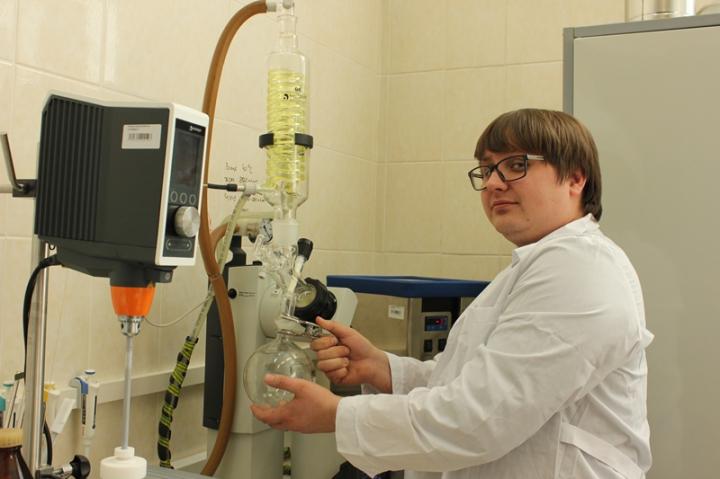
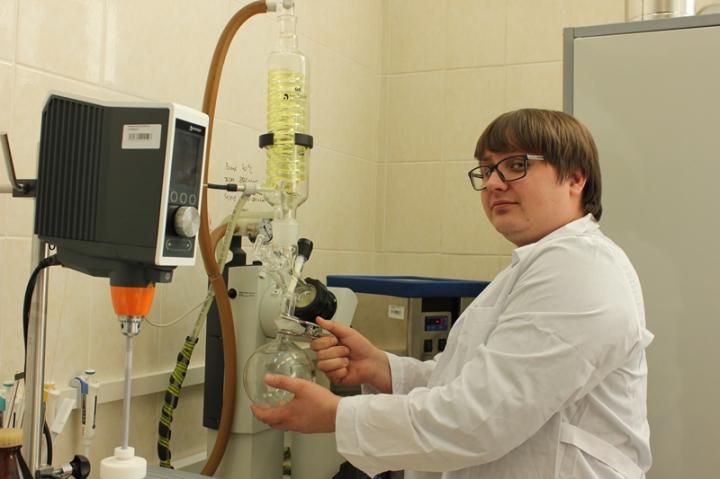
IMAGE

Credit: Tomsk Polytechnic University

Scientists from Tomsk Polytechnic University and the University of Chemistry and Technology (Prague, Czech Republic) have created novel chemical sensors for Raman spectrometers, i.e. the devices that allow determining quantitative and qualitative composition of substances and their structure with high accuracy. TPU scientists have equipped sensors with organic chemical compounds. They have already obtained sensors for determining dyes prohibited in Europe and heavy metals in water at ultralow concentrations.

The latest outcomes of the study have been published in Sensors and Actuators B: Chemical.

A sensor is a multi-layer material based on a thin gold film with the size of 1×0.5 cm. The surface of the substrate is modified into a wave-like structure. Using special reagents, TPU scientists graft organic compounds on the surface of the substrate by a covalent surface modification via diazonium chemistry.

'In the study we demonstrate possibility of creating such chemical sensors. The novelty is that we combined both chemical and physical methods. Our colleagues in Prague prepare substrates by physical methods and we modify organic compounds using chemical methods. Due to this combination we eventually got the opportunity to detect heavy metals at ultralow concentrations. We can monitor trace concentrations of substances. Thus, the sensitivity of sensors for dyes reaches 10-16 mol and for heavy metals it is about 10-14 mol,' says Pavel Postnikov, the Associate Professor of the Department of Organic Substances and Polymer Materials.

'The process of analysis is very simple: we put the sensor into the water and molecules of toxic substances are immobilized on the surface of the substrate. The analysis of dyes is more difficult,' notes Pavel Postnikov. We use an interesting polymer which is water-soluble at room temperature and when heated it turns into insoluble form. Polymer chains capture dye molecules and, when heated, press them to the surface. Then, we take out the substrate and place it in the spectrometer. We get the result in two minutes.'

In the long term, these sensors may be used to monitor liquids in food technology, medicine and environmental studies.

'It takes several minutes to carry out this analysis. Therefore, it can be used on site, for example, one may take samples from the reservoirs and receive an immediate result that would show if there are any toxic substances present in the water even at ultralow concentrations,' adds the researcher.

###

Media Contact

Kristina Nabokova
[email protected]
7-382-270-5685
@TPUnews_en

http://www.tpu.ru/en

Original Source

https://tpu.ru/en/about/tpu_today/news/view?id=3063 http://dx.doi.org/10.1016/j.snb.2017.07.018
Share12Tweet7Share2ShareShareShare1

Related Posts

How the Gut Reprograms the Brain to Crave Essential Nutrients — Biology

How the Gut Reprograms the Brain to Crave Essential Nutrients

May 22, 2026
Decoding the Mechanisms Behind Collective Cell Movement — Biology

Decoding the Mechanisms Behind Collective Cell Movement

May 22, 2026

Harvard Scientists Develop Innovative Methods to Detect the Body’s “Orphan” Signaling Receptors

May 22, 2026

Seasonal Lake Denitrification Shifts Amid Climate Warming

May 22, 2026
Please login to join discussion

POPULAR NEWS

  • blank

    New Study Reveals Plants Can Detect the Sound of Rain

    734 shares
    Share 293 Tweet 183
  • ESMO 2025: mRNA COVID Vaccines Enhance Efficacy of Cancer Immunotherapy

    309 shares
    Share 124 Tweet 77
  • Research Indicates Potential Connection Between Prenatal Medication Exposure and Elevated Autism Risk

    847 shares
    Share 339 Tweet 212
  • Breastmilk Balances E. coli and Beneficial Bacteria in Infant Gut Microbiomes

    58 shares
    Share 23 Tweet 15

About

BIOENGINEER.ORG

We bring you the latest biotechnology news from best research centers and universities around the world. Check our website.

Follow us

Recent News

Compact Dual-Band Dual-Polarized Antenna with Proximity Coupling

Serum Urokinase Differentiates Borderline HER2 Cancers

Enhancing Low-Dose CT Scans with Interpretable Multi-Gaussian Cluster Variance Reduction

Subscribe to Blog via Email

Enter your email address to subscribe to this blog and receive notifications of new posts by email.

Join 82 other subscribers
  • Contact Us

Bioengineer.org © Copyright 2023 All Rights Reserved.

Welcome Back!

Login to your account below

Forgotten Password?

Retrieve your password

Please enter your username or email address to reset your password.

Log In
No Result
View All Result
  • Homepages
    • Home Page 1
    • Home Page 2
  • News
  • National
  • Business
  • Health
  • Lifestyle
  • Science

Bioengineer.org © Copyright 2023 All Rights Reserved.