• HOME
  • NEWS
  • EXPLORE
    • CAREER
      • Companies
      • Jobs
    • EVENTS
    • iGEM
      • News
      • Team
    • PHOTOS
    • VIDEO
    • WIKI
  • BLOG
  • COMMUNITY
    • FACEBOOK
    • INSTAGRAM
    • TWITTER
Wednesday, May 13, 2026
BIOENGINEER.ORG
No Result
View All Result
  • Login
  • HOME
  • NEWS
  • EXPLORE
    • CAREER
      • Companies
      • Jobs
        • Lecturer
        • PhD Studentship
        • Postdoc
        • Research Assistant
    • EVENTS
    • iGEM
      • News
      • Team
    • PHOTOS
    • VIDEO
    • WIKI
  • BLOG
  • COMMUNITY
    • FACEBOOK
    • INSTAGRAM
    • TWITTER
  • HOME
  • NEWS
  • EXPLORE
    • CAREER
      • Companies
      • Jobs
        • Lecturer
        • PhD Studentship
        • Postdoc
        • Research Assistant
    • EVENTS
    • iGEM
      • News
      • Team
    • PHOTOS
    • VIDEO
    • WIKI
  • BLOG
  • COMMUNITY
    • FACEBOOK
    • INSTAGRAM
    • TWITTER
No Result
View All Result
Bioengineer.org
No Result
View All Result
Home NEWS Science News Chemistry

Towards lasers powerful enough to investigate a new kind of physics

Bioengineer by Bioengineer
July 3, 2020
in Chemistry
Reading Time: 3 mins read
0
IMAGE
Share on FacebookShare on TwitterShare on LinkedinShare on RedditShare on Telegram

An international team of researchers has demonstrated an innovative technique for increasing the intensity of lasers
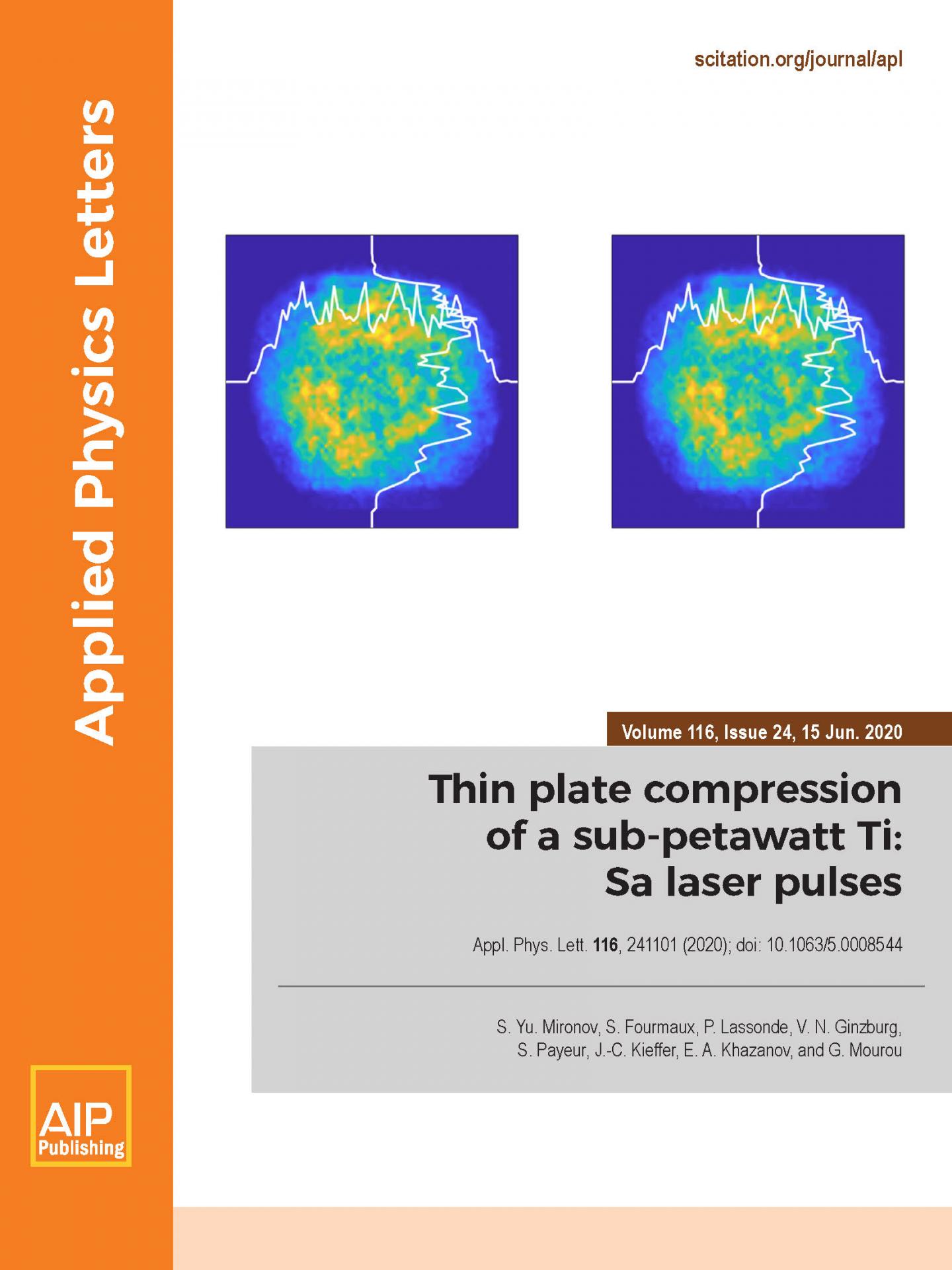
IMAGE

Credit: AIP Publishing

In a paper that made the cover of the journal Applied Physics Letters, an international team of researchers has demonstrated an innovative technique for increasing the intensity of lasers. This approach, based on the compression of light pulses, would make it possible to reach a threshold intensity for a new type of physics that has never been explored before: quantum electrodynamics phenomena.


Researchers Jean-Claude Kieffer of the Institut national de la recherche scientifique (INRS), E. A. Khazanov of the Institute of Applied Physics of the Russian Academy of Sciences and in France Gérard Mourou, Professor Emeritus of the Ecole Polytechnique, who was awarded the Nobel Prize in Physics in 2018, have chosen another direction to achieve a power of around 10^23 Watts (W). Rather than increasing the energy of the laser, they decrease the pulse duration to only a few femtoseconds. This would keep the system within a reasonable size and keep operating costs down.


To generate the shortest possible pulse, the researchers are exploiting the effects of non-linear optics. “A laser beam is sent through an extremely thin and perfectly homogeneous glass plate. The particular behaviour of the wave inside this solid medium broadens the spectrum and allows for a shorter pulse when it is recompressed at the exit of the plate,” explains Jean-Claude Kieffer, co-author of the study published online on 15 June 2020 in the journal Applied Physics Letters.


Installed in the Advanced Laser Light Source (ALLS) facility at INRS, the researchers limited themselves to an energy of 3 joules for a 10-femtosecond pulse, or 300 terawatts (1012W). They plan to repeat the experiment with an energy of 13 joules over 5 femtoseconds, or an intensity of 3 petawatts (1015 W). “We would be among the first in the world to achieve this level of power with a laser that has such short pulses,” says Professor Kieffer.


“If we achieve very short pulses, we enter relativistic problem classes. This is an extremely interesting direction that has the potential to take the scientific community to new horizons,” says Professor Kieffer. “It was a very nice piece of work solidifying the paramount potential of this technique,” concludes Gérard Mourou.


About the study:


“Thin plate compression of a sub-petawatt Ti:Sa laser pulses” by S. Yu. Mironov, S. Fourmaux, P. Lassonde, V. N. Ginzburg, S. Payeur, J.-C. Kieffer, E. A. Khazanov, and G. Mourou was published in June 2020 in the journal Applied Physics Letters. They have received financial support from the Natural Sciences and Engineering Research Council of Canada, the Canada Foundation for Innovation, the ministère de l’Économie, de la Science et de l’Innovation du Québec and the Ministry of Science and Higher Education of the Russian Federation.

DOI: 10.1063/5.0008544


Media Contact
Audrey-Maude Vezina
[email protected]

Original Source

http://www.inrs.ca/english/actualites/towards-lasers-powerful-enough-investigate-new-kind-physics

Related Journal Article

http://dx.doi.org/10.1063/5.0008544

Tags: Atomic PhysicsAtomic/Molecular/Particle PhysicsChemistry/Physics/Materials SciencesOpticsParticle Physics
Share12Tweet8Share2ShareShareShare2

Related Posts

Gravitational Wave Detectors Now Feature Automatic Signal Tuning — Chemistry

Gravitational Wave Detectors Now Feature Automatic Signal Tuning

May 13, 2026
Harnessing Neural Networks for Advances in Nonlinear Optics — Chemistry

Harnessing Neural Networks for Advances in Nonlinear Optics

May 12, 2026

Innovative Method Unveiled to Detect Signs of Dark Matter

May 12, 2026

Illuminating the Science Behind Historical Featherwork Art

May 12, 2026
Please login to join discussion

POPULAR NEWS

  • Research Indicates Potential Connection Between Prenatal Medication Exposure and Elevated Autism Risk

    842 shares
    Share 337 Tweet 211
  • New Study Reveals Plants Can Detect the Sound of Rain

    728 shares
    Share 290 Tweet 182
  • Salmonella Haem Blocks Macrophages, Boosts Infection

    62 shares
    Share 25 Tweet 16
  • Breastmilk Balances E. coli and Beneficial Bacteria in Infant Gut Microbiomes

    57 shares
    Share 23 Tweet 14

About

We bring you the latest biotechnology news from best research centers and universities around the world. Check our website.

Follow us

Recent News

Glycocalyx Exchange Powers Liquid Biopsies of Endothelium

Intensive Caregiving Duties Linked to Accelerated Cognitive Decline, Study Finds

Nanoplatform Combats Skin Inflammation via RNA, ROS

Subscribe to Blog via Email

Enter your email address to subscribe to this blog and receive notifications of new posts by email.

Join 82 other subscribers
  • Contact Us

Bioengineer.org © Copyright 2023 All Rights Reserved.

Welcome Back!

Login to your account below

Forgotten Password?

Retrieve your password

Please enter your username or email address to reset your password.

Log In
No Result
View All Result
  • Homepages
    • Home Page 1
    • Home Page 2
  • News
  • National
  • Business
  • Health
  • Lifestyle
  • Science

Bioengineer.org © Copyright 2023 All Rights Reserved.