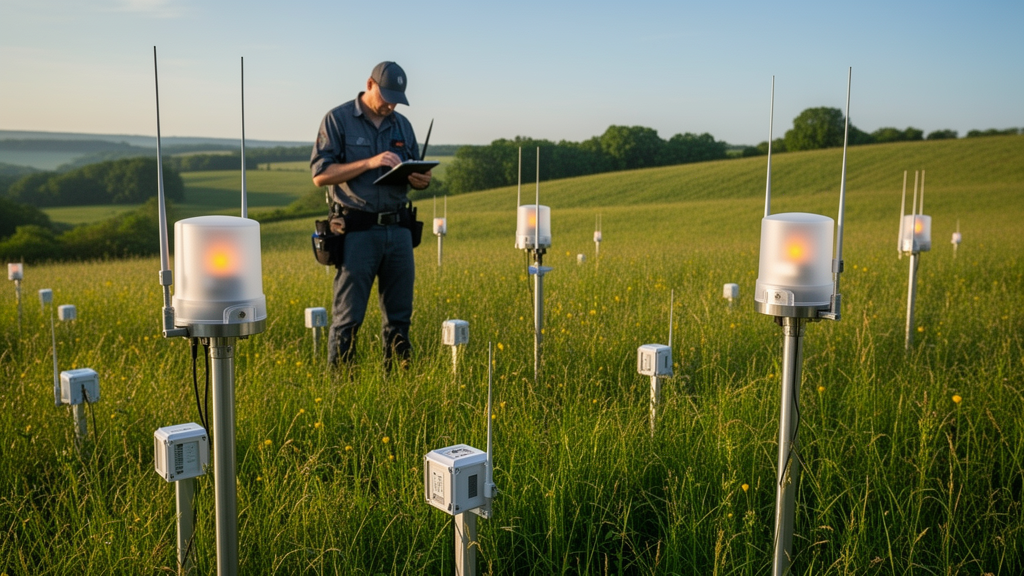
A new research framework introduces an AI-assisted distributed decision-making approach designed to improve range-free localization in wireless sensor networks (WSNs). By extending the classical Distance Vector-Hop (DV-Hop) method, the approach incorporates an intelligent anchor selection mechanism to refine the positioning of unknown sensor nodes. The findings, published in the International Journal of Networked and Distributed Computing, demonstrate that AI-driven, topology-aware strategies can significantly surpass traditional anchor-intensive localization schemes in accuracy.
At the core of the proposed system is a dynamic anchor elimination mechanism guided by machine learning classifiers. This mechanism allows each individual node to autonomously identify and select the most informative anchors within the network.
To support this decision-making process, the team implemented a tailored feature extraction scheme. This method captures essential data points, including spatial relationships between nodes, network connectivity metrics, and distance estimation errors. By processing these variables through machine learning models, the network can conduct context-aware assessments, ensuring that each node prioritizes anchors that contribute most effectively to the final localization calculation.
The study validated the proposed framework through extensive testing across 40 distinct WSN scenarios, which encompassed both uniform and non-uniform anchor deployments. The experiments sought to determine the impact of removing poorly informative anchors on the overall precision of the network. Researchers monitored the Root Mean Square Error (RMSE) to gauge performance gains under various machine learning configurations and network structures.
Results from the analysis indicated that removing even a single, poorly informative anchor can result in substantial improvements. The best-performing configuration, utilizing LM combined with LGBM under uniform anchor deployments, achieved a reduction in RMSE of nearly 30% compared to conventional full-anchor configurations. This improvement underscores the value of selective anchor usage in enhancing the positional accuracy of wireless sensors.
However, the analysis also highlighted limitations related to network topology. The performance of the localization algorithm showed degradation when anchors were concentrated in limited regions of the deployment area. This observation emphasizes that while AI-driven selection is effective, the physical placement and distribution of anchors remain critical factors in maintaining overall system performance.
Overall, this research challenges the conventional assumption in wireless network design that increasing the total number of anchors automatically leads to better localization. By prioritizing the quality and relevance of anchor data over raw quantity, the AI-driven approach provides a more efficient and accurate alternative for range-free localization in WSNs.
Subject of Research: Artificial intelligence optimization for wireless sensor network localization accuracy.
Article Title: Topology-Aware Anchor Selection Using AI for Range-Free Localization in Wireless Sensor Networks
Article References: Díaz-Román, J., Mederos, B., Cota-Ruiz, J., Enríquez-Aguilera, F., Sifuentes, E., Mejía-Muñoz, J.-M., & Bravo, G. (2026). Topology-Aware Anchor Selection Using AI for Range-Free Localization in Wireless Sensor Networks. International Journal of Networked and Distributed Computing, 14(2), Article 40. https://doi.org/10.1007/s44227-026-00120-4
Image Credits: AI Generated
DOI: 10.1007/s44227-026-00120-4
Keywords: Wireless Sensor Networks, WSN, Localization, AI, Machine Learning, DV-Hop, Anchor Selection, Distributed Computing, RMSE, Feature Extraction, Network Topology, Sensor Node, Data-Driven, Spatial Relationships, Network Connectivity
News Source: Reid Dalton. (November 18, 2026). Topology-Aware Anchor Selection Improves Localization Accuracy in Wireless Sensor Networks. Scienmag.