


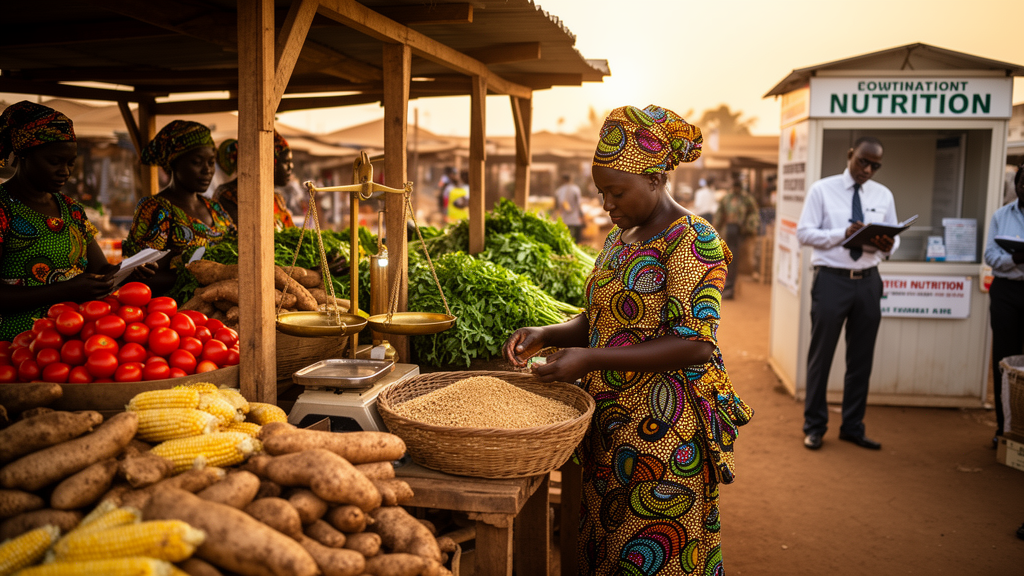
Public policies in Togo are falling well short of what international best practices call for in creating a healthy food environment, according to a new evaluation published in BMC Nutrition. Using the Food Environment Policy Index, known as Food-EPI, researchers found that implementation levels were below 40 percent for the majority of the indicators assessed when measured against international benchmarks. The study, led by Tiatou Souho and colleagues, set out to determine how far government action in Togo contributes to a food environment that is healthy, sustainable and equitable for the country’s population.
Food-EPI is a structured tool that evaluates two components considered key determinants in shaping healthier and more sustainable food environments: the policies themselves and the infrastructure support behind them. For this assessment, the tool was adapted to address the triple burden of malnutrition, a framing intended to fight all forms of malnutrition rather than a single type. In total, 59 indicators were validated and used to gauge the extent of policy implementation and infrastructure support in Togo. The comparison against international best practices provided a standardized yardstick for judging how much of the recommended policy agenda the country has actually put in place.
The results paint a picture of substantial gaps. With implementation below 40 percent for most indicators, the evaluation suggests that considerable efforts remain before Togo reaches the level of policy action that international benchmarks describe. The triple burden dimension of the analysis showed an even sharper concentration of weakness: only two indicators reached implementation levels of up to 60 percent. That figure indicates that across the range of policies relevant to all forms of malnutrition, very few areas approach the upper range of implementation observed anywhere in the assessment.
The study did not stop at diagnosis. Based on the evaluation results, experts who took part in the process formulated recommendations for improving the policy environment. These recommendations were then ranked according to several criteria: their potential impact, their sustainability, their feasibility, and their effects on the triple burden of malnutrition and on gender equity. From this ranking process, ten priority recommendations were identified. The authors describe this as an evidence-based approach, meaning the priorities derive directly from the measured gaps rather than from general advocacy positions.
The purpose of the exercise, as stated in the study, was to evaluate the level at which public policies implemented in Togo contribute to the establishment of a healthy, sustainable and equitable food environment. The researchers frame food systems as playing a central role in human motivations and social interactions, a framing they use to argue that public authorities bear responsibility for implementing effective policies in this domain. The Food-EPI methodology has been applied in other countries as well; related work cited in the same journal includes evaluations in Türkiye and repeated assessments in New Zealand, the latter documenting nine years of limited policy progress.
The conclusion drawn by the authors is direct: the study highlights the current state of public policies shaping the food environment in Togo and shows that considerable efforts are still required to achieve a healthy, sustainable and equitable food environment. They place this national finding in a regional context, arguing that in the setting of harmonization across West Africa, such efforts in Togo and its neighbor countries represent opportunities to move the region toward the targets of the Sustainable Development Goals. The published version assessed here was released as open access on 12 October 2026 and carries the article’s permanent DOI.
Methodologically, the adaptation of Food-EPI to the triple burden is a notable feature of the Togo assessment. The standard index distinguishes policy domains from infrastructure support domains, and the Togo team validated 59 indicators spanning both. The ranking of the resulting recommendations against impact, sustainability, feasibility, triple burden effects and gender equity reflects a multi-criteria prioritization rather than a single-metric judgment. This structure is intended to give policymakers a ranked list of actions whose expected value has been systematically compared, though the study reports the prioritization outcome without detailing implementation costs or timelines in the abstract.
For readers assessing the significance of the findings, the key numbers are the implementation percentages. Below 40 percent for the majority of indicators means that, relative to international best practices, most of the measured policy and infrastructure elements in Togo are at less than half of the benchmark level. The two indicators reaching up to 60 percent on the triple burden side mark the ceiling of the observed performance in that component. The study’s own summary is that these results demonstrate the distance between current Togolese policy and the healthy, sustainable and equitable food environment the evaluation was designed to measure, and that the ten priority recommendations represent the experts’ evidence-based route for closing that distance.
Subject of Research: Evaluation of Togo's national food environment policies using the Food-EPI index and the formulation of evidence-based priority recommendations
Article Title: Evaluation of national policy for healthy food environment in Togo and formulation of evidence-based recommendations using Food-EPI
Article References: Souho, T., Melila, M., Kwadjode, K., Manga, J. S., Diouf, A., Moubarac, J.-C., Kabassina, M. E., Pita, G. S., Dare, G., Bere, E., Vandevijvere, S., Bouraïma, M., & Amouzou, S. K. (2026). Evaluation of national policy for healthy food environment in Togo and formulation of evidence-based recommendations using Food-EPI. BMC Nutrition. https://doi.org/10.1186/s40795-026-01513-y
Image Credits: AI Generated
DOI: 10.1186/s40795-026-01513-y
Keywords: Togo, Food-EPI, food environment policy, triple burden of malnutrition, public health nutrition, policy evaluation, infrastructure support, evidence-based recommendations, West Africa, Sustainable Development Goals, gender equity, BMC Nutrition
News Source: Ophelia Keating. (October 30, 2026). Togo’s food policies fall short of global best practices, Food-EPI review finds. Scienmag.



