Credit: Nitz/Nature Neuroscience
Imagine you're navigating a city like New York, or any other that's laid out on a grid. Suppose you run into a roadblock as you're heading north. How do you know that you can turn to your left, say, and then take a right at the next intersection to continue in your original direction? According to research from the University of California San Diego, it may be thanks to some newly identified neurons in an area of your brain called the subiculum.
In a paper published by Nature Neuroscience, the researchers say they have found neurons that help an animal align itself within a cognitive map of its environment. Working with rats, the researchers observe that cells in the subiculum seem to encode an animal's current axis of travel. The neurons signal "I'm on this line, in this orientation."
"We're describing an entirely new and unexpected form of neural activity," said senior author Douglas Nitz, a professor of cognitive science in the UC San Diego Division of Social Sciences. "The cells fire when the animal travels in either direction along a single axis."
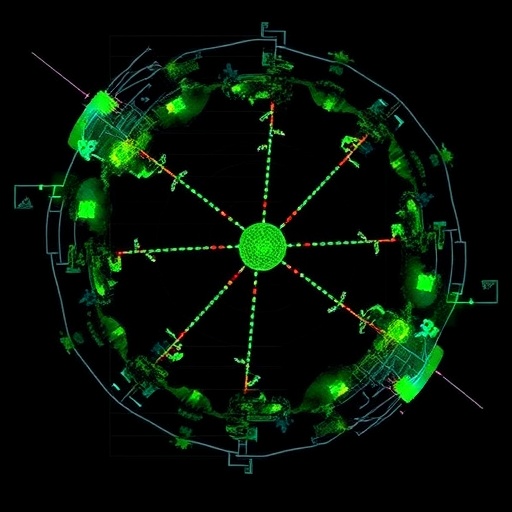
The rats ran on six interconnected routes much like a city grid, and the researchers took recordings from single neurons in the subiculum. Neurons that the researchers have dubbed "axis-tuned" fired when the animal traveled in either direction on a particular line – one of these firing, for example, when the animal moved north to south or south to north, but staying quiet for east-west. Others were activated for other lines of travel.
"The novel representation here is that the rat is mentally grouping these different locations," said first author and UC San Diego Department of Cognitive Science Ph.D. student Jacob Olson. "Functionally, the routes are all the same, and what the axis-tuned neuron appears to do is encode the functional similarity among different paths. It encodes how multiple pathways are oriented to each other and connected."
Like humans, Nitz said, rats tend to create and travel on pathways. But the researchers also checked if these neurons worked during open-field foraging. They did not. They fired only when the rats were traveling on paths.
The neurons appear to be distinct from head direction cells discovered earlier, the researchers write, for two reasons: Head direction neurons fire when an animal's head is pointed a certain way but not in the opposite direction. They also fire in an open field.
The axis-tuned cells account for about 10 percent of the subiculum neurons, the researchers estimate.
The subiculum is one of the primary outputs of the hippocampus, they note, a region of the brain known to be involved in orientation, location and episodic memory. But what kind of signal the subiculum produces has been a bit of mystery.
"This neural activity is a brand new kid on the block in a rich field of literature," said Nitz. The axis-tuned cell adds to what we already know about orientation encoding in the brain, he said, and takes its place among other cells important to navigation and orientation: place cells, grid cells and head direction cells.
Next steps for the research include studies on how much experience a rat needs with a path before the axis-tuned cells begin functioning, and on whether the representations show up in humans as well.
###
UC San Diego undergraduate student Kanyanat Tongprasearth is also a coauthor on the paper.
The research was supported by grants from the National Science Foundation (IOS-1149718) and the Kavli Institute for Brain and Mind (#2015-055).
Media Contact
Inga Kiderra
[email protected]
858-822-0661
@UCSanDiego
http://www.ucsd.edu