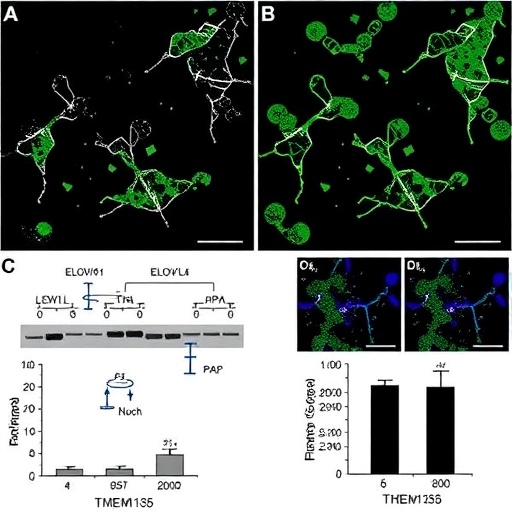
A molecular switch that helps the intestine manage incoming fat may have been identified in an unexpected place: the activity of a protein called TMEM135. In a study published in Experimental & Molecular Medicine, researchers report that reducing or eliminating TMEM135 prevents excessive lipid accumulation in the intestine. Their findings suggest that the protein influences two processes that must remain tightly balanced—how much fat intestinal cells absorb and how efficiently they burn it for energy.
The intestine is designed to capture dietary lipids, package them, and distribute them throughout the body. This process is essential for absorbing energy and fat-soluble vitamins, but it can become harmful when lipid uptake outpaces lipid disposal. Excess fatty acids can be stored inside intestinal cells as lipid droplets or redirected into metabolic pathways that generate damaging intermediates. The new study links TMEM135 deficiency to a metabolic response that appears to limit this buildup by coordinating fatty-acid entry with oxidation.
At the center of the mechanism is ELOVL6, an enzyme that remodels fatty acids by extending their carbon chains. ELOVL6 preferentially converts 16-carbon fatty acids into longer 18-carbon forms, changing the composition of the cellular lipid pool. This is more than a chemical fine-tuning operation: the length and structure of fatty acids can influence membrane properties, lipid storage, signaling, and the activation of metabolic genes. According to the researchers, TMEM135 deficiency affects this ELOVL6-dependent pathway, creating conditions that promote the breakdown of fatty acids rather than their accumulation.
The downstream target is PPARα, a nuclear receptor that acts as a major transcriptional regulator of lipid oxidation. When activated, PPARα enters the nucleus and stimulates genes involved in fatty-acid transport, mitochondrial β-oxidation, and related energy-producing pathways. In practical terms, this program helps cells convert fatty acids into acetyl-CoA and other metabolic intermediates that can be processed for energy. The study proposes that altered ELOVL6 activity activates PPARα, thereby increasing the intestine’s capacity to burn lipids.
This connection provides a possible explanation for why TMEM135 deficiency can protect intestinal cells from lipid overload. Rather than simply blocking the absorption of dietary fat, the process appears to reshape how absorbed fatty acids are handled after they enter the cell. By influencing fatty-acid composition through ELOVL6 and activating PPARα-driven oxidation, the deficiency may shift intestinal metabolism toward a state in which lipids are processed more rapidly and stored less extensively.
The finding is notable because intestinal lipid metabolism is often discussed primarily in terms of uptake. Specialized transport proteins and enzymes move fatty acids across the intestinal lining, where they are reassembled into triglycerides and packaged into lipoprotein particles. However, uptake alone does not determine whether fat accumulates. The cell’s ability to oxidize, export, or safely store those molecules is equally important. The reported TMEM135–ELOVL6–PPARα pathway places these stages within a single regulatory framework.
The work could eventually inform research into conditions associated with abnormal lipid handling, including obesity, metabolic dysfunction, fatty liver disease, and intestinal lipid disorders. If the pathway can be manipulated safely, activating its beneficial components could offer a strategy for increasing fatty-acid oxidation without broadly suppressing nutrient absorption. Yet the findings should not be interpreted as evidence that TMEM135-targeting treatments are ready for use. A metabolic pathway that influences lipid processing in the intestine may also affect other organs, energy balance, inflammation, or the availability of essential fatty acids.
The study also raises broader questions about TMEM135 itself. The protein has been linked to intracellular organelle biology and lipid-related functions, but its precise role in coordinating intestinal metabolism remains an area for investigation. Future studies will need to establish how TMEM135 controls ELOVL6, whether the effect occurs directly or through intermediate signaling pathways, and how strongly the mechanism depends on diet. Researchers will also need to determine whether the same response occurs in human intestinal tissue and whether long-term activation of PPARα produces beneficial or unwanted consequences.
For now, the research offers a striking example of how the body can defend itself against lipid overload by changing the fate of fat after absorption. TMEM135 deficiency appears to reorganize fatty-acid metabolism through ELOVL6-mediated PPARα activation, linking molecular lipid remodeling to the expression of genes that drive oxidation. The result is a potentially powerful metabolic circuit in which the intestine does not merely take up nutrients, but actively decides whether those nutrients should be stored or burned.
Subject of Research: TMEM135 deficiency and intestinal lipid metabolism
Article Title: TMEM135 deficiency prevents intestinal lipid accumulation by coordinating lipid uptake and oxidation through ELOVL6-mediated PPARα activation
Article References: Kim, H., Park, C., Wei, X. et al. TMEM135 deficiency prevents intestinal lipid accumulation by coordinating lipid uptake and oxidation through ELOVL6-mediated PPARα activation. Exp Mol Med (2026). https://doi.org/10.1038/s12276-026-01795-z
Image Credits: AI Generated
DOI: 10.1038/s12276-026-01795-z
Keywords: TMEM135, intestinal lipid metabolism, ELOVL6, PPARα, fatty-acid oxidation, lipid accumulation, lipid uptake, metabolic regulation
Tags: dietary fat processing and energy balanceELOVL6 enzyme and fatty acid elongationFat metabolism regulation in the intestineimpact of TMEM135 deficiency on fatty acid metabolismintestinal lipid absorption and storage mechanismslipid droplet formation and breakdownlipid remodeling and metabolic healthmolecular pathways of lipid oxidationPPARα activation in lipid oxidationprevention of lipid accumulation in intestinal cellsregulation of fatty acid chain length by ELOVL6TMEM135 protein role in lipid homeostasis