Dental implants fail surprisingly often for a technology with a 95 percent osseointegration success rate: the reported incidence of peri-implantitis, an inflammatory disease of the tissues surrounding an implant, ranges from 15 to 40 percent. The condition involves loss of attachment of the gingival tissues, alveolar bone resorption, and ultimately implant loosening. A study published in Materials Today Bio now reports a surface engineering strategy that attacks the disease at three stages at once, by killing bacteria with light-generated heat, neutralizing inflammatory molecules, and encouraging gum tissue to seal tightly around the implant abutment.
The team, led by researchers including Min Xing and Jiajun Qiu, created a disordered optical metasurface CeOx/TiO2 heterostructure on titanium abutment surfaces. They used plasma immersion ion implantation to embed cerium ions into titanium, followed by heat treatment at 550 degrees Celsius for one hour. The implantation formed a thin, uniform cerium-doped layer, and the subsequent oxidation produced a CeOx/TiO2 heterostructure. Cross-sectional electron microscopy revealed a layered architecture: an oxygen-rich oxide zone on top and a cerium diffusion zone extending more than 3500 nanometers deep, far beyond the few hundred nanometers typical of conventional ion implantation, apparently thanks to lattice defects providing migration pathways combined with thermally activated bulk diffusion.
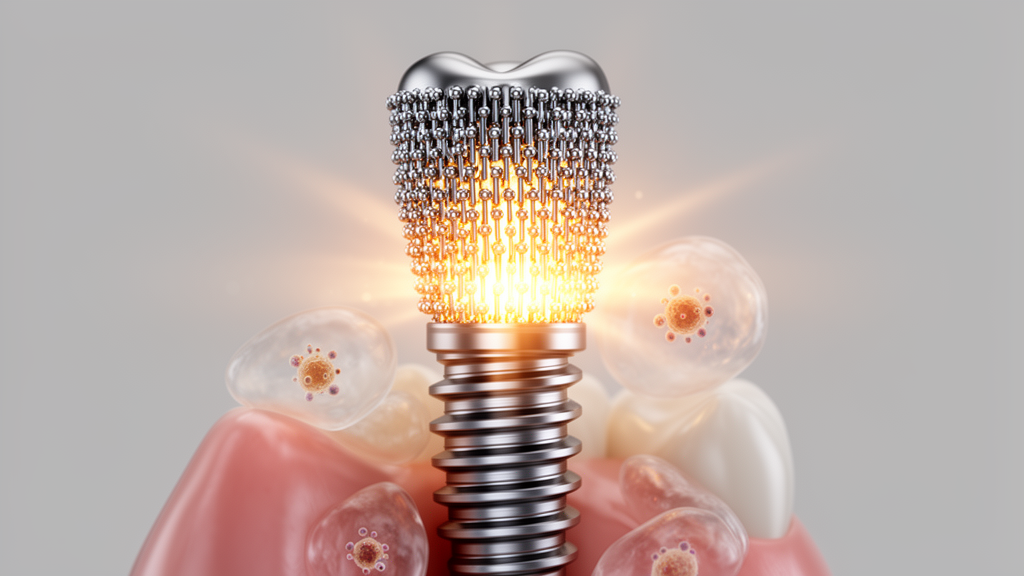
The most visually striking feature was a dense network of nanocavities, roughly 10 to 30 nanometers in diameter, distributed in a gradient along the interface. Cavities near the oxide-substrate boundary were small and densely packed, growing larger and sparser toward the surface. The authors attribute their formation to stress accumulation from defect supersaturation and lattice mismatch, with vacancy clusters migrating toward the surface during heat treatment in a Kirkendall-like process. Because these cavities are far smaller than near-infrared wavelengths of 780 to 1100 nanometers, they act as a disordered metasurface: embedded voids in a high-refractive-index TiO2 matrix induce multiple scattering that traps light, extends its path length, and raises absorption probability, while the near-vacuum thermal conductivity of the voids helps accumulate heat.
The optical payoff was substantial. Under 1064-nanometer near-infrared irradiation at 0.50 W/cm2, surface temperatures reached 64.1 degrees Celsius for bare titanium, 77.1 for cerium-implanted titanium, 96.2 for TiO2, and 120.9 degrees Celsius for the full CeOx/TiO2 heterostructure in air. The coating also proved stable across three on-off irradiation cycles, holding roughly 120 degrees Celsius. In ultrapure water, the same irradiation lifted CeOx/TiO2 to 56.2 degrees Celsius within ten minutes, and in mouse subcutaneous tissue at 0.75 W/cm2 it reached 49.9 degrees Celsius, the highest of the tested surfaces. Spectroscopic measurements showed the heterostructure narrowed the bandgap from 3.16 to 2.84 electronvolts, which density functional theory calculations attributed to cerium 4f orbital states introducing an intermediate defect-mediated band that permits excitation by near-infrared rather than ultraviolet light.
That photothermal performance translated directly into antibacterial action. Against Staphylococcus aureus under irradiation, TiO2 achieved a 90.78 percent kill rate while CeOx/TiO2 reached 99.96 percent; against Escherichia coli the figures were 98.04 and 100.00 percent. Scanning electron microscopy showed membrane damage in irradiated bacteria on the coated surfaces, and protein leakage assays confirmed loss of membrane integrity. The coating also showed potent bactericidal activity against Porphyromonas gingivalis, an anaerobic periodontal pathogen, and crystal violet staining indicated significantly reduced preformed S. aureus biofilm biomass on irradiated TiO2 and CeOx/TiO2 compared with untreated controls.
The cerium component served a second, chemically distinct purpose. In assays with 500 micromolar hydrogen peroxide, cerium-containing coatings kept fluorescence levels of a hydroxyl-radical probe near baseline, indicating reactive oxygen species scavenging. The authors attribute this to reversible cycling between Ce4+ and Ce3+, mimicking superoxide dismutase and catalase enzymatic activity in a self-regenerating cycle. In human gingival fibroblasts, intracellular ROS levels on CeOx/TiO2 dropped significantly under hydrogen peroxide, near-infrared irradiation, and hyperthermia stress, and cell viability remained high under all three conditions. The coating also promoted fibroblast adhesion, spreading, and migration, and upregulated mRNA and protein expression of fibronectin, type I collagen, and integrin beta-1, key components of the extracellular matrix that anchors gum tissue to the abutment.
Transcriptome sequencing of fibroblasts on the coated surface found 1144 genes significantly upregulated and 86 downregulated relative to bare titanium. Enrichment analysis highlighted antioxidant activity, extracellular matrix organization, wound healing, and focal adhesion terms, with the Rap1 signaling pathway identified as a major regulatory hub, potentially activated upstream through neuroactive ligand-receptor interactions that elevate intracellular calcium, which the team confirmed by Fluo-4 fluorescence and Western blotting of pathway proteins. The authors caution, however, that this proposed signaling cascade rests on bioinformatic predictions and correlative protein data, and lacks causal verification through receptor blockade or gene knockdown experiments.
The pivotal test came in a beagle dog model. Peri-implantitis was induced with silk ligatures around implants in four dogs, using a self-controlled design in which each animal received both bare titanium and CeOx/TiO2-modified abutments at randomized molar positions, yielding 16 observation sites. Once disease was established, with probing pocket depths of 4 to 6 millimeters and V-shaped bone defects visible on radiographs, the modified abutments were installed and irradiated weekly with a 1064-nanometer laser at 0.75 W/cm2 for five minutes, holding the abutment surface at 50 degrees Celsius, a threshold chosen to avoid bone thermal necrosis. After four weeks, the CeOx/TiO2 group showed significantly reduced probing depth and plaque, lower gingival crevicular fluid levels of the inflammatory markers TNF-alpha and IL-6, macrophage polarization markers shifting toward the reparative CD206 phenotype, and increased expression of BP180, VEGF, and type I collagen, all associated with soft tissue sealing and repair. Micro-CT showed increases in bone volume fraction, bone-implant contact, and trabecular thickness and number relative to titanium controls.
The authors are candid about the limitations. Ion release measurements did show that under acidic conditions mimicking cola, at pH 2.5, both titanium and cerium release rose markedly over 14 days, with cerium reaching about 45 parts per billion under irradiation, though release stayed low at neutral pH.
Even with those caveats, the study demonstrates an unusually integrated materials design: one coating that converts clinical laser light into localized heat for targeted bacterial killing, simultaneously mops up the oxidative radicals that drive inflammation, and biochemically encourages the soft tissue barrier that keeps bacteria out in the first place. Whether weekly near-infrared treatments can be practical in routine supportive peri-implantitis care, and whether the benefits hold in complex oral microbial communities and under years of mechanical stress, are questions the authors themselves flag for future work. For now, the metasurface heterostructure stands as a proof of concept that implant surfaces can be engineered to prevent, treat, and regenerate rather than merely coexist with their biological environment.
Subject of Research: A CeOx/TiO2 optical metasurface coating on titanium dental implant abutments for photothermal antibacterial treatment and prevention of peri-implantitis
Article Title: Robust optical metasurface heterostructures for prevention and treatment of peri-implantitis
Article References: Xing, M., Zhang, H., Chen, T., Ye, K., Feng, J., Qian, W., Liu, X., & Qiu, J. (2026). Robust optical metasurface heterostructures for prevention and treatment of peri-implantitis. Materials Today Bio, 41, Article 103783. https://doi.org/10.1016/j.mtbio.2026.103783
Image Credits: AI Generated
DOI: 10.1016/j.mtbio.2026.103783
Keywords: peri-implantitis, dental implants, titanium, metasurface, CeOx/TiO2 heterostructure, photothermal antibacterial, near-infrared, reactive oxygen species, soft tissue sealing, plasma immersion ion implantation, beagle dog model, gingival fibroblasts
News Source: Denise Maddox. (October 29, 2026). Titanium Coating Uses Light-Trapping Metasurface to Fight Peri-Implantitis. Scienmag.