


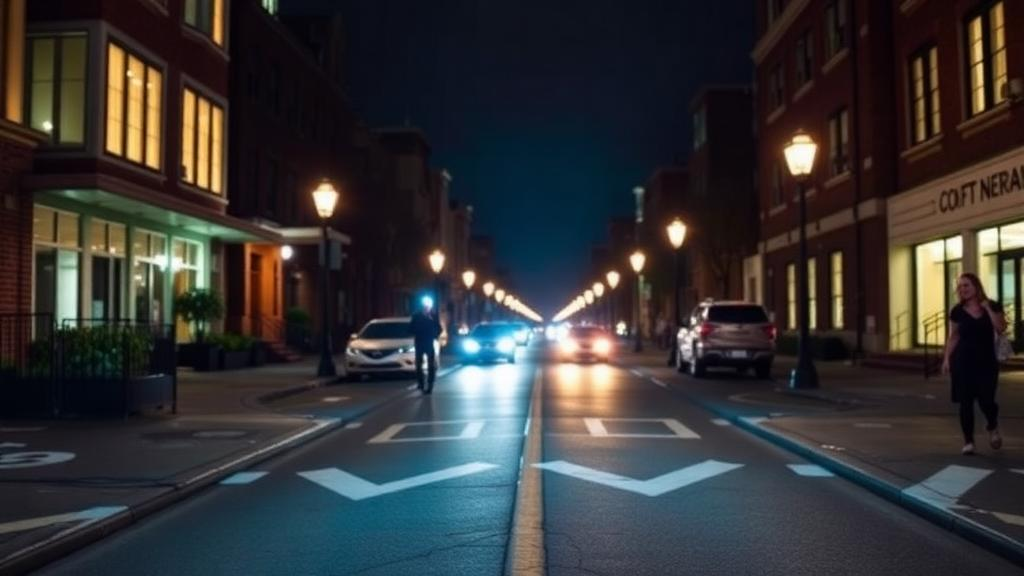
Women rated campus streets as safer and more pleasant when nighttime lighting was brighter, according to a photo-based immersive virtual environment study published in Architectural Research. Researchers led by Wenwen Tao and Kyung Hoon Lee created paired daytime and nighttime 360-degree scenes from 18 street segments on four university campuses in a single Chinese city and asked 55 female participants to rate every scene in both conditions, producing 990 ratings per time condition.
The study framed its questions through the Prospect-Concealment-Escape framework, derived from prospect-refuge theory, which describes perceived safety through three dimensions: prospect, meaning visibility and openness; concealment, meaning occlusion and possible hiding places; and escape, meaning mobility and route choice. In this study, the escape dimension was operationalized as accessibility, capturing walking ease and the availability of alternative routes. Prior research suggests high prospect and high escape increase perceived control, whereas high concealment increases uncertainty and anxiety.
Because each participant rated every scene, the ratings were clustered at both the participant and scene levels. To handle this non-independence, the team fitted cross-classified linear mixed-effects models with random intercepts for both participants and scenes, controlling for road width and street type. Nighttime illuminance had been measured in the field with a lux meter mounted 160 centimeters above ground to approximate pedestrian eye level, following a standardized protocol conducted from January 10 to 17, 2025. The 18 segments varied substantially, with nighttime illuminance ranging from 0.06 to 90 lux and road widths of roughly 2 to 12 meters.
The first hypothesis concerned main effects. Higher nighttime illuminance was significantly associated with higher ratings of both perceived safety and environmental preference after controlling for road width and street type, which showed no reliable association and only marginal differences respectively. Descriptively, daytime ratings exceeded nighttime ratings overall: environmental preference averaged 4.775 during the day versus 2.990 at night, and perceived safety averaged 4.727 versus 2.840, underscoring how much dimmer and less favored the same streets felt after dark.
The second hypothesis tested whether lighting worked through the three psychological channels. Illuminance significantly increased ratings of visibility and accessibility and significantly decreased ratings of concealment. When all three mediators were entered simultaneously, visibility and accessibility showed significant positive effects on both outcomes, while concealment showed significant negative effects. Indirect effects, evaluated with Monte Carlo confidence intervals based on 50,000 draws, were all supported: the total indirect effect was 0.017 for safety and 0.016 for preference. Importantly, a significant direct effect of illuminance remained on both outcomes, indicating partial mediation. The authors interpret this residual association as likely reflecting broader evaluative inferences, such as perceived orderliness, maintenance, and social visibility, that the three cue ratings do not capture.
The third hypothesis examined whether time of day changed the strength of these pathways, using the full day-night dataset with time-by-cue interaction terms. The answer was selective rather than uniform. The positive association between visibility and environmental preference was stronger at night, and concealment showed a stronger negative association with perceived safety at night, suggesting heightened sensitivity to potential hiding places after dark. Most other interactions were non-significant or only marginal, including the time-by-accessibility interaction in the safety model, so the evidence did not support a uniform nighttime amplification pattern across all pathways.
The participants were women aged 20 to 45, with 74.5 percent aged 20 to 29. All were non-students from the target campuses, a sampling choice intended to control for scene familiarity. Most reported walking more frequently in the daytime, about 38 percent also walked at night, and roughly 78 percent typically walked with companions. About 89 percent were Chinese, a composition the authors flag as limiting generalizability to other cultural and management contexts.
The study has further limitations the authors acknowledge. The stimuli were static 360-degree scenes rather than dynamic walking experiences, and future work could incorporate route-based tasks with behavioral or physiological measures such as walking speed, gaze, or heart rate. The lighting measure was segment-level average illuminance, which does not capture uniformity, glare, correlated color temperature, or color rendering, and pedestrian flow as a social-visibility cue was not directly measured. Both the sample and the scenes came from four campuses in one city, and prior virtual reality experience was not systematically recorded.
For design practice, the findings argue against simply adding brightness. Because the lighting effect operated partly through visibility, accessibility, and reduced concealment, the authors suggest coordinating lighting with spatial interface treatments: improving evenness of lighting at intersections, turns, and decision points; pruning dense vegetation and treating recessed setbacks and blind corners that can read as hiding spots; and keeping primary routes continuous while preserving visible secondary exits. They also caution that uneven lighting creating strong bright-dark contrasts can leave visually uncertain areas that offset the benefits of brightening.
Within its scope, the study offers a mechanistic account of why similar lighting increases can produce different outcomes across street segments. Where added light translates into clearer sightlines and fewer dark corners, benefits for perceived safety and preference appear more robust; where interface conditions continue to offer concealment, those gains may be weakened. The conclusions apply most directly to young adult women in semi-public campus settings with similar socio-cultural conditions, and replication across other cities, age groups, and street types remains a task for future research.
Subject of Research: Perceived safety and environmental preference of female pedestrians on campus streets under varying nighttime lighting
Article Title: Female Pedestrians’ Perceived Safety and Environmental Preference on Campus Streets: An IVE-Based Quantitative Study Using the Prospect–Concealment–Escape (P–C–E) Framework
Article References: Tao, W., & Lee, K. H. (2026). Female Pedestrians’ Perceived Safety and Environmental Preference on Campus Streets: An IVE-Based Quantitative Study Using the Prospect–Concealment–Escape (P–C–E) Framework. Architectural Research, 28(1), Article 10. https://doi.org/10.1007/s44515-026-00011-3
Image Credits: AI Generated
DOI: 10.1007/s44515-026-00011-3
Keywords: perceived safety, nighttime lighting, campus streets, immersive virtual environment, pedestrians, illuminance, environmental preference, women's safety, urban design, Prospect-Concealment-Escape, Female, Perceived
News Source: Denise Maddox. (October 29, 2026). Brighter Campus Streets Feel Safer to Women at Night, Virtual Reality Study Finds. Scienmag.



