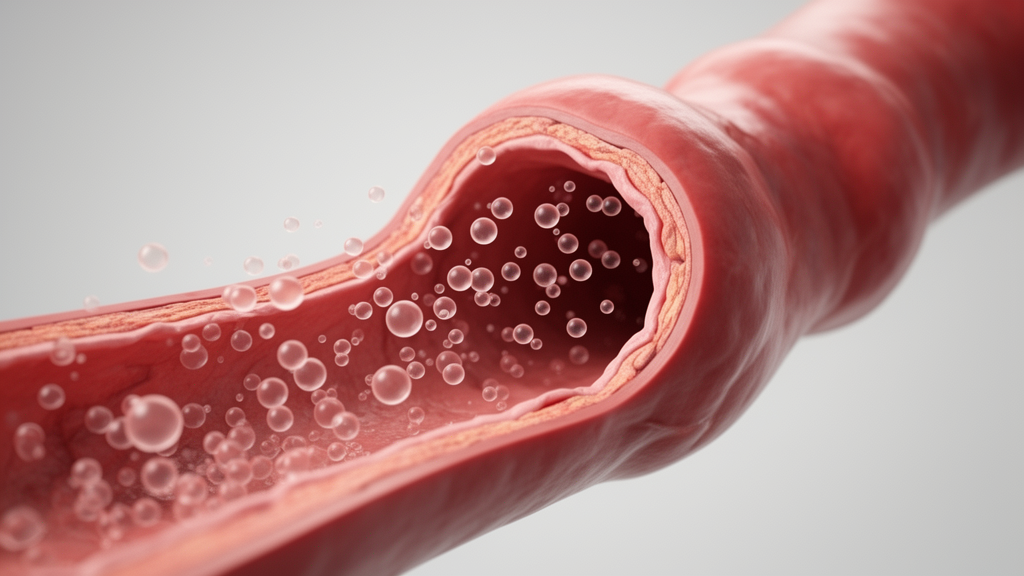
Abdominal aortic aneurysms, or AAAs, are a silent killer that affects millions worldwide. This bulging of the body’s largest artery often goes undetected until it ruptures, causing an estimated 150,000 to 200,000 deaths annually. Now, a new review published in Experimental Biology and Medicine suggests that microscopic particles called extracellular vesicles, or EVs, could become the first non-surgical therapy to slow or even reverse this deadly disease.
For patients with small AAAs, there is currently no effective drug treatment. Doctors simply monitor the aneurysm with regular imaging scans and hope it doesn’t grow. Once an aneurysm reaches a critical size, typically 55 millimeters in men or 50 millimeters in women, the only option is invasive surgery or endovascular repair. This therapeutic gap has frustrated vascular surgeons for decades, because the disease is driven by a complex web of interacting processes rather than a single molecular target.
EVs are nanoscale, membrane-enclosed particles secreted by cells that carry proteins, lipids, and genetic material between cells. Once dismissed as cellular waste, they are now recognized as powerful messengers that can reprogram the behavior of recipient cells. Because they can simultaneously modulate inflammation, cell death, and tissue degradation, they offer a biologically rational platform for treating a multi-pathway disease like AAA.
The review, led by Huibo Ma and colleagues at Peking Union Medical College Hospital, synthesizes recent preclinical studies showing that therapeutic EVs can attenuate aneurysm formation in mouse models. Mesenchymal stromal cell-derived EVs, for example, suppress macrophage-driven inflammation by delivering microRNAs such as miR-147 and miR-17-5p, which target key inflammatory pathways. Other studies show that EVs can redirect destructive neutrophil behavior toward harmless apoptosis, protecting vascular smooth muscle cells from ferroptosis-related damage.
Perhaps most strikingly, EVs appear to protect the vascular wall from senescence, the process by which cells stop dividing and accumulate damage with age. One study showed that EVs enriched with NAMPT, an enzyme that boosts NAD+ biosynthesis, restored mitochondrial function in vascular smooth muscle cells and delayed the pathological phenotypic switching that drives aneurysm expansion. This anti-aging effect on the vascular wall could be particularly relevant for a disease that predominantly affects older adults.
But natural EVs have significant limitations. After systemic administration, they are rapidly cleared by the liver and spleen, and they show poor accumulation at the aneurysm site. To overcome this, researchers are engineering EVs with enhanced targeting capabilities. One team coupled cathepsin K-binding peptides onto EV surfaces using click chemistry, improving binding to aneurysmal cells. Another group introduced osteopontin-targeted peptides, exploiting the enrichment of this protein in AAA lesions, and showed that these engineered EVs reduced aneurysm formation across two different mouse models.
Even more futuristic approaches combine EVs with magnetic guidance and chemotaxis. Researchers created hybrid exosome-nanomotor constructs by coupling bone marrow stromal cell exosomes onto magnetically responsive mesoporous silica modules loaded with catalase. This dual-drive strategy allowed the vesicles to navigate toward hydrogen peroxide-rich aneurysmal microenvironments while being guided by an external magnetic field, resulting in reduced post-treatment aneurysm diameter and improved elastic matrix repair in a rat model.
Despite these exciting advances, the review emphasizes that EV-based AAA therapy remains at an early preclinical stage. Key barriers include unclear biodistribution and clearance, insufficient evidence of lesion-specific target engagement, and highly heterogeneous EV isolation and characterization methods. The authors also highlight the challenge of evidence attribution: many studies cannot definitively demonstrate that observed effects arise from bona fide EVs rather than co-isolated non-vesicular contaminants such as lipoproteins.
The translational path forward will require rigorous standardization. The authors call for adoption of community guidelines such as MISEV2023, fit-for-purpose quality control including identity, purity, sterility, and potency assays linked to AAA mechanisms, and scalable manufacturing systems. They also suggest that EV biomarkers for diagnosis and monitoring may be closer to clinical application than therapeutics, with candidates such as ficolin-3 and miR-106a already showing promise in small patient cohorts.
Looking ahead, the authors argue that the future value of EVs in AAA may lie not in replacing all alternative platforms, but in occupying a complementary position between purely synthetic carriers and live-cell therapies. With mechanism-informed engineering to improve payload definition and device-enabled strategies to enhance lesion targeting and vascular retention, EVs could evolve from promising biological insights toward clinically credible tools for aneurysm stabilization. For a disease that currently offers patients little more than surveillance and surgery, that would represent a transformative shift.
The epidemiological backdrop of AAA underscores why a pharmacological option is so urgently needed. The disease predominantly affects older adults, with prevalence reaching roughly 5 to 10 percent in men over 65, and its incidence climbs steeply with age. As populations age, the proportion of people over 65 is projected to rise from 12 percent to 22 percent over the next three decades, which will amplify the number of patients living under surveillance and the overall public health burden of aneurysm disease.
Understanding what EVs actually are helps explain their appeal. They fall into three broad categories defined by size, origin, and release mechanism. Exosomes, typically 30 to 150 nanometers in diameter, arise when cell membrane invaginations form early endosomes that mature into multivesicular bodies; these bodies then fuse with the plasma membrane and release their internal vesicles outward. Microvesicles, ranging from about 100 to 1,000 nanometers, bud directly from the cell surface. Apoptotic bodies, the largest class at 500 to 5,000 nanometers, are shed during the late stages of programmed cell death. Each type carries a distinct molecular signature shaped by its parent cell.
The cargo repertoire of EVs is remarkably rich. Researchers have catalogued more than 3,000 protein species within EVs, alongside enzymes, growth factors, signaling molecules, and adhesion proteins that reflect the donor cell’s identity and functional state. Their lipid membranes are built from cholesterol, sphingomyelin, phosphatidylserine, and ceramide, while their nucleic acid payload includes messenger RNA, microRNA, long noncoding RNA, circular RNA, and transfer RNA fragments. Recent work has even identified subpopulations of EVs carrying mitochondrial components such as mitochondrial DNA and proteins, hinting at a role in repairing mitochondrial function within recipient cells.
This molecular diversity matters therapeutically because EV cargo is not fixed. It varies with the source cell type and with the physiological or pathological condition that cell is experiencing, meaning researchers can in principle select or engineer donor cells to package protective molecules. Beyond local signaling at the site of release, EVs also travel through the bloodstream and mediate long-distance communication between organs, which is precisely the property that makes them attractive as systemic drug delivery vehicles.
The pathological processes that EVs appear to counteract map closely onto what is known about AAA biology. Chronic inflammation, vascular smooth muscle cell dysfunction and loss, and extracellular matrix degradation are considered the central drivers of aneurysm initiation and expansion. Preclinical EV studies have targeted each of these pillars: suppressing macrophage-driven inflammation and steering macrophage polarization, blocking neutrophil extracellular trap-associated injury, protecting smooth muscle cells from senescence, ferroptosis, apoptosis, and mitochondrial dysfunction, and limiting the enzymatic breakdown of the arterial wall’s structural scaffold.
The engineering strategies described in the review address a common shortcoming of naive EV preparations, namely insufficient lesion targeting, rapid systemic clearance, and limited retention within the vascular wall. Cargo-enriched vesicles boost the concentration of therapeutic molecules, peptide-targeted vesicles home to aneurysm-specific markers, magnetically guided systems allow external steering, chemotaxis-enabled designs exploit the inflammatory microenvironment itself as a navigation cue, and biomaterial-assisted approaches anchor vesicles at the lesion site for prolonged local action.
A recurring theme in the review is the problem of evidence attribution. Because EVs are isolated from complex biological fluids, preparations can be contaminated with non-vesicular particles such as lipoproteins and protein aggregates that share similar size and density. If such contaminants drive the observed benefit, the therapeutic narrative could be misleading. This is why the authors stress rigorous characterization, including orthogonal methods that confirm vesicular identity, alongside functional assays tied to AAA-relevant mechanisms rather than generic potency readouts.
Dosing remains another unresolved question. Unlike conventional small molecules, EVs lack a clearly defined active ingredient, so establishing dose, frequency, and potency metrics requires new frameworks. Regulatory agencies have not yet settled on standardized expectations for EV-based products, and manufacturing at clinical scale poses additional hurdles in reproducibility, sterility, and batch consistency. The authors argue that progress will depend on coordinated adoption of community guidelines and fit-for-purpose quality control spanning identity, purity, sterility, and potency.
On the diagnostic side, EV-based biomarkers may reach the clinic sooner than therapeutics. Because EVs circulate in blood and carry disease-specific molecular signatures, they could serve as noninvasive indicators of aneurysm presence, growth rate, or rupture risk. Candidates such as ficolin-3 and miR-106a have already shown promise in small patient cohorts, though larger validation studies will be needed before such markers can inform routine surveillance decisions.
Ultimately, the review positions EVs not as a replacement for existing platforms but as a complementary middle ground between purely synthetic nanoparticles and live-cell therapies. Synthetic carriers offer precise engineering but lack biological complexity, while cell-based treatments carry potency but raise safety and manufacturing concerns. EVs combine a natural membrane with engineerable surfaces and payloads, and with continued refinement in targeting, retention, and standardization, they may yet translate from laboratory insight into a credible non-surgical option for patients who currently have none.
Subject of Research: Extracellular vesicles for abdominal aortic aneurysm: mechanisms, therapeutic potential, and translational challenges
Article Title: Extracellular vesicles for abdominal aortic aneurysm: mechanisms, therapeutic potential, and translational challenges
Article References: Ma, H., Xie, Z., Cai, Y., Li, F., Wu, J., & Zheng, Y. (2026). Extracellular vesicles for abdominal aortic aneurysm: mechanisms, therapeutic potential, and translational challenges. Experimental Biology and Medicine, 251, Article 11246. https://doi.org/10.3389/ebm.2026.11246
Image Credits: AI Generated
Keywords: Extracellular, vesicles, abdominal, aortic, aneurysm, mechanisms, therapeutic, potential, translational, challenges, scientific research
News Source: Drew Townsend. (October 16, 2026). Tiny vesicles could offer a drug-free path to treating deadly aortic aneurysms. Scienmag.