Deep in the tropical rainforests of Hainan Island, a beetle smaller than a grain of rice has rewritten the map of one of the world’s rarest insect families. Researchers collecting beneath the bark of a dead broadleaf tree in Jianfengling National Park have discovered a species of the genus Derolathrus in China for the first time, describing it as new to science in the Deutsche Entomologische Zeitschrift. The find, named Derolathrus hainanensis after its island home, brings the count of known species in this enigmatic lineage to fourteen and extends the documented range of a family so elusive that many entomologists spend entire careers without encountering a single specimen.
The family Jacobsoniidae, to which Derolathrus belongs, is what taxonomists call a relict lineage: a surviving branch of an ancient evolutionary tree that once likely held far more diversity than it does today. Currently, the family contains only three living genera, Derolathrus, Saphophagus and Sarothrias, with thirty described species in total, twenty-six of them extant and four known only as fossils. Their distribution is strikingly sporadic, scattered across the Australian, Oriental and Neotropical regions in a pattern that suggests long-isolated populations clinging to fragmented tropical habitats rather than any recent dispersal.
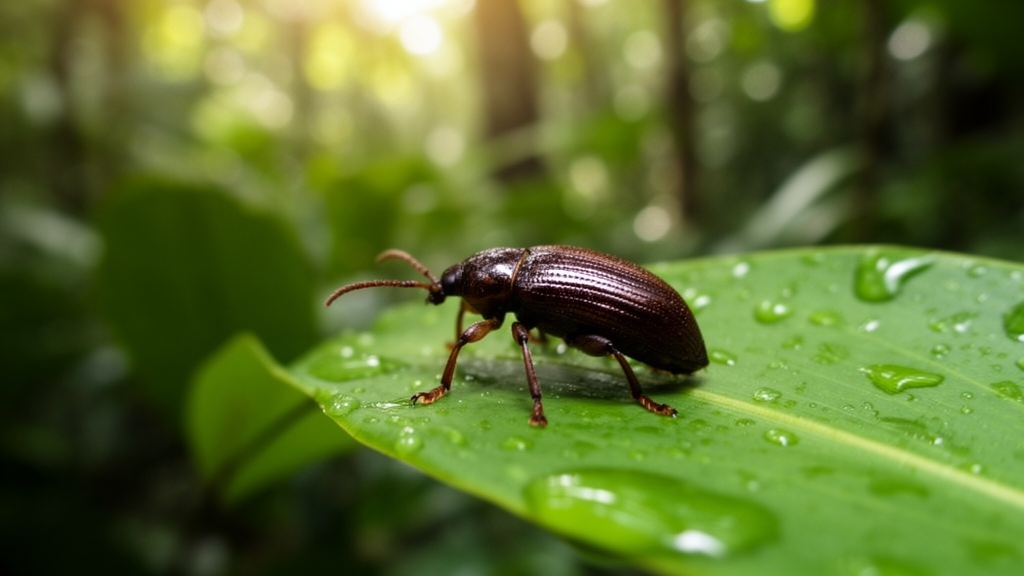
What makes these beetles remarkable is their sheer minuteness. Members of the family range from 0.65 to 2.50 millimetres in body length, and Derolathrus species stay under one millimetre. The new Chinese species measures just 0.93 to 0.98 millimetres, reddish-brown, narrowly elongate and subcylindrical in shape. At that scale, the beetles live in a world of fungal hyphae and bark crevices, a microhabitat invisible to casual observation. Their biology remains poorly understood, with specimens typically recovered from leaf litter or decaying wood, and Derolathrus species additionally recorded from fungal fruiting bodies and even bat guano.
The discovery itself was a product of patient fieldwork. On 28 March 2025, collector Ri-Xin Jiang found the adults congregating in the damp sections beneath the bark of a dead broadleaf tree in Mingfeng Valley, part of the Jianfengling area of Hainan Tropical Rainforest National Park, at roughly 940 metres altitude. The tree had not yet rotted away, and the beetles clustered where fungal colonisation was underway, offering novel biological information for a genus whose habits have rarely been documented in such detail.
In total, the team secured a holotype male and sixteen paratypes, seven males and eight females, now deposited at the Institute of Entomology of Guizhou University and the National Animal Collection Resource Center at the Institute of Zoology, Chinese Academy of Sciences. Morphological documentation relied on high-resolution imaging: habitus photographs were captured with a Canon 5D Mark IV camera fitted with a Mitutoyo Plan NIR 10 lens and a Godox MF12 flash, while finer details were recorded with a Nikon SMZ25 stereoscopic microscope. Zerene Stacker software combined focal planes into fully sharp composite images, an essential technique when the entire subject is smaller than the period at the end of a sentence.
The diagnostic anatomy of the new species reveals the technical characters that define the genus. Derolathrus beetles carry a 3-3-3 tarsal formula, meaning each foot bears three tarsomeres, and a distinctive antennal club formed of two fused articles, a combination that separates them from other jacobsoniid beetles. In D. hainanensis, the head and pronotum display polygonal reticulation across their surface, the polygons more or less squared, punctuated by sparse large punctures each bearing a short seta. The head disc carries a shallow, flat longitudinal depression, and the pronotal disc bears a similar impression extending about half the pronotal length.
Under the elytra, the wing covers, the species shows an entire sutural stria and a second stria so reduced that it spans less than a tenth of the elytral length, connected at its base to a shallow pit. The metaventrite, a large plate on the underside of the thorax, is strikingly long, about as long as the combined abdominal ventrites, and the slender symmetrical aedeagus carries parameres that curve distinctly toward the middle and round off at their tips. Females are morphologically similar to males, with no obvious sexual characters in external appearance, and measurements overlap between the sexes.
Comparative analysis places the new species closest to D. foveiceps, described only in 2023, with both sharing longitudinal depressions on the head and pronotal discs. The separating character is subtle but consistent: the pronotum of D. hainanensis lacks rows of setiferous depressions flanking the median depression, whereas D. foveiceps carries at least four such rows on each side. The species list and updated identification key published with the paper now guide researchers through all fourteen known species, including three known only from fossils preserved in amber and ancient sediments.
China’s jacobsoniid record previously rested on two species of the related genus Sarothrias: S. sinicus, described from Xizang Province in 2015, and S. songi, described from Hainan in 2018. The addition of Derolathrus doubles the number of jacobsoniid genera known from the country and hints that the humid bark and litter microhabitats of southern Chinese forests may harbour further undiscovered lineages of minute beetles.
For conservationists, the find underscores how much biodiversity remains hidden in tropical forest ecosystems, particularly in the microhabitats of dead and dying trees that are often cleared as unsightly hazards. Because Derolathrus hainanensis is known only from its type locality in Jianfengling, its long-term survival depends on the persistence of the decaying-wood habitats that forest management practices frequently remove. The discovery stands as a reminder that even a beetle less than a millimetre long can carry a story of ancient lineages, island rainforests and the unexplored frontier of life at the smallest scales.
Subject of Research: Beetle taxonomy
Article Title: First record of the jacobsoniid beetle genus Derolathrus Sharp ( Coleoptera , Jacobsoniidae ) from China with the description of a new species
Article References: Jiang, R.-X., Chen, X.-S., & Yang, L. (2025). First record of the jacobsoniid beetle genus Derolathrus Sharp (Coleoptera, Jacobsoniidae) from China with the description of a new species. Deutsche Entomologische Zeitschrift, 72(2), 217-223. https://doi.org/10.3897/dez.72.159951
Image Credits: AI Generated
Keywords: Derolathrus, Jacobsoniidae, beetle taxonomy, Hainan, new species, China biodiversity, First, record, jacobsoniid, beetle, genus, Sharp
News Source: Gavin Prescott. (October 18, 2026). Tiny new beetle species from Hainan marks first record of rare genus in China. Scienmag.