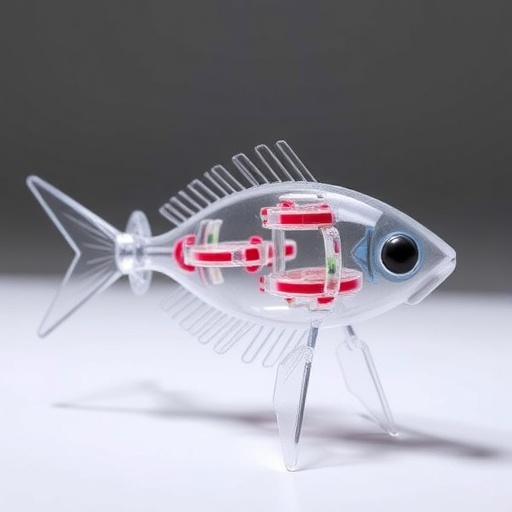
In a groundbreaking advancement that could revolutionize targeted drug delivery within the human body, researchers at Harbin Institute of Technology have engineered miniature, fish-inspired magnetic soft robots capable of operating as coordinated swarms. These tiny robots, each measuring merely two millimeters in length, harness the collective dynamics observed in natural fish schools to traverse complex biological environments efficiently. This innovation addresses critical limitations that have long hindered the effectiveness of individual soft robots in medical applications, paving the way for unprecedented precision in therapeutics.
The genesis of this technology lies in biomimicry, drawing inspiration from the elegant and adaptive foraging behaviors of fish schools in the wild. Fish often increase their chances of survival and search efficiencies by dynamically aggregating and dispersing in response to environmental cues. Mirroring this phenomenon, the researchers have designed each robot to emulate the swimming mechanics and social coordination of fish, allowing the swarm to collectively navigate, explore, and interact with targeted tissue sites in the human body.
Each individual robotic unit is composed of hard-magnetic elastomers, materials that exhibit both compliance and magneto-responsive properties. This unique composition enables the soft robots to respond precisely to externally applied magnetic fields. With actuation driven by an oscillating magnetic field supplemented by a gradient field, these robots can manifest complex swimming behaviors with six degrees of freedom: pitch, yaw, roll, horizontal and vertical translation, and forward propulsion. These movement capabilities grant the robots an extraordinary level of maneuverability, akin to swimming fish, permitting their penetration into intricate and confined biological regions.
A pivotal breakthrough reported by the team involves the meticulous programming of the magnetic field’s constant component at frequencies close to the robots’ natural resonance. It is within this resonance regime that the swimming direction of the robots is dominantly governed by this constant field component. Exploiting this principle, the researchers successfully induce selective directional control within the swarm, causing individual robots to swim independently along divergent trajectories despite the application of a uniform global magnetic field. This differential regulation constitutes a significant leap toward genuinely coordinated swarm control under a single overarching magnetic actuation system.
Such precision control permits the robotic swarm to dynamically disperse to navigate constricted anatomical pathways or to aggregate upon reaching pathological sites, such as lesions or tumors. Notably, once the swarm arrives at the lesion interface, the robots collectively adjust their configuration and morphology to conform to the solid-liquid interface of the diseased tissue. This adaptive shape modulation not only enhances adhesion to the target site but also optimizes the coverage area for drug dispensing, maximizing therapeutic efficacy while minimizing off-target side effects.
In rigorous laboratory and ex vivo trials employing animal tissue models, the team demonstrated the feasibility and efficacy of this approach. One compelling experiment showcased how the robot swarm adeptly navigated toward a synthetic gastric lesion. Upon congregating at the lesion, the swarm reconfigured itself to align precisely with the lesion’s contours, positioning itself optimally for targeted drug administration. These results underscore the potential clinical relevance of the technology for site-specific therapy in gastrointestinal maladies.
The implications of utilizing soft magnetic materials are profound. Their intrinsic flexibility ensures biocompatibility and reduces potential tissue damage during navigation. Moreover, their responsiveness to remotely controlled magnetic fields obviates the need for onboard power sources or complex control electronics within each robot, drastically simplifying miniaturization and enhancing systemic safety.
The research team meticulously characterized the dynamic interplay between the oscillating magnetic fields and the robots’ resonant behaviors. By harnessing the natural frequency of the robots’ oscillatory motions, they unlocked highly selective directional control, a breakthrough unmatched in prior miniature soft robotic designs. This innovative control methodology underpins the swarm’s autonomous yet coordinated movement.
Moreover, the ability of the swarm to exhibit collective decision-making behaviors, such as obstacle avoidance and environmental adaptation, mirrors biological ecosystems, further enhancing their utility in unpredictable in vivo environments. The robots’ capacity to adjust their swarm morphology provides versatility in addressing lesions of various shapes, sizes, and textures.
Funding for this pioneering research was provided by the National Key Research and Development Program of China, the National Natural Science Foundation of China, and the Natural Science Foundation of Heilongjiang Province. This collaborative investment highlights the strategic importance of advancing soft robotics for biomedical applications.
Looking ahead, this multifaceted robotic swarm platform opens diverse avenues for minimally invasive diagnostics, therapeutic interventions, and postoperative monitoring. Its scalability, responsiveness, and adaptive capabilities position it as a front-runner for clinical translation, particularly in treating diseases where precision matters, such as cancer and localized infections.
As the global scientific community continues to explore the frontiers of microrobotics and bioinspired engineering, the Harbin team’s work stands as a testament to the power of interdisciplinary innovation. By fusing materials science, fluid dynamics, magnetic field engineering, and bioautomation, they have charted a path toward smarter, safer, and more effective medical interventions with swarms of fish-like soft robots leading the charge.
Subject of Research: Miniature fish-like magnetic soft robot swarms for targeted drug delivery via resonance-based magnetic field control.
Article Title: Not provided in the content.
News Publication Date: Not provided in the content.
Web References:
http://dx.doi.org/10.1093/nsr/nwaf429
References: Not explicitly provided.
Image Credits: ©Science China Press
Keywords
Miniature robots, magnetic soft robotics, swarm robotics, targeted drug delivery, biomedical engineering, magnetic field control, six degrees of freedom, resonance frequency, biomimicry, robotic navigation, lesion targeting, adaptive morphology, fish-inspired robotics.
Tags: biomimicry in roboticscollaborative robotic swarmsfish school dynamics in roboticshard-magnetic elastomers applicationsmagnetic soft robots technologymedical robotics innovationsmulti-point 3D lesion targetingnavigating biological environmentsprecision therapeutics advancementssoft robotics in medicinetargeted drug delivery systemstiny fish-inspired robots