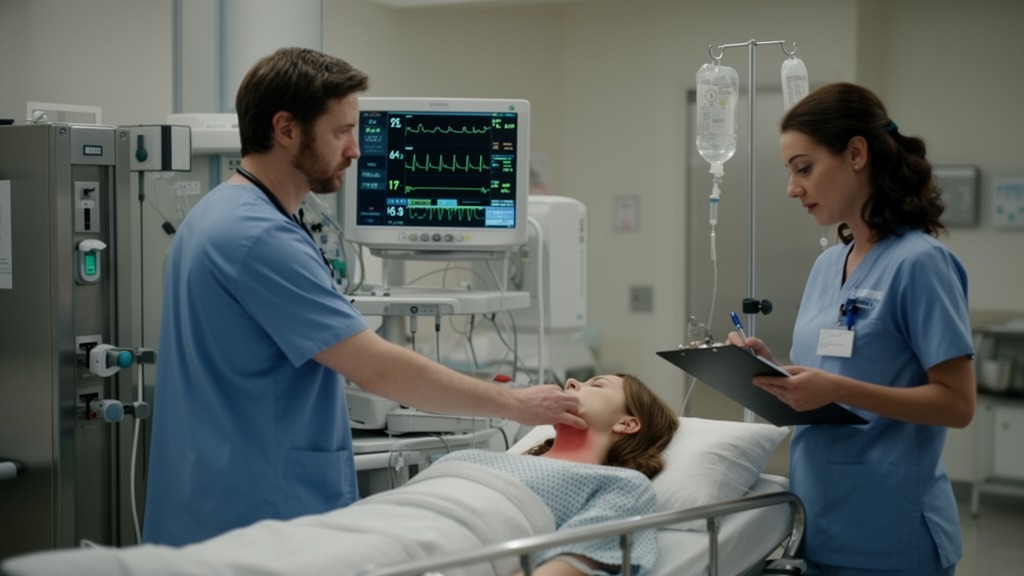
Thyroid storm is one of the rarest and most explosive emergencies in endocrinology, a state in which untreated hyperthyroidism spirals into fever, delirium, heart failure, and multiorgan collapse. Because the condition is so uncommon, clinicians have long lacked robust evidence about which bedside tools best predict who will survive an admission and who will deteriorate within hours. A new retrospective observational study from Nippon Medical School Hospital in Tokyo, published in BMC Endocrine Disorders, offers a data-driven answer: of four widely used severity scores calculated at the moment of admission, the Burch–Wartofsky Point Scale showed the strongest ability to separate patients who fared well from those who died in hospital or suffered cardiopulmonary arrest requiring resuscitation.
The research team, led by Tomoko Nagamine and colleagues in the Department of Endocrinology, Metabolism and Nephrology, examined the records of 22 individuals diagnosed with thyroid storm between 2012 and 2024. That number may seem small, but it reflects the reality of a disease that strikes only a tiny fraction of patients with thyrotoxicosis, and it makes the study one of the more detailed single-center analyses of admission-time risk prediction in this population. The researchers classified outcomes into two groups: eighteen patients with favorable outcomes and four patients with poor outcomes, defined as in-hospital death or cardiopulmonary arrest requiring resuscitation, regardless of whether spontaneous circulation was subsequently restored.
To assess severity on arrival, the team applied four scoring systems that occupy different corners of acute medicine. The Acute Physiology and Chronic Health Evaluation II, or APACHE II, is a heavyweight intensive care score that combines twelve physiological measurements with age and chronic health status. The Sequential Organ Failure Assessment, or SOFA, tracks dysfunction across six organ systems with repeated measurements over time, while its abbreviated cousin, quick SOFA, distills the concept to three bedside variables: altered mentation, low systolic blood pressure, and rapid respiratory rate. The Burch–Wartofsky Point Scale, by contrast, was designed specifically for thyroid storm in the early 1990s and assigns points for features such as fever, tachycardia, atrial fibrillation, heart failure, delirium, and precipitating events.
The central finding was strikingly consistent: all four scores were significantly higher in the poor outcome group than in the favorable outcome group. In other words, every instrument captured some signal of impending catastrophe, whether it was built for general critical illness or tailored to thyroid derangement. This convergence matters because it suggests that the physiological chaos of thyroid storm leaves fingerprints across multiple domains of assessment, from respiratory and cardiovascular function to consciousness and renal performance, and that no single organ system tells the whole story.
When the researchers turned to exploratory receiver operating characteristic analysis, the standard statistical technique for judging how well a test discriminates between two groups, the Burch–Wartofsky Point Scale emerged with the highest discriminatory performance. A cutoff of 105 points or more identified poor outcomes with a reported sensitivity of 100 percent and a specificity of 94.4 percent, meaning that in this cohort every patient who went on to a catastrophic outcome scored above the threshold, while nearly all patients who recovered scored below it. The authors are careful to note that these estimates are constrained by the small number of poor outcomes, only four events, which inflates statistical uncertainty and demands validation in larger, independent cohorts before the threshold is adopted clinically.
Beyond the headline scores, the study mapped which clinical parameters traveled with adverse outcomes. Poor outcomes clustered with markers of spreading organ dysfunction: coagulopathy detected through abnormal prothrombin time, renal impairment, metabolic acidosis, impaired consciousness measured on the Glasgow Coma Scale, thrombocytopenia reflecting falling platelet counts, and atrial fibrillation, the chaotic upper-chamber rhythm that is both a classic feature of thyrotoxic cardiomyopathy and a harbinger of hemodynamic collapse. Each of these findings paints a picture of thyroid storm as a systemic disease in which excess circulating thyroid hormone drives a hypermetabolic state that then cascades into liver, kidney, blood, and brain injury.
The mechanistic story behind these associations is well understood in outline. Surging levels of triiodothyronine and thyroxine sensitize the heart to catecholamines, pushing cardiac output beyond sustainable limits while simultaneously impairing the heart’s ability to relax and fill. Fever and sweating cause fluid losses that compound hypotension. The resulting tissue hypoperfusion generates lactic acid, which appears as metabolic acidosis on arterial blood gas analysis. Meanwhile, the prothrombotic and proinflammatory milieu can tip coagulation pathways into dysfunction, and reduced hepatic clearance of clotting factors compounds the problem. Thrombocytopenia may signal both consumption and bone marrow suppression in the sickest patients. The study’s finding that these laboratory derangements distinguished survivors from nonsurvivors fits neatly into this physiological framework.
For emergency physicians and intensivists, the practical implication is that the Burch–Wartofsky Point Scale, despite being three decades old and never originally validated against hard outcomes, may carry prognostic information beyond its diagnostic role. The scale was conceived as a case-finding instrument, a way to decide whether a febrile, tachycardic patient with Graves’ disease has crossed into storm territory. The new data suggest that a markedly elevated score, well above the traditional diagnostic threshold, does not merely confirm the diagnosis but also flags a patient whose physiology is already failing in ways that predict death or arrest. In a disease where mortality historically approached 20 to 30 percent and hinges on rapid administration of thionamides, beta-blockers, iodine, and corticosteroids, any tool that accelerates triage toward intensive care could be consequential.
The study also carries methodological lessons for the field. Thyroid storm is so rare that no single center can assemble the hundreds of patients needed for definitive prognostic modeling, which is why the authors explicitly frame their receiver operating characteristic estimates as exploratory and call for validation in larger independent cohorts. Multicenter registries, such as those maintained by the Japan Endocrine Society and the Japanese Thyroid Association, whose diagnostic criteria informed the case definitions in this work, represent the most plausible path forward. Combining the disease-specific sensitivity of the Burch–Wartofsky scale with the organ-failure granularity of SOFA might ultimately yield a hybrid score that outperforms either instrument alone, a hypothesis the present data cannot test but clearly motivate.
Until such validation arrives, the message for clinicians is one of layered vigilance. Every patient with thyroid storm requires immediate intensive management, as the authors emphasize, but the admission Burch–Wartofsky Point Scale may provide additional information for early risk stratification, particularly when scores climb toward or beyond the 105-point threshold identified here. Coupled with close attention to coagulation parameters, renal function, acid–base status, mental status, platelet counts, and cardiac rhythm, the scale could help clinicians decide which patients need escalation to continuous hemodiafiltration, plasma exchange, or mechanical circulatory support before collapse occurs. In a condition where hours separate recovery from catastrophe, sharpening the first-hour assessment remains one of the most valuable interventions available, and this study adds a measured, cautiously optimistic data point to that effort.
Subject of Research: Prognostic value of admission severity scores, including the Burch–Wartofsky Point Scale, for predicting adverse in-hospital outcomes in thyroid storm
Article Title: Admission Burch–Wartofsky point scale and critical care scores as predictors of adverse in-hospital outcomes in thyroid storm: a retrospective observational study
Article References: Nagamine, T., Yada-Tanabe, T., Kobayashi, S., Nagao, M., Fukuda, I., Sugihara, H., & Iwabu, M. (2026). Admission Burch–Wartofsky point scale and critical care scores as predictors of adverse in-hospital outcomes in thyroid storm: a retrospective observational study. BMC Endocrine Disorders. https://doi.org/10.1186/s12902-026-02614-2
Image Credits: AI Generated
DOI: 10.1186/s12902-026-02614-2
Keywords: thyroid storm, Burch–Wartofsky Point Scale, APACHE II, SOFA, qSOFA, risk stratification, prognostic markers, critical care, hyperthyroidism, atrial fibrillation, organ failure, retrospective study
News Source: Ophelia Keating. (October 9, 2026). Thyroid Storm Severity Score at Admission May Flag Patients Facing the Worst Outcomes. Scienmag.