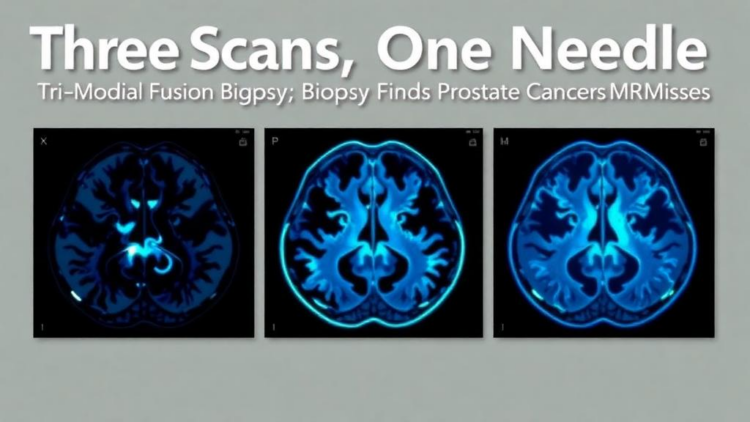
For decades, the diagnosis of clinically significant prostate cancer has rested on an uncomfortable compromise. Multiparametric MRI transformed the field by allowing many men with suspicious blood tests to safely avoid biopsy, yet the technique still fails to reveal between 8 and 20 percent of the aggressive tumors that matter most. A new prospective study published in the European Journal of Nuclear Medicine and Molecular Imaging suggests a way to close that gap: fusing three imaging worlds—PSMA PET/CT, MRI, and real-time ultrasound—into a single biopsy navigation system. In 308 biopsy-naive men, the tri-modal approach detected 4.9 percent more clinically significant cancers than the standard MRI-ultrasound fusion biopsy, and the gains were concentrated exactly where diagnostic uncertainty has always been greatest.
The study, led by researchers at the First Affiliated Hospital of Soochow University in Suzhou, China, was designed as a paired diagnostic accuracy trial registered with the Chinese Clinical Trial Registry. Every participant underwent all three biopsy strategies in a single session: a tri-modal PSMA PET/CT-MRI-US fusion biopsy, a conventional MRI-US fusion biopsy, and a 12-core systematic biopsy. Because each man served as his own control, the comparison directly quantified the incremental yield contributed by adding molecular imaging to the targeting pipeline, rather than relying on comparisons between different groups of patients. The primary endpoint was the absolute difference in patient-level detection of clinically significant prostate cancer, defined as Grade Group 2 or higher on the International Society of Urological Pathology scale.
The biological rationale for the approach is elegant. Multiparametric MRI detects structural disruption—changes in tissue architecture, water diffusion, and contrast enhancement—whereas PSMA PET targets the overexpression of prostate-specific membrane antigen, a receptor that is upregulated on aggressive tumor cells. The two modalities therefore interrogate fundamentally different features of the same disease, and published discordance rates between them range from 30 to 50 percent. Lesions visible only on PSMA PET carry clinically significant cancer rates of roughly 26 to 39 percent, while MRI-only lesions carry rates of 15 to 20 percent. In this cohort, the asymmetry was even starker: among non-co-localized lesions, 39.3 percent of PSMA-only lesions harbored clinically significant cancer, compared with just 17.5 percent of MRI-only lesions.
Translating those molecular signals into accurate needle placement, however, demands precise spatial registration between preoperative images and the real-time ultrasound plane. Conventional MRI-US fusion relies on software-assisted alignment of images acquired in different positions—the patient supine during MRI and in the lithotomy position during transrectal ultrasound—and registration errors from prostate deformation, patient movement, and operator variability can exceed the diameter of small aggressive tumors. The tri-modal platform, developed under a Chinese patent and implemented on the Carbon AI fusion system, attacks this problem in three stages. A convolutional neural network first segments the prostate on preoperative CT and MRI, converting the resulting surfaces into point clouds that are rigidly aligned using an iterative closest point algorithm. The optimal transformation minimizes a combined loss function balancing mutual information between the images and Dice overlap between the segmented surfaces.
Because PSMA PET and CT share the same coordinate system, the PET signal can then be mapped directly into MRI space. During the biopsy itself, the same neural network segments the real-time transrectal ultrasound images, and point-cloud registration under electromagnetic tracking solves for the rotation and translation that best match the live prostate contour to its MRI counterpart. The result is real-time, three-modality navigation in which molecular uptake is converted directly into biopsy coordinates. Three cores were taken from each PET-positive lesion and three from each MRI-positive lesion, meaning co-localized lesions received six cores, while systematic biopsy followed the standard 12-core Ginsburg protocol. Pathologists reading the cores were blinded to all imaging data and biopsy approach.
The headline result was unambiguous. Tri-modal fusion biopsy found clinically significant cancer in 119 of the 308 patients, versus 104 detected by MRI-US fusion biopsy. Fifteen men were identified exclusively by the tri-modal approach, and not a single cancer was found by MRI-US fusion alone that the tri-modal method missed. The number needed to biopsy to detect one additional clinically significant cancer was 20.5. Subgroup analyses revealed where the extra yield came from: PSMA-positive lesions smaller than 10 millimeters showed an 8.3 percent absolute gain, PI-RADS 4 lesions a 5.8 percent gain, and patients with prostate-specific antigen density of 0.15 or higher a 6.0 percent gain. For PI-RADS 5 lesions, the advantage disappeared—a ceiling effect, since MRI-guided biopsy already detects nearly all cancers in that category.
Lesion-level statistics reinforced the message. Using generalized estimating equations to account for multiple lesions within each patient, PSMA-positive lesions carried nearly twice the odds of harboring clinically significant cancer compared with MRI-positive lesions, an association that persisted after adjustment for age, PSA density, and PI-RADS score, reaching an odds ratio of 1.97. Co-localized lesions—positive on both modalities—had the highest cancer rate of all at 62.3 percent. Notably, the modality-by-zone interaction was not significant, indicating that the heterogeneous signal typical of the transition zone, where benign enlargement can mimic disease, did not compromise the fusion accuracy. Among the 124 men with clinically significant cancer, only five were detected solely by systematic biopsy, invisible on both PET and MRI.
Beyond the biopsy table, the team built a PSMA-derived risk score combining lesion diameter, maximum standardized uptake value, the SUV ratio relative to the parotid gland, lesion location, and diffuse uptake patterns. In a held-out test set of 92 patients, the score achieved an area under the curve of 0.933, outperforming both the visual PRIMARY score (0.873) and the molecular imaging miPSMA score (0.838), with good calibration confirmed by the Hosmer-Lemeshow test. When the researchers combined the score with PI-RADS category and PSA density into a clinical model, a simulated risk-guided strategy would have spared biopsies in roughly 42 percent of the test-set patients while missing only 2.3 percent of clinically significant cancers—below the 5 percent miss threshold recommended by current guidelines—and producing no overdiagnoses.
The authors are careful to frame that simulation as exploratory. The risk thresholds are cohort-specific, the test set was small, and the analysis was retrospective rather than prospective. Other limitations deserve emphasis. The superset design meant the tri-modal approach sampled all MRI-visible lesions plus additional PSMA-only targets, so the 4.9 percent detection gain reflects both molecular targeting and increased sampling density—321 extra cores in total. The study also cannot disentangle how much of the benefit came from the AI registration platform versus the PET information itself, and needle-guidance accuracy was not formally validated. As a single-center study, the results await multicenter confirmation before any change to clinical practice.
Safety and cost considerations round out the picture. No serious adverse events occurred; transient hematuria affected a third of patients on day one but fell to about 1 percent within a week, and only two men developed brief post-procedural fever. Adding PSMA PET/CT does carry roughly 3 to 5 millisieverts of radiation—comparable to a year of natural background—and meaningful cost, which is why the modality is currently reserved for equivocal MRI findings or high-risk disease rather than routine pre-biopsy use. Yet if the simulated risk-guided pathway holds up in prospective validation, the scans spared in the 42 percent of low-risk men could offset much of that burden. For now, the study offers a technically sophisticated preview of where prostate cancer diagnosis may be heading: a fusion of anatomy, function, and molecular biology, guided by algorithms, that finds the tumors MRI alone cannot see.
Subject of Research: Tri-modal PSMA PET/CT-MRI-US fusion biopsy for detecting clinically significant prostate cancer
Article Title: Tri-modal PSMA PET/CT-MRI-US fusion biopsy for clinically significant prostate cancer: a prospective paired diagnostic study
Article References: Huang, C., Jin, L., Sun, Y., Wu, M., Zhang, X., Xu, X., He, X., Qiu, F., Wang, X., Guo, L., Huang, R., Li, J., Deng, S., Lin, Y., Wei, X., Zhang, B., & Huang, Y. (2026). Tri-modal PSMA PET/CT-MRI-US fusion biopsy for clinically significant prostate cancer: a prospective paired diagnostic study. European Journal of Nuclear Medicine and Molecular Imaging. https://doi.org/10.1007/s00259-026-08181-x
Image Credits: AI Generated
DOI: 10.1007/s00259-026-08181-x
Keywords: prostate cancer, PSMA PET/CT, fusion biopsy, multiparametric MRI, diagnostic accuracy, AI registration, electromagnetic tracking, risk score, PI-RADS, systematic biopsy, molecular imaging, clinical trial
Cite Scienmag News
APA MLA Chicago
Ophelia Keating. (October 1, 2026). Three Scans, One Needle: Tri-Modal Fusion Biopsy Finds Prostate Cancers MRI Misses. Scienmag. https://scienmag.com/three-scans-one-needle-tri-modal-fusion-biopsy-finds-prostate-cancers-mri-misses/
Ophelia Keating. “Three Scans, One Needle: Tri-Modal Fusion Biopsy Finds Prostate Cancers MRI Misses.” Scienmag, 1 October 2026, https://scienmag.com/three-scans-one-needle-tri-modal-fusion-biopsy-finds-prostate-cancers-mri-misses/. Accessed 1 October 2026.
Ophelia Keating. “Three Scans, One Needle: Tri-Modal Fusion Biopsy Finds Prostate Cancers MRI Misses.” Scienmag. October 1, 2026. https://scienmag.com/three-scans-one-needle-tri-modal-fusion-biopsy-finds-prostate-cancers-mri-misses/
Copy citation Download RIS
Tags: advanced prostate cancer imagingAI registrationclinical trialcombining PSMA PET/CT MRI ultrasounddetection of aggressive prostate tumorsdiagnostic accuracyelectromagnetic trackingfusion biopsyimaging fusion technology in prostate cancermolecular imagingMRI-ultrasound fusion biopsy limitationsmultiparametric MRIPI-RADSprostate biopsy techniques comparisonprostate cancerprostate cancer clinical significanceprostate cancer detection in biopsy-naive menprostate cancer diagnosisprostate cancer diagnostic accuracyPSMA PET/CTPSMA PET/CT prostate cancer detectionrisk scoresystematic biopsytri-modal imaging fusion biopsy