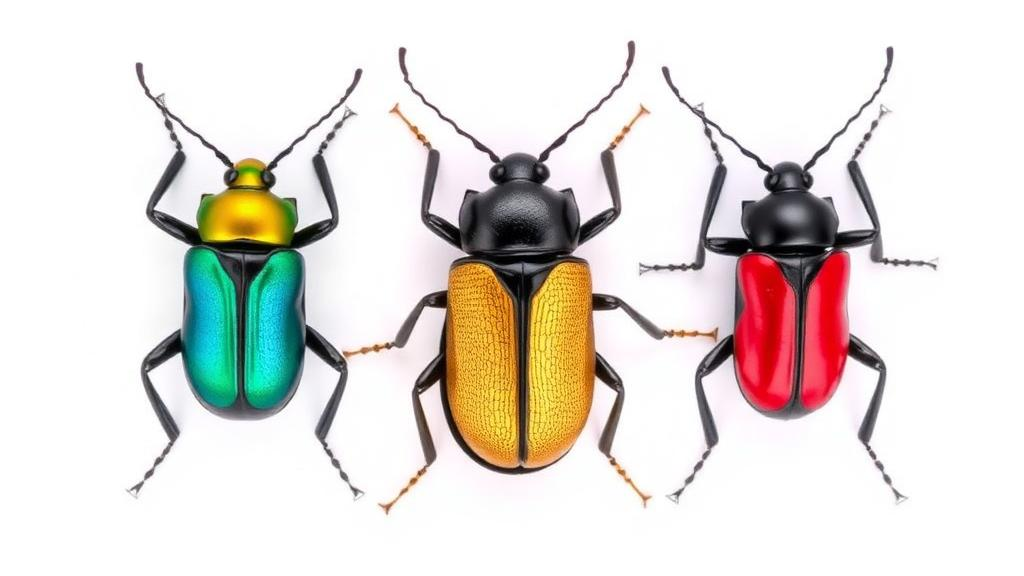
Three new species of the jewel-beetle genus Aphanisticus have been identified from three Southern African countries, expanding the known diversity of a group whose members are distinguished by their flattened or cylindrical bodies, sculpted pronotums and often metallic colors. The new species are Aphanisticus fencli from South Africa, A. franki from Botswana and A. snizeki from Zambia. Their descriptions were accompanied by a reclassification of related beetles, the designation of type specimens, a new synonym and a practical identification key based on body proportions, coloration and surface structure.
The Aphanisticus genus contains about 360 species distributed across warm-temperate and tropical parts of the Eastern Hemisphere, with 147 species previously known from the Afrotropical Region. Most are small, compact beetles with convex, nearly cylindrical bodies, but the genus also includes broader, oval or triangular forms. A few species groups possess conspicuously flattened elytra, the hardened forewings that cover and protect the flying wings. The new South African species, A. fencli, belongs to a newly proposed group that also includes A. gebhardti, A. lineolatus and A. planatus.
Researchers established the new A. gebhardti species group around a combination of characters unusual within Aphanisticus. Members have relatively large, elongated and flattened bodies, with the length typically exceeding the width by more than three times. Their heads are small and narrower than the front edge of the pronotum, while the frontovertex forms a shallow depression. The pronotum is moderately transverse and somewhat shield-shaped, and the elytra carry recognizable longitudinal striations. The group is currently known only from the Republic of South Africa, where all four recognized species have been recorded.
A. fencli is the most immediately conspicuous member of the group because its dorsal surface is bicolored: the head and pronotum are black with an indistinct bluish sheen, while the elytra are blue. Its body is strongly flattened and measures 3.95 to 5.95 millimeters long, with the holotype 4.5 millimeters long and 1.4 millimeters wide. The elytra are roughly 2.2 to 2.4 times as long as they are wide, and each bears a raised sutural ridge and another elevated interval. Fine longitudinal striae cover parts of the surface, becoming interrupted or tangled into short irregular marks farther from the midline.
The identification key developed in the study separates A. fencli from the three established members of its group by its blue elytra, black pronotum, rounded oculofrontal borders and less elongated body. A. lineolatus has a more regular pattern of elytral striae, deeper and smaller pronotal punctures and a body length of about 5.2 to 5.4 millimeters. The larger A. gebhardti and A. planatus are distinguished from one another by their proportions, coloration and the degree of projection along the inner margins of the eyes. The new species is known only from its type locality in Bulwer, KwaZulu-Natal, where the series was collected on November 11, 2001.
The study also clarified a long-standing naming problem within the group. A lectotype was designated for A. gebhardti from a specimen collected in Cape Town, and another lectotype was selected for A. lineolatus. Comparisons showed that A. semicoeruleus, described by Théry in 1930, and A. lineolatus, described by Obenberger in 1928, represent the same species. The name A. lineolatus is therefore retained, and A. semicoeruleus is recorded as its junior synonym. The researchers concluded that the specimen used by Théry had probably been drawn from Obenberger’s original type series.
A. franki represents a different form within the genus, with a convex, subcylindrical body rather than the flattened profile characteristic of the A. gebhardti group. Described from the West Okawango South Delta in Botswana, it measures 4.7 to 5.5 millimeters long and has an olivaceous-green surface with occasional, indistinct bronzy reflections. Its head is broad, the eyes are large and convex, and the pronotum is nearly regularly rounded, with two shallow transverse elevations across its disc. Each elytron ends in a distinct lateral tooth, one of the traits used to distinguish it from the superficially similar A. mitratus of Madagascar.
A. snizeki, the third new species, is known from a single female specimen collected near Kapiri Mposhi in Zambia’s Central Province. It is 5.05 millimeters long and 1.4 millimeters wide, with a bluish-green back carrying an indistinct violet reflection and a black underside with a faint bronzy sheen. Its body is convex and subcylindrical, and the pronotum is broadly heart-shaped. The elytra are about 2.55 times as long as they are wide, are depressed along the raised suture toward the rear and terminate in sharp triangular teeth. Unlike A. franki, A. snizeki has a deeply concave frontovertex and more sharply angled posterior corners on the pronotum.
The authors placed A. snizeki in comparison with A. coeruleipennis, another Southern African species with a metallic appearance. A. coeruleipennis is smaller and more robust, with a body only about 3.15 millimeters long, and it has a dark reddish-violet pronotum paired with blue-violet elytra. The identification traits of A. snizeki therefore depend on the combination of its larger, more convex body, bluish-green coloration, more pronounced surface reticulation and distinct elytral teeth. Because the new species is known from a female holotype, its male anatomy remains unknown, limiting direct comparison with the illustrated aedeagi of the newly described A. fencli and A. franki.
All three species remain known only from their type localities: Bulwer in South Africa, the West Okawango South Delta in Botswana and the vicinity of Kapiri Mposhi in Zambia. The research relied mainly on extensive material collected in recent years by Czech entomologists, supplemented by specimens held in major natural-history and research collections across Europe, Asia and South Africa. Microscopic examination, ocular measurements and focus-stacked macro photography were used to assess the fine punctures, ridges, grooves and surface textures that distinguish closely related species. The resulting additions show that even a comparatively well-studied jewel-beetle genus retains hidden diversity, particularly in Africa’s undercollected landscapes.
Subject of Research: Taxonomic discovery of three new Aphanisticus jewel-beetle species in Southern Africa
Article Title: Three new species of buprestid genus Aphanisticus Latreille, 1810 from Southern African countries ( Coleoptera , Buprestidae ), with nomenclatural and taxonomic notes
Article References: Kalashian, M. Y., & Kubáň, V. (2026). Three new species of buprestid genus Aphanisticus Latreille, 1810 from Southern African countries (Coleoptera, Buprestidae), with nomenclatural and taxonomic notes. ZooKeys, 1287, 201-211. https://doi.org/10.3897/zookeys.1287.200030
Image Credits: AI Generated
DOI: 10.3897/zookeys.1287.200030
Keywords: Aphanisticus, jewel beetles, Buprestidae, new species, Southern Africa, taxonomy, entomology, species discovery, Botswana, Zambia, South Africa, Three
News Source: Margaret Porter. (October 19, 2026). Three New Jewel Beetles Discovered Across Southern Africa. Scienmag.