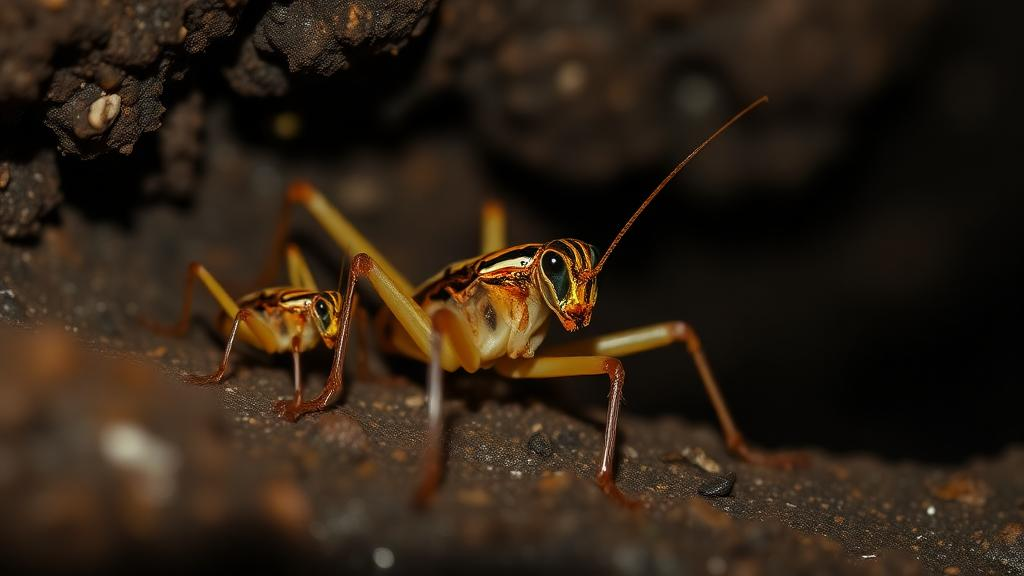
Deep in the rainforests of Malaysian Borneo, three camel crickets previously unknown to science have been formally described. Taxonomists Qi Zhu and Ming Kai Tan identified the three new species of the genus Paradiestrammena, a group of wingless orthopterans in the family Rhaphidophoridae, from specimens collected in the states of Sarawak and Sabah. The species are named Paradiestrammena cordata, P. aquilina and P. sabahensis, and their descriptions appear in the journal ZooKeys, accompanied by a revised identification key to the males of all species in the genus.
The genus Paradiestrammena has had a turbulent taxonomic history. Chopard erected it in 1919, transferring four Diestrammena species into it on the basis of relatively few, nearly regular spines on the hind tibiae, although no type species was designated at the time. Chopard then described an additional species, P. vitalisi, from Laos later that same year. Within a few years, Karny and Chopard had synonymized the genus with Diestrammena, and it languished there for decades. Storozhenko later established the subgenus Atachycines (Eutachycines) and designated D. feai as its type species, transferring several species based on the structure of the male genitalia and the spines of the fore and mid tibiae.
Confusion persisted because the type species of Atachycines, Diestrammena (Atachycines) horazumi, had been described from a nymph, leaving the classification of Atachycines species uncertain. In 1998, Gorochov reestablished Paradiestrammena and designated D. gravelyi as its type species. He transferred several more species into the genus and described three new ones: P. vernalis from Vietnam, P. kotljarovskyi from Japan and P. tarbinskyi from Malaysia. Subsequent work continued to shuffle species around: Gorochov described further species from Vietnam, Cambodia, Thailand and Japan in 2002; Sugimoto and Ichikawa later moved D. apicalis to Atachycines and synonymized P. kotljarovskyi with it after examining images of the holotype; and Ichikawa transferred P. mira to the genus Neotachycines in 2006, treating P. propinqua as its junior synonym.
Before the present study, Paradiestrammena comprised 13 valid species distributed mainly in Vietnam, Cambodia, Malaysia, Thailand, Laos and southern China. With the three new Bornean species added, the authors now count 16 species in the genus. All three genera of the tribe that includes Paradiestrammena, namely Paradiestrammena, Atachycines and Eutachycines, are predominantly distributed in Southeast Asia, a pattern that markedly distinguishes them from related genera. Despite repeated revisions, the generic placement of species among these three genera and the phylogenetic relationships among them remain unclear, and the authors note that further investigation is required to clarify these relationships and to reassess the validity of current species-level classifications.
The new study draws on two sources of material: historical specimens held in the Zoological Reference Collection of the Lee Kong Chian Natural History Museum in Singapore, and new material collected in Sabah between 2022 and 2026. Specimens were preserved in absolute analytical-grade ethanol and later pinned and dry-preserved. Male genitalia were dissected with an insect needle, and pinned specimens were imaged with digital SLR cameras attached to a Visionary Digital Passport system, with image stacking performed using Zerene Stacker and Leica imaging software. Live specimens were photographed in the field with a macro lens and twin flash. Measurements followed the protocol of Zhu and colleagues’ earlier 2020 work, which had described two Paradiestrammena species from China and provided DNA barcode sequences for each.
The first new species, Paradiestrammena cordata, is known only from the type locality near Bau in Sarawak, close to Kuching, where the male holotype was collected in February 1997. The species name derives from the Latin cordata, meaning heart-shaped, and refers to the nearly heart-shaped sclerite of the male genitalia, which has a broadly concave basal area and an apical hooked process curving upwards. In its diagnosis, P. cordata is compared with P. tarbinskyi from the Malay Peninsula: the apical area of the dorsomedian lobe of the genitalia bears a concavity in the new species but is rounded in P. tarbinskyi, and the apical process is slightly shorter and hooked rather than long, thin and spine-shaped. The new species also differs from its Bornean congener P. sarawakana in its unicolorous yellowish-brown body, whereas P. sarawakana carries black and brown patterns. The male measures 8.65 millimetres in body length, with a hind tibia of 17.65 millimetres bearing 16 inner and outer dorsal spines. The female remains unknown.
The second new species, Paradiestrammena aquilina, was discovered in Sabah. The male holotype was found in May 2022 on the ground underneath a dead log at the Rainforest Discovery Centre in Sepilok, near Sandakan, at an altitude of 20 metres. Two male paratypes were later collected in July 2026 on a clayey slope beside a trail in the Segaliud Lokan Forest Reserve, along with nymphs from the same reserve, including two found under a rock along a small creek inside a clayey area. The species name comes from the Latin aquilin, meaning eagle-shaped, in reference to the sclerite of the male genitalia, which resembles a giant eagle spreading its wings, with a wide and deep concavity at its base and a hooked process with a blunt, rounded apex. P. aquilina resembles P. gravelyi from the Malay Peninsula in general habitus and coloration but differs in the deeper basal concavity of the genital sclerite, the rounded apex of the hooked process, and the broadly rounded, almost truncated posterior margin of the female subgenital plate. Compared with P. sarawakana, it shows more intense and larger dark patches, with the anterior and posterior thirds of the pronotal lateral lobes black and the middle third yellow.
Field observations recorded in the paper offer a rare glimpse of the species’ natural history. The authors observed P. aquilina among clayey substrate, often on slopes, in the understory of sheltered forest, and noted that individuals, both adults and nymphs, tend to aggregate near each other. Males range from 8.10 to 8.85 millimetres in body length, with hind tibiae of 16.80 to 18.10 millimetres bearing 15 to 16 inner and 16 to 17 outer dorsal spines. The body is brown with black stripes, the eyes are black, the face carries two black longitudinal stripes, and the legs display a black annular pattern, with the basal half of the hind femur marked by black penniform stripes.
The third new species, Paradiestrammena sabahensis, is the largest of the three and is described as large for the genus. The male holotype was collected in November 2024 at 21h02 on the base of a tree trunk in the Maliau Basin, at an Agathis–Nepenthes site one kilometre in, at an altitude of 646 metres. A single female paratype came from the same locality. The species is very similar to P. aquilina in habitus, coloration and the general shape of the male genitalia, but it can be distinguished by its distinctly larger size, a triangular dorsal process at the median area of the genital sclerite rather than a hooked process at the apical end, a wide and shallow basal concavity with stouter lateral areas, and a larger, more apically protruding triangular dorsomedian lobe. The female differs from P. aquilina in having a subgenital plate that is more acute at the posterior end, and the ovipositor bears a crenulated ventral margin at its apex. Against P. gravelyi, the new species stands out by its larger habitus, the triangular rather than hooked apical process of the sclerite, and a triangular rather than quadrangular subgenital plate. The male measures 11.8 millimetres in body length, the female 10.8 millimetres, with a female hind tibia of 22.7 millimetres and an ovipositor of 7.1 millimetres. It is known only from the type locality, and its coloration closely resembles that of P. aquilina.
Tying the revision together, the authors provide an updated identification key to Paradiestrammena species based on male characters, built around the shape of the male genitalia: whether the apical area of the dorsomedian lobe is concave or rounded, whether the basal area of the sclerite is concave or nearly straight, and whether the apical process is hooked, spine-shaped or triangular. The three new species slot into the key alongside established names such as P. autumnalis, P. contumi, P. maculata, P. vitalisi, P. trigona, P. xima and P. vernalis. Four species cannot be keyed: P. enata, P. sarawakana and P. storozhenkoi are known only from females, and the male of P. mistshenkoi is known only as a nymph. Specimens from the study are deposited in the Forest Research Centre in Sepilok, Sabah, and the Zoological Reference Collection in Singapore, ensuring that the physical evidence behind Borneo’s newest cricket species remains available for the next round of taxonomic scrutiny.
Subject of Research: Taxonomy and description of three new Paradiestrammena camel cricket species from Borneo, Malaysia
Article Title: Taxonomic review of the genus Paradiestrammena ( Orthoptera , Rhaphidophoridae ), with descriptions of three new species from Borneo, Malaysia
Article References: Zhu, Q., Muhammad, A. A., Robillard, T., Damit, D. F. B. A., Japir, R., Chung, A. Y. C., Shi, F., & Tan, M. K. (2026). Taxonomic review of the genus Paradiestrammena (Orthoptera, Rhaphidophoridae), with descriptions of three new species from Borneo, Malaysia. ZooKeys, 1296, 91-105. https://doi.org/10.3897/zookeys.1296.213690
Image Credits: AI Generated
DOI: 10.3897/zookeys.1296.213690
Keywords: Paradiestrammena, Rhaphidophoridae, Orthoptera, Borneo, Sarawak, Sabah, taxonomy, new species, camel crickets, male genitalia, Southeast Asia, species key
News Source: Gavin Prescott. (October 29, 2026). Three new cave cricket species discovered in the rainforests of Borneo. Scienmag.