A team from the University of Leicester, Yunnan Key Laboratory for Palaeobiology and the Institute of Palaeontology at Yunnan University, Chengjiang Fossil Museum, and the Natural History Museum in London, have redescribed a unique fossil animal from rocks nearly 520 million years old that fills in a gap in our understanding of the evolution of animals known as arthropods.
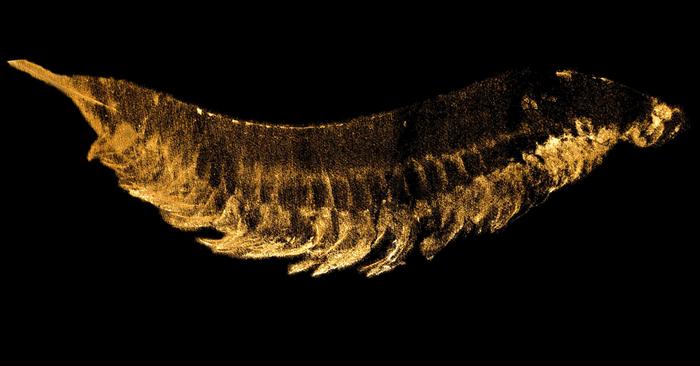
Credit: Courtesy of Professor Yu Liu, Yunnan University.
A team from the University of Leicester, Yunnan Key Laboratory for Palaeobiology and the Institute of Palaeontology at Yunnan University, Chengjiang Fossil Museum, and the Natural History Museum in London, have redescribed a unique fossil animal from rocks nearly 520 million years old that fills in a gap in our understanding of the evolution of animals known as arthropods.
The animal, which has the scientific name Kylinxia, was imaged using a CT scanner which revealed its soft anatomy buried in the rock. The size of a large shrimp, its surprising features include three eyes on the head and a pair of fearsome limbs presumably used to catch prey.
The study is published this week in the high impact journal Current Biology.
Fossils of many kinds of marine animals first appear in rocks from about half a billion years ago and signal a time when complex ecosystems were developing in the world’s oceans. One of the key localities for such fossils is the area around the town of Chengjiang in southern China, where the fossils in this study were collected by the Chinese team. The fossils were recovered from the Cambrian Chengjiang biota of China’s Yunnan Province, from which over 250 species of exceptionally preserved fossil organisms have been described.
The new find is important for deciphering the history of arthropods. These are animals whose bodies are divided into segments, most of which bear a paired of jointed limbs, like crabs, lobsters, insects, and spiders.
Although there are plenty of arthropods in the fossil record – most famously the trilobites – the vast majority only preserve their hard skeletons. Because the new Chinese material is preserved nearly complete, the team were able to image the head of Kylinxia, identifying six segments: the front one bearing eyes, the second with a pair of large grasping limbs, and the other four each bearing a pair of jointed limbs.
Lead author of the study Robert O’Flynn, a PhD student at the University of Leicester School of Geography, Geology and the Environment, said: “The preservation of the fossil animal is amazing. After CT-scanning we can digitally turn it around and literally stare into the face of something that was alive over 500 million years ago. As we spun the animal around, we could see that its head possesses six segments, just as in many living arthropods.”
Professor Mark Williams, Robert’s primary supervisor at the University of Leicester, said: “Kylinxia, and the Chengjiang biota whence it came, are instrumental to building our understanding of early euarthropod evolution. I like to think that similar discoveries will continue to be made by Robert.”
Professor Yu Liu from the Yunnan Key Laboratory for Palaeobiology said: “Robert and I were examining the micro-CT data as part of his doctoral thesis in the hope of refining and correcting previous interpretation of head structures in this genus, Kylinxia. Amazingly, we found that its head is composed of six segments, as in, e.g., insects.”
Dr Greg Edgecombe from the Natural History Museum added: “Most of our theories on how the head of arthropods evolved were based on these early-branching species having fewer segments than living species. Discovering two previously undetected pairs of legs in Kylinxia suggests that living arthropods inherited a six-segmented head from an ancestor at least 518 million years ago.”
- “The early Cambrian Kylinxia zhangi and evolution of the arthropod head” is published in Current Biology, doi: 10.1016/j.cub.2023.08.022, link: http://www.doi.org/10.1016/j.cub.2023.08.022
- This study is supported by the Science Foundation of Yunnan Province (grant numbers: 202301AS070049; 2015HA021).
Journal
Current Biology
DOI
10.1016/j.cub.2023.08.022
Article Title
The early Cambrian Kylinxia zhangi and evolution of the arthropod head
Article Publication Date
28-Aug-2023