• HOME
  • NEWS
  • EXPLORE
    • CAREER
      • Companies
      • Jobs
    • EVENTS
    • iGEM
      • News
      • Team
    • PHOTOS
    • VIDEO
    • WIKI
  • BLOG
  • COMMUNITY
    • FACEBOOK
    • INSTAGRAM
    • TWITTER
Saturday, May 9, 2026
BIOENGINEER.ORG
No Result
View All Result
  • Login
  • HOME
  • NEWS
  • EXPLORE
    • CAREER
      • Companies
      • Jobs
        • Lecturer
        • PhD Studentship
        • Postdoc
        • Research Assistant
    • EVENTS
    • iGEM
      • News
      • Team
    • PHOTOS
    • VIDEO
    • WIKI
  • BLOG
  • COMMUNITY
    • FACEBOOK
    • INSTAGRAM
    • TWITTER
  • HOME
  • NEWS
  • EXPLORE
    • CAREER
      • Companies
      • Jobs
        • Lecturer
        • PhD Studentship
        • Postdoc
        • Research Assistant
    • EVENTS
    • iGEM
      • News
      • Team
    • PHOTOS
    • VIDEO
    • WIKI
  • BLOG
  • COMMUNITY
    • FACEBOOK
    • INSTAGRAM
    • TWITTER
No Result
View All Result
Bioengineer.org
No Result
View All Result
Home NEWS Science News Biology

Threatened South American coati found roaming in a large city

Bioengineer by Bioengineer
April 27, 2022
in Biology
Reading Time: 3 mins read
0
South American Coati at the Canoas airbase in Rio Grande do Sul, Brazil
Share on FacebookShare on TwitterShare on LinkedinShare on RedditShare on Telegram

You may assume that metropolitan areas are devoid of wildlife, but that is very far from the truth. The remaining green spaces within the urban matrices of large cities can serve as corridors or stepping stones for wild animals. Sometimes, even threatened mammal species end up using them.
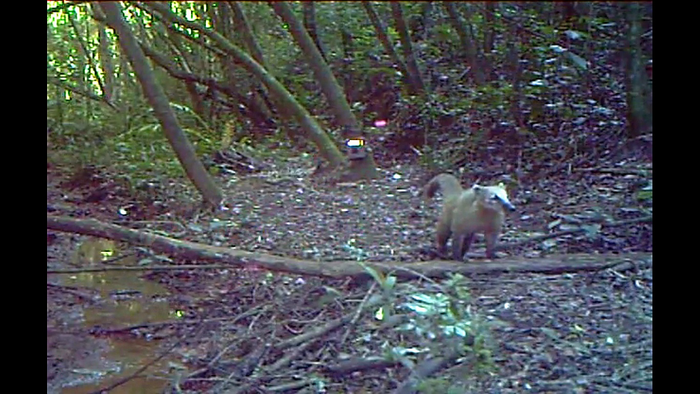
South American Coati at the Canoas airbase in Rio Grande do Sul, Brazil

Credit: Diego Floriano da Rocha, Thaís Brauner do Rosario and Cristina Vargas Cademartori

You may assume that metropolitan areas are devoid of wildlife, but that is very far from the truth. The remaining green spaces within the urban matrices of large cities can serve as corridors or stepping stones for wild animals. Sometimes, even threatened mammal species end up using them.

On August 12, 2020, a research team from Brazil recorded a South American coati in Canoas, the fourth most populous and densely urbanized city in the southernmost state of Brazil, Rio Grande do Sul. The animal was detected with a camera trap during a Masters research project conducted at the Canoas Airbase, one of the last green spaces remaining in the municipality.

Widely distributed throughout the continent, the South American coati is a medium-sized carnivore living on trees and feeding mainly on small invertebrates and fruits. The species is classified as Vulnerable in Rio Grande do Sul, and it’s considered threatened mainly because of the loss of its forest habitats.

The study that recorded an individual in the urban area was conducted as part of a partnership between the Canoas Airbase and La Salle University. Led by Dr Cristina Vargas Cademartori from La Salle University, the research team was made up of Diego Floriano da Rocha (Doctoral student), Thaís Brauner do Rosario (Masters student), Ana Carolina Pontes Maciel (biologist at the Canoas Airbase), and Duana Suelem Alves (undergraduate student). They described in detail the record and the study area in a paper in the open-access journal Neotropical Biology and Conservation.

The researchers were surprised to find the coati in the midst of a dense urban area. Although the species is not considered threatened in the majority of its area of distribution, its populations have been in decline because of habitat loss and hunting.

“This record confirms the capacity of this species to use environments that have been changed by anthropic activity,” the researchers write in their paper, adding that, because of all the food that humans leave behind, urban environments can in fact favor the establishment of more adaptable species like the coati.

The discovery highlights the importance of urban green spaces for wildlife conservation. “This is very important for defining appropriate conservation measurements for endangered species, especially beyond protected areas,” the authors conclude.


Original source:

da Rocha DF, do Rosario TB, Maciel ACP, Alves DS, Cademartori CV (2022) Record of occurrence of Nasua nasua (Linnaeus, 1766) (Carnivora, Procyonidae) in a densely urbanized area of the city of Canoas, southern Brazil. Neotropical Biology and Conservation 17(2): 111-116. https://doi.org/10.3897/neotropical.17.e81824


Journal

Neotropical Biology and Conservation

DOI

10.3897/neotropical.17.e81824

Article Title

Record of occurrence of Nasua nasua (Linnaeus, 1766) (Carnivora, Procyonidae) in a densely urbanized area of the city of Canoas, southern Brazil

Article Publication Date

20-Apr-2022

Share12Tweet8Share2ShareShareShare2

Related Posts

Ancient Plant Populations Reveal Fresh Insights into Climate Resilience — Biology

Ancient Plant Populations Reveal Fresh Insights into Climate Resilience

May 8, 2026
Rare Brain Disorders in Children Linked to Mutations in Lesser-Known Protein Complex — Biology

Rare Brain Disorders in Children Linked to Mutations in Lesser-Known Protein Complex

May 8, 2026

From Odd Insect to Underwater Predator: The Remarkable Evolution of a Bloodthirsty Fruit Fly

May 8, 2026

SNU Professor Sangwoo Seo’s Team Develops Next-Generation CRISPR Biocontainment Technology to Control Microbial Survival Without DNA Cleavage

May 8, 2026

POPULAR NEWS

  • Research Indicates Potential Connection Between Prenatal Medication Exposure and Elevated Autism Risk

    839 shares
    Share 336 Tweet 210
  • New Study Reveals Plants Can Detect the Sound of Rain

    726 shares
    Share 290 Tweet 181
  • Scientists Investigate Possible Connection Between COVID-19 and Increased Lung Cancer Risk

    68 shares
    Share 27 Tweet 17
  • Salmonella Haem Blocks Macrophages, Boosts Infection

    61 shares
    Share 24 Tweet 15

About

We bring you the latest biotechnology news from best research centers and universities around the world. Check our website.

Follow us

Recent News

Esomeprazole vs. Fexuprazan: Anti-Inflammatory Effects Compared

Medical Care Patterns in Complex-Needs Chinese Elders

Epidermal MHC-II Drives NK Cell Attack in Psoriasis

Subscribe to Blog via Email

Enter your email address to subscribe to this blog and receive notifications of new posts by email.

Join 82 other subscribers
  • Contact Us

Bioengineer.org © Copyright 2023 All Rights Reserved.

Welcome Back!

Login to your account below

Forgotten Password?

Retrieve your password

Please enter your username or email address to reset your password.

Log In
No Result
View All Result
  • Homepages
    • Home Page 1
    • Home Page 2
  • News
  • National
  • Business
  • Health
  • Lifestyle
  • Science

Bioengineer.org © Copyright 2023 All Rights Reserved.