


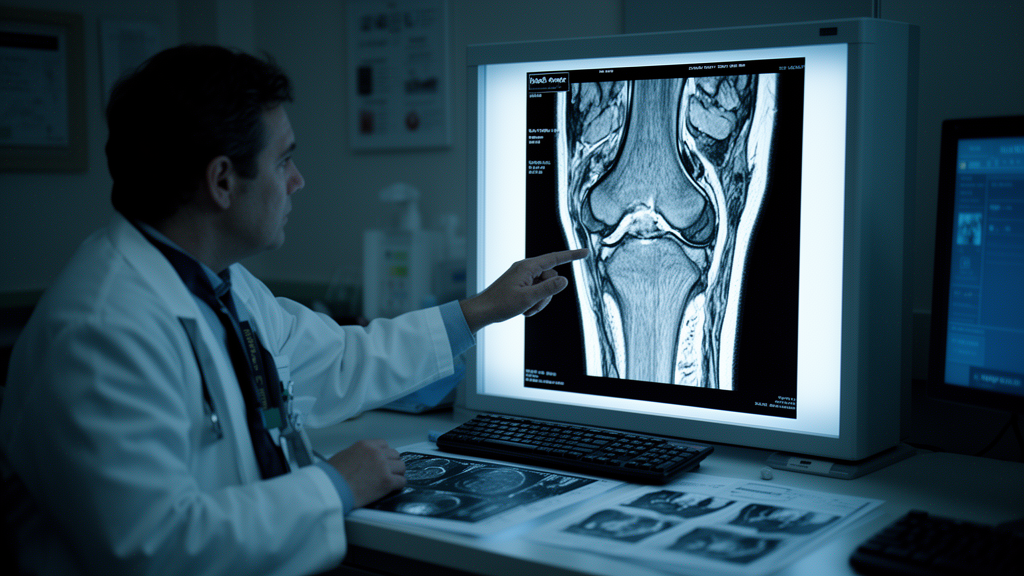
A large longitudinal analysis of the Osteoarthritis Initiative cohort has found that the amount of thigh muscle a person gains or loses over two years, measured automatically on MRI, is associated with whether that hip later needs total replacement surgery. The study, published in the journal Arthroplasty, followed hips from a multicenter cohort of people with or at risk of osteoarthritis and found that a greater increase in total thigh muscle cross-sectional area over two years was linked to a lower incidence of subsequent total hip arthroplasty, the definitive operation for advanced hip osteoarthritis.
During follow-up through OAI year 9, 99 hips met the case definition for total hip arthroplasty.
The headline result was statistically robust. A greater two-year change in total thigh muscle cross-sectional area, meaning greater gain or less loss, was associated with a lower incidence of subsequent hip replacement, with a hazard ratio of 0.75 per one-standard-deviation increase and a 95 percent confidence interval of 0.63 to 0.90, corresponding to p equal to 0.002. The converse also held: lower change values or greater muscle loss over the two years were associated with a higher incidence of subsequent hip replacement. In the matched cohort, the mean total muscle cross-sectional area fell from 9,524.5 square millimeters at baseline to 9,325.0 square millimeters at year 2, an average loss of 199.5 square millimeters, while intramuscular and intermuscular fat areas both increased.
Secondary analyses told a more cautious story. Greater two-year changes in quadriceps, hamstrings and adductors cross-sectional areas each showed nominal inverse associations with subsequent hip replacement, with hazard ratios of 0.79, 0.78 and 0.81 respectively. However, when the 95 secondary MRI comparisons were adjusted using the Benjamini-Hochberg false discovery rate procedure, none of these region-specific findings retained statistical significance, with adjusted q-values of 0.185, 0.146 and 0.251. Alternative processing approaches fared no better: relative change in total muscle and adductors reached the smallest adjusted q-values at 0.051, and nominal associations for percentage change in total fat and total muscle intramuscular fat dissolved after correction. No baseline MRI measure, whether raw cross-sectional area, area expressed as a proportion of total thigh area, or area normalized by body mass index, was significantly associated with subsequent replacement.
The authors were careful to frame what the study does and does not establish. This was an association analysis, not a prediction study: the investigators did not develop or validate a clinical prediction model, did not assess discrimination, calibration or time-dependent area under the curve, and did not evaluate clinical utility. The team also ran sensitivity analyses using complete cases, one-to-three matching and one randomly selected hip per participant; the total muscle result remained consistent throughout, with the one-hip-per-participant analysis yielding a hazard ratio of 0.76 and a confidence interval of 0.62 to 0.93.
Several limitations temper the interpretation. Residual and unmeasured confounding remains possible despite propensity score matching, and reverse causation cannot be excluded: pain and functional decline may reduce physical activity and drive muscle loss, so the observational design cannot determine whether muscle loss causally increases replacement risk or instead reflects worsening hip disease. The MRI measurements came from a single axial slice at the distal-thigh level rather than a volumetric assessment, and the OAI thigh protocol did not capture key hip-related muscles such as the gluteal musculature, limiting mechanistic inference about hip stability and loading. The surgical indication was not consistently available, so replacements performed for osteonecrosis of the femoral head or other non-osteoarthritis indications could not be reliably excluded, and the endpoint itself is an imperfect surrogate, since the decision to operate also reflects symptoms, patient preference, access to care, insurance and overall health.
The biological rationale is nonetheless plausible. Thigh muscles contribute to lower-limb power, stability and balance, and muscle loss may co-occur with pain, reduced activity, joint instability and further functional decline. Previous work has linked decreased quadriceps cross-sectional area and increased intramuscular fat to knee osteoarthritis progression, and elevated thigh intramuscular fat infiltration has been associated with increased incidence of both knee and hip osteoarthritis. Muscle fat infiltration has also been tied to metabolic dysfunction and chronic inflammation, though the present data provided no conclusive evidence that intermuscular or intramuscular fat is independently associated with subsequent hip replacement. The clinical context is substantial: recent projections estimate a 71 percent increase in hip replacement demand among U.S. adults by 2030 compared with 2014, from 370,800 to 635,000 annual procedures, although the growth rate has decelerated since 2008.
What the study offers, the authors conclude, is a candidate risk-stratification marker rather than a ready-made clinical tool. A single baseline measurement may be swamped by between-person variation, whereas the longitudinal trajectory of total thigh muscle size appears to carry prognostic information that a snapshot does not. Automated segmentation could make such quantification reproducible at scale in future studies, and the OAI cohort’s size, detailed covariates and extended follow-up make it well suited to this kind of longitudinal marker work. But independent validation and formal assessment of predictive performance are required before any clinical application, and the study was not designed to test whether muscle-strengthening exercise prevents hip osteoarthritis progression or replacement; any such benefit remains a hypothesis for appropriately designed interventional trials.
Subject of Research: Longitudinal thigh muscle MRI measurements and the incidence of subsequent total hip arthroplasty in the Osteoarthritis Initiative cohort
Article Title: Association of thigh muscle status and longitudinal changes assessed by MRI with subsequent total hip arthroplasty: insights from the osteoarthritis initiative
Article References: Yin, X., Li, Z., Zhu, Y., Liu, D., Zhang, T. J., Cai, S., & Wu, N. (2026). Association of thigh muscle status and longitudinal changes assessed by MRI with subsequent total hip arthroplasty: insights from the osteoarthritis initiative. Arthroplasty, 8(1), Article 64. https://doi.org/10.1186/s42836-026-00423-5
Image Credits: AI Generated
DOI: 10.1186/s42836-026-00423-5
Keywords: total hip arthroplasty, hip osteoarthritis, thigh muscle, MRI, Osteoarthritis Initiative, cross-sectional area, longitudinal cohort, propensity score matching, muscle loss, risk stratification, U-Net segmentation, intramuscular fat
News Source: Ophelia Keating. (October 30, 2026). Thigh muscle change on MRI linked to later hip replacement risk. Scienmag.



