

• HOME
  • NEWS
  • EXPLORE
    • CAREER
      • Companies
      • Jobs
    • EVENTS
    • iGEM
      • News
      • Team
    • PHOTOS
    • VIDEO
    • WIKI
  • BLOG
  • COMMUNITY
    • FACEBOOK
    • INSTAGRAM
    • TWITTER
Monday, June 29, 2026
BIOENGINEER.ORG
No Result
View All Result
  • Login
  • HOME
  • NEWS
  • EXPLORE
    • CAREER
      • Companies
      • Jobs
        • Lecturer
        • PhD Studentship
        • Postdoc
        • Research Assistant
    • EVENTS
    • iGEM
      • News
      • Team
    • PHOTOS
    • VIDEO
    • WIKI
  • BLOG
  • COMMUNITY
    • FACEBOOK
    • INSTAGRAM
    • TWITTER
  • HOME
  • NEWS
  • EXPLORE
    • CAREER
      • Companies
      • Jobs
        • Lecturer
        • PhD Studentship
        • Postdoc
        • Research Assistant
    • EVENTS
    • iGEM
      • News
      • Team
    • PHOTOS
    • VIDEO
    • WIKI
  • BLOG
  • COMMUNITY
    • FACEBOOK
    • INSTAGRAM
    • TWITTER
No Result
View All Result
Bioengineer.org
No Result
View All Result
Home Headlines

Thickness of grey matter predicts ability to recognize faces and…

Bioengineer.org by Bioengineer.org
January 19, 2018
in Headlines, Health, Science News
Reading Time: 2 mins read
0
Share on FacebookShare on TwitterShare on LinkedinShare on RedditShare on Telegram
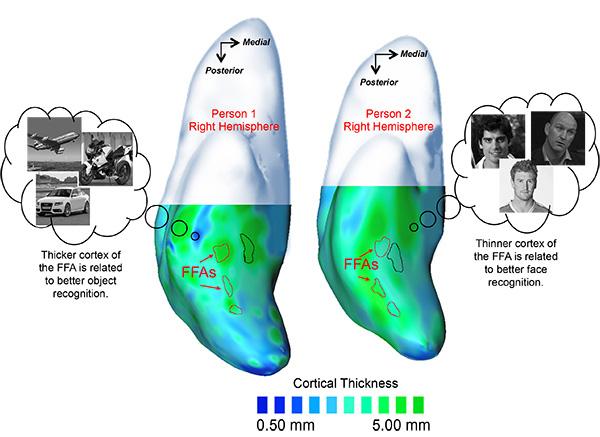
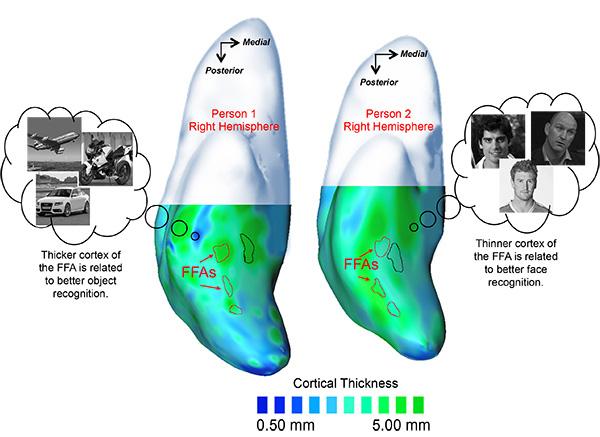
IMAGE

When you see a familiar face, when a bird-watcher catches a glimpse of a rare bird perched on a limb, or when a car-fancier spots a classic auto driving past, the same small region in the brain becomes engaged.

For almost two decades, neuroscientists have known that this area, called the fusiform face area (FFA), plays a vital role in the brain's ability to recognize faces and objects that an individual has learned to identify.

Now a new study, accepted for publication by the Journal of Cognitive Neuroscience, has taken this a step further by finding that the thickness of the cortex in the FFA – as measured using magnetic resonance imaging – can predict a person's ability to recognize faces and objects.

"It is the first time we have found a direct relationship between brain structure and visual expertise," said Isabel Gauthier, David K. Wilson Professor of Psychology at Vanderbilt University, who directed the study. "It shows more clearly than ever that this part of the brain is relevant to both face and object recognition abilities."

Surprising twist on cortical thickness

Relationships between cortical thickness and other types of processes, such as motor learning and acquisition of musical skills, have been observed before. The relationship seems relatively straightforward: the process of learning to type faster or play a violin causes the neurons in the relevant area of the cortex to make new connections, which causes the cortex to appear thicker. However, the link between cortical thickness and how well we recognize faces and objects turns out to have a surprising twist.

To establish this surprising relationship, Gauthier and her co-authors, post-doctoral fellow Rankin McGugin and Ana Van Gulick from Carnegie Mellon University, measured the ability of 27 men to identify objects from several different categories divided into two groups: living and non-living. They also tested subjects' ability at recognizing faces.

Using advanced brain-mapping techniques, the researchers were able to pinpoint the exact location of the FFA in each individual and to measure its cortical thickness. When they analyzed the results, the researchers found that the men with thicker FFA cortex performed generally better at identifying non-living objects while those having thinner FFA cortex performed better at identifying faces and living objects.

"It was really a surprise to find that the effects are in opposite directions for faces and non-living objects," said Gauthier. "One possibility that we are exploring is that we acquire expertise for faces much earlier than we learn about cars, and brain development is quite different earlier versus later in life."

There are significant sex differences in facial and object recognition, so the researchers would like to repeat the experiment using women to see if this same relation holds true. They would also like to start with a group of non-experts and then track how the thickness of their FFA cortex changes as they undergo the training process to become experts.

###

This research was supported by National Science Foundation grant SBE-0542013 and National Eye Institute grant R01-EY013441-06A2.


Share12Tweet8Share2ShareShareShare2

Related Posts

Tracking Lanthanide-Labeled Microplastics in Plants

June 25, 2026

POSTECH Researchers Slash Cost of Reconstituted Cell-Free Systems by 95%

June 25, 2026

AI and Physics Collaborate to Design Advanced Hydrogen Storage Materials

June 25, 2026

Natural Hallucinogens: Evolution’s Ecological Tools, Not Mere Chemical Byproducts

June 25, 2026
Please login to join discussion

POPULAR NEWS

  • Saying Goodbye to PGY-6: Pediatric Fellowship Realities

    103 shares
    Share 41 Tweet 26
  • Multi-Hospital Study Reveals Long Covid Burden Is Twice as High as Current Estimates

    92 shares
    Share 36 Tweet 23
  • Detection of EDCs in Breast Milk and Infant Urine Up to Six Months Highlights Early Exposure Risks

    77 shares
    Share 31 Tweet 19
  • New Drug Candidate Developed at McMaster Shows Potential for Treating Brain Cancer

    58 shares
    Share 23 Tweet 15

About

We bring you the latest biotechnology news from best research centers and universities around the world. Check our website.

Follow us

Recent News

Tracking Lanthanide-Labeled Microplastics in Plants

POSTECH Researchers Slash Cost of Reconstituted Cell-Free Systems by 95%

AI and Physics Collaborate to Design Advanced Hydrogen Storage Materials

Subscribe to Blog via Email

Success! An email was just sent to confirm your subscription. Please find the email now and click 'Confirm' to start subscribing.

Join 82 other subscribers
  • Contact Us

Bioengineer.org © Copyright 2023 All Rights Reserved.

Welcome Back!

Login to your account below

Forgotten Password?

Retrieve your password

Please enter your username or email address to reset your password.

Log In
No Result
View All Result
  • Homepages
    • Home Page 1
    • Home Page 2
  • News
  • National
  • Business
  • Health
  • Lifestyle
  • Science

Bioengineer.org © Copyright 2023 All Rights Reserved.
