


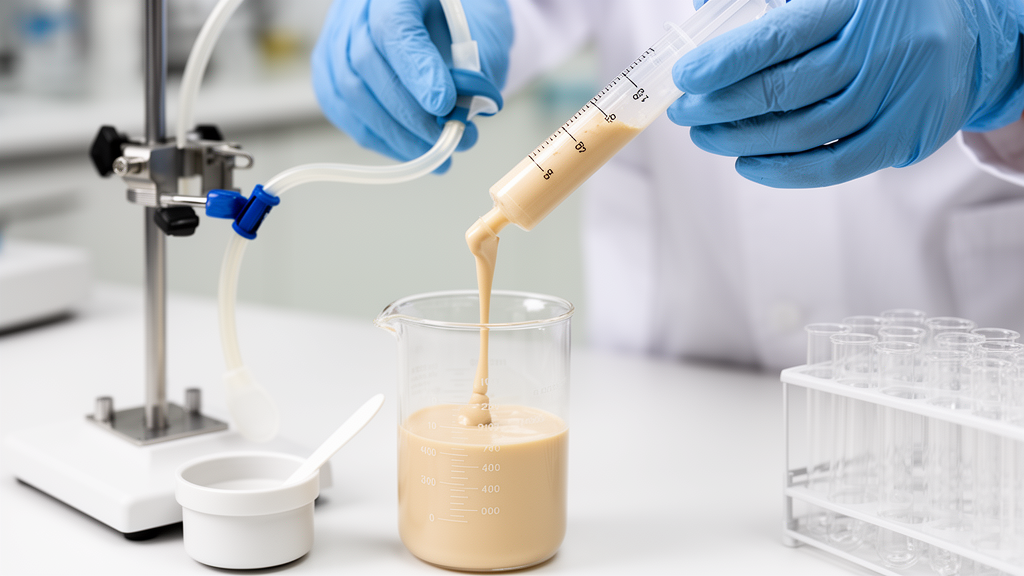
Increasing the caloric density of a powdered enteral formula raised its viscosity, changed its International Dysphagia Diet Standardisation Initiative (IDDSI) thickness classification, and slowed its flow through feeding tubes in a laboratory study published in BMC Nutrition on 29 October 2026.
Researchers prepared a fiber-free powdered formula at sixteen caloric densities ranging from 1.0 to 2.5 kcal/mL, all tested at 25 °C. Viscosity was measured in six replicates per condition, and thickness was classified using the IDDSI syringe flow test.
Mean viscosity rose from 27.50 ± 1.03 to 347.83 ± 6.21 centipoise across the density range, a difference the authors reported as statistically significant with P < 0.0001. IDDSI levels spanned from level 0 to level 3 as concentration increased. The ordered relationship between concentration and viscosity was described using Spearman correlation, and viscosity values were compared with one-way analysis of variance followed by Tukey’s post hoc test.
Gravity administration was assessed through feeding tubes of 4 to 16 French (Fr). The abstract reports single documented 12 Fr collections at 1.5, 1.8, and 2.3 kcal/mL that yielded approximately 125, 75, and 25 mL over ten minutes, corresponding to average flow rates of 12.5, 7.5, and 2.5 mL/min. These figures indicate a marked reduction in gravity flow as caloric density rose, although they come from single documented collections rather than replicated measurements.
Approximate residual syringe volumes were recoverable for four concentrations, but the study did not include replicate residual measurements, so those observations remain limited. Pump infusion was programmed at 100 mL/h, and pump mass differences were available for 1.0 to 1.9 kcal/mL with six observations per condition. Greater dispersion in pump performance appeared at 1.8 and 1.9 kcal/mL, suggesting more variable delivery at the higher densities within that range.
At 2.0 kcal/mL and above, unsuccessful passage was reported only qualitatively, without a quantitative mass series. The authors therefore describe a consistent pattern of reduced flow at higher densities while avoiding a precise numerical threshold for pump failure.
In their conclusions, the researchers state that increasing caloric density was associated with higher viscosity and IDDSI level and with reduced gravity flow in the tested formula. They emphasize that the combined measurements identify changes relevant to enteral administration while supporting formula- and device-specific assessment rather than a universal compatibility threshold.
That caution matters for practice: the findings apply to one fiber-free powdered formula tested under specific laboratory conditions, not to all enteral products, tube sizes, or infusion devices. The article was shared early as a peer-reviewed, accepted version carrying a permanent DOI, subject to further edits before the final Version of Record. Clinicians and caregivers considering caloric density adjustments should rely on product- and device-specific testing, since this study’s measurements cannot be generalized to other formulations or equipment.
Subject of Research: Laboratory testing of how enteral formula caloric density affects viscosity, IDDSI classification, and feeding tube and pump performance
Article Title: Influence of enteral nutrition viscosity on international dysphagia diet standardisation initiative classification, feeding tube, and pump infusion compatibility
Article References: de Vasconcelos, R. C., de Vasconcelos, J. N. F. C., de Vasconcelos, G. C., de Vasconcelos, P. R. C., & de Vasconcelos, P. R. L. (2026). Influence of enteral nutrition viscosity on international dysphagia diet standardisation initiative classification, feeding tube, and pump infusion compatibility. BMC Nutrition. https://doi.org/10.1186/s40795-026-01537-4
Image Credits: AI Generated
DOI: 10.1186/s40795-026-01537-4
Keywords: enteral nutrition, viscosity, IDDSI, caloric density, feeding tubes, pump infusion, gravity flow, dysphagia, BMC Nutrition, laboratory study, tube patency, formula concentration
News Source: Ophelia Keating. (October 29, 2026). Thicker enteral formulas slow feeding tube flow and shift IDDSI levels in lab tests. Scienmag.



