A lollipop might be a sweet reward for a kid who’s endured a trip to the doctor’s office, but now, this candy could make diagnostic testing during a visit less invasive and more enjoyable. Researchers publishing in ACS’ Analytical Chemistry have shown, for the first time, that a lollipop-based saliva collection system can capture bacteria from adults and remain shelf-stable for up to a year. Study participants also preferred the candies over conventional collection systems.
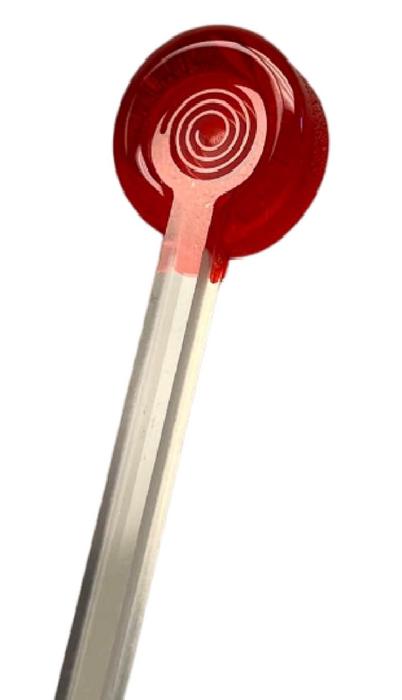
Credit: Adapted from Analytical Chemistry, 2023, DOI: 10.1021/acs.analchem.3c00462
A lollipop might be a sweet reward for a kid who’s endured a trip to the doctor’s office, but now, this candy could make diagnostic testing during a visit less invasive and more enjoyable. Researchers publishing in ACS’ Analytical Chemistry have shown, for the first time, that a lollipop-based saliva collection system can capture bacteria from adults and remain shelf-stable for up to a year. Study participants also preferred the candies over conventional collection systems.
Throat swabs are commonly used to collect samples for the diagnosis of a wide variety of illnesses, including strep throat. A less-gag-inducing method is saliva sampling, in which technicians analyze a patient’s spit with methods such as quantitative polymerase chain reaction (qPCR). Because this type of sample can be collected directly by a patient, the technique is popular for at-home testing and saw expanded use during the COVID-19 pandemic. Gathering the necessary amount of saliva can be somewhat gross, though, which is why some scientists are looking to make the process more enjoyable by combining it with the equally drool-filled, yet much more pleasant, experience of enjoying a lollipop.
Previously, Sanitta Thongpang, Ashleigh Theberge, Erwin Berthier and colleagues developed their own lollipop collection device dubbed CandyCollect. At first glance, CandyCollect looks like most lollipops, except for its spoon-like stick with a spiral-shaped groove carved into the top. This flattened end is covered with isomalt candy, allowing for saliva to easily flow into the groove as the lollipop is eaten. In a past study, the researchers showed in lab tests that the device could capture the bacteria responsible for strep throat. Now, they wanted to target other, naturally occurring bacteria and see how their system compared to other commercially available, at-home saliva sampling methods with real people.
Researchers sent CandyCollect and two conventional saliva sampling kits to 28 adult volunteers, who used them, answered some survey questions, then shipped the devices back to the lab. The researchers eluted the samples and then quantified Streptococcus mutans and Staphylococcus aureus bacteria using qPCR. Whenever one or both of the conventional methods detected the target bacteria, CandyCollect also detected them 100% of the time. Additionally, the candies were the most popular method of the three among participants, who also agreed it was the “most sanitary” and “least disgusting.” The devices still produced accurate results after being stored for a year. Although the studies are still ongoing, the team says that this work shows that the system is adaptable and well liked. The researchers say it could inspire other scientists to develop more intuitive and convenient at-home testing methods.
The authors acknowledge funding from the National Institutes of Health, The Camille and Henry Dreyfus Foundation, the Alfred P. Sloan Research Fellowship, the David and Lucile Packard Foundation, and the Society for Laboratory Automation and Screening. The development of the CandyCollect was funded by the Washington Research Foundation and a STEP Grant from CoMotion at the University of Washington. Some authors have ownership in or employment at Stacks to the Future, LLC, Tasso, Inc., and/or Salus Discovery, LLC.
The American Chemical Society (ACS) is a nonprofit organization chartered by the U.S. Congress. ACS’ mission is to advance the broader chemistry enterprise and its practitioners for the benefit of Earth and all its people. The Society is a global leader in promoting excellence in science education and providing access to chemistry-related information and research through its multiple research solutions, peer-reviewed journals, scientific conferences, eBooks and weekly news periodical Chemical & Engineering News. ACS journals are among the most cited, most trusted and most read within the scientific literature; however, ACS itself does not conduct chemical research. As a leader in scientific information solutions, its CAS division partners with global innovators to accelerate breakthroughs by curating, connecting and analyzing the world’s scientific knowledge. ACS’ main offices are in Washington, D.C., and Columbus, Ohio.
To automatically receive news releases from the American Chemical Society, contact [email protected].
Follow us: Twitter | Facebook | LinkedIn | Instagram
Journal
Analytical Chemistry
DOI
10.1021/acs.analchem.3c00462
Article Title
“At-Home Saliva Sampling in Healthy Adults Using CandyCollect, a Lollipop-Inspired Device”
Article Publication Date
26-Jun-2023