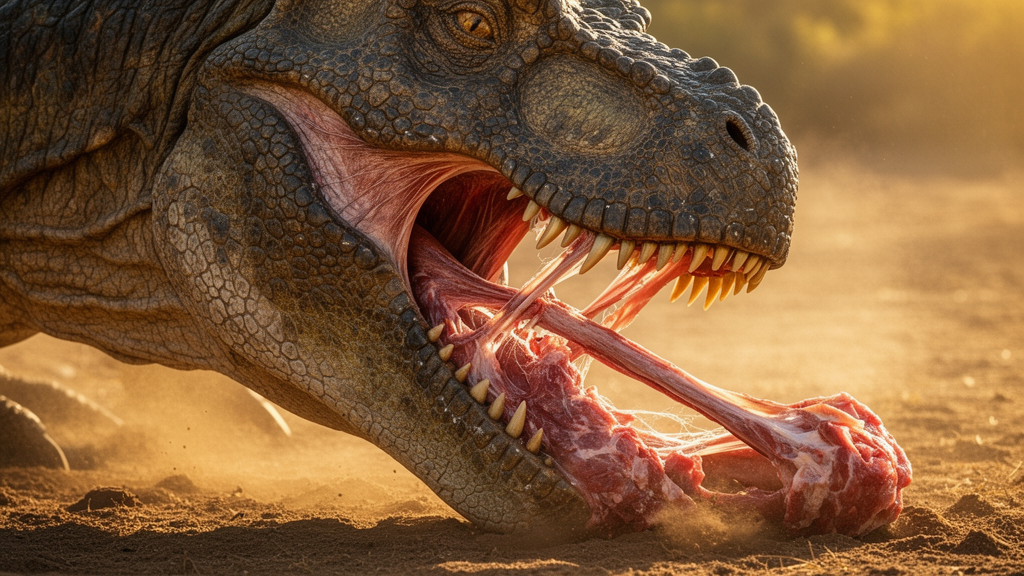
Meat-eating dinosaurs likely fed by dragging their curved, serrated teeth backwards through flesh like a saw rather than biting straight down like a dagger, according to an experimental study published in the journal Palaeontology. Researchers from the University of Reading and the University of Illinois Urbana-Champaign discovered that the teeth of theropod dinosaurs required approximately one-third less force to slice through flesh-simulating material when pulled diagonally backwards compared to when pushed vertically downwards. The investigation represents the first physical test designed to quantify the cutting performance of these distinctively shaped prehistoric teeth.
Theropods encompass a diverse group of bipedal carnivorous dinosaurs, including well-known predators such as Allosaurus and Velociraptor, alongside the evolutionary lineage of modern birds. Many members of this group possessed laterally flattened, recurved teeth equipped with finely serrated edges along both their anterior and posterior margins, presenting an architecture functionally comparable to a steak knife. Traditional depictions and earlier biomechanical hypotheses posited that these predators relied on a two-stage feeding motion, first driving their jaws vertically downward into prey before pulling away. However, the new experimental findings challenge this model, indicating that an initial vertical bite would expend unnecessary effort, whereas a single continuous diagonal pulling motion likely drove both the initial puncture and the subsequent cut.
To evaluate the functional mechanics of theropod dentition under controlled conditions, the research team engineered a custom testing apparatus named the DinoSAW. The experimental machine was configured to drive an exact replica of an allosaur tooth into ballistics gel, a standardized substrate commonly deployed in biomechanical testing to mimic the physical resistance and density of animal flesh. The apparatus tested two primary kinematic trajectories: driving the tooth vertically downward into the target material and pulling the tooth through the gel at a diagonal backward trajectory. Integrated electronic sensors precisely recorded the mechanical force profiles generated throughout each experimental penetration.
The quantitative measurements collected by the DinoSAW demonstrated a clear mechanical advantage for the diagonal sawing trajectory over vertical penetration. Driving the replica allosaur tooth straight down required an average peak force of 21.4 newtons. In contrast, drawing the tooth along a diagonal backward path required an average peak force of only 14 newtons. Dr. Manabu Sakamoto, a palaeobiologist at the University of Reading who led the research, noted that while popular perceptions often envision meat-eating dinosaurs crunching directly down onto their prey, their tooth morphology indicates a different strategy, with pulling through flesh proving substantially more efficient than biting down by a clear margin.
To understand the mechanical basis of this force disparity, the investigators filmed the deformation of the ballistics gel under polarized light during both feeding motions. This optical analysis revealed the distribution and intensity of internal stress within the material. The vertical biting motion produced intense, concentrated flashes of localized stress in the gel, reflecting high mechanical resistance. Conversely, diagonal pulling dispersed internal stress more uniformly and at significantly lower magnitudes across the substrate. This difference arises directly from the curvature and serration layout of the tooth; a vertical motion utilizes only the anterior serrated margin, whereas a backward pull aligns with the natural backward curvature of the tooth, engaging both the anterior and posterior serrated edges simultaneously.
These mechanical findings suggest that theropod dinosaurs utilized their muscular, S-shaped necks to pull forcefully backward against carcasses once their teeth engaged soft tissue. This predatory and scavenging feeding dynamic directly mirrors the feeding behaviors observed in extant theropods, such as modern birds of prey that anchor their beaks into flesh and use powerful neck motions to tear pieces away. A similar pulling action is also observed in Komodo dragons, the only living reptiles possessing ziphodont teeth with comparable curvature and serrations. Furthermore, this pulling mechanism aligns with paleontological evidence from fossil dinosaur bones, which frequently exhibit distinctive grooved feeding traces where predator teeth scraped across bone surfaces during carcass processing.
While direct behavioral observation of extinct theropods remains impossible, physical testing provides a robust empirical framework for reconstructing functional feeding ecology. Co-author Dr. Philip Anderson, an evolution, ecology, and behavior professor at the University of Illinois Urbana-Champaign, emphasized that applying physics and engineering methodologies enables researchers to rigorously identify which feeding behaviors were mechanically optimal and therefore most likely to occur in life. The researchers highlighted that future biomechanical modeling of dinosaur skulls and jaws must account for the directional orientation of feeding forces rather than focusing solely on absolute bite strength. Moving forward, the research team plans to adapt the DinoSAW apparatus to analyze other specialized dental structures, including the incisor mechanics of extinct sabre-toothed cats.
Subject of Research: Biomechanical testing of theropod dinosaur tooth cutting efficiency during feeding
Article Title: Dinosaurs likely tore meat like birds of prey
Article References: Dinosaurs likely tore meat like birds of prey. Original publication (Bibliographic details unavailable.)
Image Credits: AI Generated
DOI: Not provided
Keywords: theropods, dinosaur biomechanics, DinoSAW, paleontology, tooth morphology, allosaur, ballistics gel, cutting efficiency, University of Reading, University of Illinois Urbana-Champaign, Manabu Sakamoto, Philip Anderson, serrated teeth, bite force, feeding behavior, birds of prey, Komodo dragons
News Source: Drew Townsend. (November 26, 2026). Theropod Dinosaurs Required Less Force Pulling Teeth Diagonally Through Meat. Scienmag.